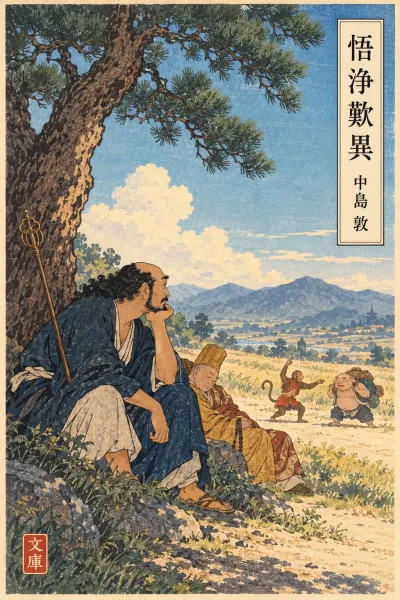
Part 2 of 7 · JLPT N1
悟浄歎異 Gojōtanni, part 2: The Monkey's Fire and the Bull Demon Battle
In this part
Gojō reflects that Gokū gives meaning to everything around him, marvelling at each sunrise and sprouting seed like a poet, yet in battle he becomes a figure of perfect, burning beauty. Gojō recalls Gokū's fight with the Bull Demon King on Mount Suiun, which he wrote down as a chronicle of shape-changing duels ending with the two giants clashing in their true forms. He felt no urge to join in, because adding his clumsy brushstroke to such a masterpiece would have shamed him.
AI translation · independently checked
我々にはなんの奇異もなく見える事柄も、悟空の眼から見ると、ことごとくすばらしい冒険の端緒だったり、彼の壮烈な活動を促す機縁だったりする。Things that seem not the least bit strange to us are, in Gokū's eyes, all either the start of some splendid adventure or the occasion that spurs him into heroic action.
もともと意味を有った外の世界が彼の注意を惹くというよりは、むしろ、彼のほうで外の世界に一つ一つ意味を与えていくように思われる。It seems less that an outside world already full of meaning catches his attention, and more that he himself gives meaning to the outside world, one thing at a time.
彼の内なる火が、外の世界に空しく冷えたまま眠っている火薬に、いちいち点火していくのである。The fire inside him sets light, one by one, to the gunpowder lying asleep in the outside world, uselessly cold.
探偵の眼をもってそれらを探し出すのではなく、詩人の心をもって(恐ろしく荒っぽい詩人だが)彼に触れるすべてを温め、(ときに焦がす惧れもないではない。)そこから種々な思いがけない芽を出させ、実を結ばせるのだ。He doesn't hunt these things out with a detective's eye; with a poet's heart (a fearfully rough poet, admittedly) he warms everything he touches (not without some risk of scorching it now and then), and from there he makes all kinds of unexpected buds sprout and bear fruit.
だから、渠・悟空の眼にとって平凡陳腐なものは何一つない。And so, to the eyes of that fellow Gokū, there is nothing at all that is ordinary or stale.
毎日早朝に起きると決まって彼は日の出を拝み、そして、はじめてそれを見る者のような驚嘆をもってその美に感じ入っている。Every day, when he gets up at dawn, he never fails to bow to the sunrise, and he is moved by its beauty with the amazement of someone seeing it for the very first time.
心の底から、溜息をついて、讃嘆するのである。He sighs from the bottom of his heart and sings its praises.
これがほとんど毎朝のことだ。This happens almost every morning.
松の種子から松の芽の出かかっているのを見て、なんたる不思議さよと眼を瞠るのも、この男である。He is also the one who, seeing a pine shoot just starting to come out of a pine seed, opens his eyes wide and says, "What a wonder this is!"
この無邪気な悟空の姿と比べて、一方、強敵と闘っているときの彼を見よ!Compare this innocent Gokū with how he looks when he is fighting a powerful enemy!
なんと、みごとな、完全な姿であろう!What a magnificent, flawless figure he is!
全身些かの隙もない逞しい緊張。A sturdy tension, without the slightest opening anywhere in his body.
律動的で、しかも一分のむだもない棒の使い方。A way of wielding his staff that is rhythmic and yet without a fraction of waste.
疲れを知らぬ肉体が歓び・たけり・汗ばみ・跳ねている・その圧倒的な力量感。A body that knows no fatigue, rejoicing, raging, sweating, leaping: that overwhelming sense of power.
いかなる困難をも欣んで迎える強靱な精神力の横溢。A tough spirit overflowing with strength, which gladly welcomes any hardship at all.
それは、輝く太陽よりも、咲誇る向日葵よりも、鳴盛る蝉よりも、もっと打込んだ・裸身の・壮んな・没我的な・灼熱した美しさだ。It is a beauty more devoted, more naked, more vigorous, more selfless and more blazing than the shining sun, than sunflowers in full bloom, than cicadas in full song.
あのみっともない猿の闘っている姿は。That is what that ugly monkey looks like when he fights.
一月ほど前、彼が翠雲山中で大いに牛魔大王と戦ったときの姿は、いまだにはっきり眼底に残っている。About a month ago he fought a great battle with the Bull Demon King, Gyūma Daiō, on Mount Suiun, and the sight of him then is still clearly fixed in my mind's eye.
感嘆のあまり、俺はそのときの戦闘経過を詳しく記録に取っておいたくらいだ。I was so filled with admiration that I even wrote down a detailed record of how the fight went.
……牛魔王一匹の香獐と変じ悠然として草を喰いいたり。...Gyūmaō, changed into a musk deer, was grazing at his ease.
悟空これを悟り虎に変じ駈け来たりて香獐を喰わんとす。Gokū, perceiving this, changed into a tiger and came running, meaning to devour the musk deer.
牛魔王急に大豹と化して虎を撃たんと飛びかかる。Gyūmaō swiftly became a great leopard and sprang to strike the tiger.
悟空これを見て狻猊となり大豹目がけて襲いかかれば、牛魔王、さらばと黄獅に変じ霹靂のごとくに哮って狻猊を引裂かんとす。Gokū, seeing this, became a lion and fell upon the great leopard; whereupon Gyūmaō, with a "So be it, then!", changed into a yellow lion and, roaring like a thunderclap, sought to tear the lion apart.
悟空このとき地上に転倒すと見えしが、ついに一匹の大象となる。At this Gokū seemed to tumble to the ground, but at last he became a great elephant.
鼻は長蛇のごとく牙は筍に似たり。His trunk was like a long serpent, his tusks like bamboo shoots.
牛魔王堪えかねて本相を顕わし、たちまち一匹の大白牛たり。Gyūmaō, unable to bear it, revealed his true form, and in an instant was a great white bull.
頭は高峯のごとく眼は電光のごとく双角は両座の鉄塔に似たり。His head was like a lofty peak, his eyes like lightning, his two horns like a pair of iron towers.
頭より尾に至る長さ千余丈、蹄より背上に至る高さ八百丈。From head to tail he measured over a thousand fathoms; from hoof to back, eight hundred fathoms.
大音に呼ばわって曰く、儞悪猴今我をいかんとするや。In a great voice he called out, saying: "You wicked ape, what now would you do to me?"
悟空また同じく本相を顕わし、大喝一声するよと見るまに、身の高さ一万丈、頭は泰山に似て眼は日月のごとく、口はあたかも血池にひとし。Gokū likewise revealed his true form, and in the moment it took him to give one mighty shout, he stood ten thousand fathoms tall, his head like Mount Tai, his eyes like the sun and moon, his mouth like nothing less than a pool of blood.
奮然鉄棒を揮って牛魔王を打つ。Fiercely he swung his iron staff and struck Gyūmaō.
牛魔王角をもってこれを受止め、両人半山の中にあってさんざんに戦いければ、まことに山も崩れ海も湧返り、天地もこれがために反覆するかと、すさまじかり。Gyūmaō caught the blow on his horns, and the two fought furiously halfway up the mountain, so terribly that truly the mountains seemed to crumble, the seas to boil over, and heaven and earth to be turned upside down.
……...
なんという壮観だったろう!What a spectacular sight it was!
俺はホッと溜息を吐いた。I let out a sigh.
そばから助太刀に出ようという気も起こらない。I didn't even feel like stepping in from the side to help.
孫行者の負ける心配がないからというのではなく、一幅の完全な名画の上にさらに拙い筆を加えるのを愧じる気持からである。Not because there was no fear of Son Gyōja losing, but because I would have been ashamed to add my clumsy brush to a perfect masterpiece of a painting.
Vocabulary
| Word | Meaning | JLPT |
|---|---|---|
| 端緒たんしょ | beginning, starting point, first clueFormal; also read たんちょ. | — |
| 促すうながす | to urge, to prompt, to spur on | N1 |
| 点火てんか | ignition, setting fire to点火する = to light, ignite (fuses, engines). | N1 |
| 焦がすこがす | to scorch, to singeIntransitive partner: 焦げる (to get burnt). | N2 |
| 陳腐ちんぷ | stale, hackneyed, trite | — |
| 驚嘆きょうたん | amazement, wonder, admiration | — |
| 瞠るみはる | to open (one's eyes) wide in surpriseAlmost always in 目を瞠る; often written 見張る. | — |
| 隙すき | opening, gap, unguarded moment隙がない = leaves no opening; said of a fighter on guard. | — |
| 横溢おういつ | overflowing, brimming overLiterary; used for energy, vitality, spirit. | — |
| 没我ぼつが | selflessness, self-forgetting absorptionLiterally 'sinking the self'; 没我的 = utterly absorbed. | — |
| 本相ほんそう | true form, real shapeUsed of shape-shifters dropping a disguise. | — |
| 助太刀すけだち | joining a fight to help someoneFrom samurai usage: lending one's sword (太刀) to another. | — |
| 拙いつたない | clumsy, unskilled, poorOften used modestly of one's own work. | — |
| 愧じるはじる | to be ashamed ofUsually written 恥じる; 愧 is a rarer literary kanji. | N1 |
Grammar
〜たり〜たりする N4 sometimes A, sometimes B; A or B among others
Attached to the copula as だったり…だったりする, it lists alternatives: the same ordinary things turn out to be either the start of an adventure or a trigger for action.
ことごとくすばらしい冒険の端緒だったり、彼の壮烈な活動を促す機縁だったりする
are all either the start of some splendid adventure or the occasion that spurs him into heroic action
〜というよりは、むしろ〜 N3 rather than A, (it is) more B
Sets aside a first description as less accurate and offers a better one after むしろ. Here it reverses the direction of meaning: Gokū gives meaning to the world rather than receiving it.
外の世界が彼の注意を惹くというよりは、むしろ、彼のほうで外の世界に一つ一つ意味を与えていくように思われる
it seems less that the outside world catches his attention, and more that he gives meaning to the outside world one thing at a time
〜ないではない N2 it is not that there is no ~; there is some ~
A double negative that cautiously admits something. 惧れもないではない concedes that there is in fact some danger of scorching.
ときに焦がす惧れもないではない
not without some risk of scorching it now and then
〜のあまり N2 out of excessive ~; so ~ that
After a noun of feeling, it gives an emotion so strong that it leads to the action that follows. Gojō's admiration was so great that he wrote the fight down.
感嘆のあまり、俺はそのときの戦闘経過を詳しく記録に取っておいたくらいだ
I was so filled with admiration that I even wrote down a detailed record of how the fight went
〜んとす N1 to be about to ~; to try to ~
Classical volitional ん (= modern う/よう) plus す (= する), typical of kanbun-style narration. 喰わんとす means 'was about to devour / meant to devour'.
虎に変じ駈け来たりて香獐を喰わんとす
changed into a tiger and came running, meaning to devour the musk deer
〜のごとく/〜に似たり N2 like ~; resembles ~
ごとく is the literary form of ように, and 似たり is classical for 似ている. The chronicle piles up similes with them to describe the giant bull.
頭は高峯のごとく眼は電光のごとく双角は両座の鉄塔に似たり
His head was like a lofty peak, his eyes like lightning, his two horns like a pair of iron towers