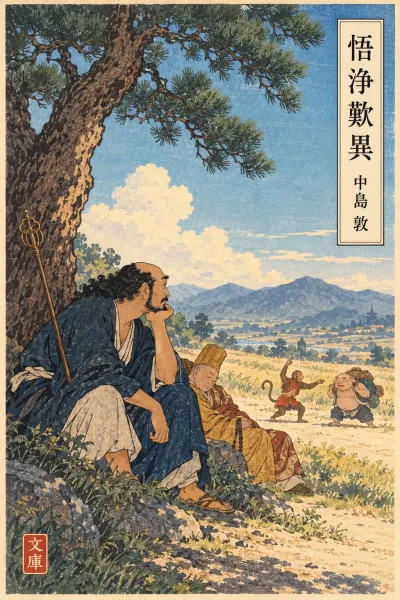
Part 3 of 7 · JLPT N1
悟浄歎異 Gojōtanni, part 3: Gokū's Wisdom and Fearless Joy
In this part
Gojō reflects that hardship only makes Gokū burn brighter, and that, illiterate as he is, Gokū sees the shortest path to any goal with uncanny clarity and has a considerable practical knowledge of animals, plants and stars that leaves Gojō feeling the poverty of book learning. He recalls how Gokū, trapped inside Kōbi Rōbutsu's golden cymbal and half dissolved, worried only about his master and finally escaped through a hole drilled in a dragon's horn. Gokū never thinks of his own death, so his deeds feel grand but never tragic.
AI translation · independently checked
災厄は、悟空の火にとって、油である。To Gokū's fire, disaster is oil.
困難に出会うとき、彼の全身は(精神も肉体も)焔々と燃上がる。Whenever he meets a difficulty, his whole being, mind and body alike, goes up in roaring flames.
逆に、平穏無事のとき、彼はおかしいほど、しょげている。On the other hand, when everything is calm and uneventful, he is comically downcast.
独楽のように、彼は、いつも全速力で廻っていなければ、倒れてしまうのだ。Like a spinning top, he has to keep turning at full speed all the time, or else he falls over.
困難な現実も、悟空にとっては、一つの地図――目的地への最短の路がハッキリと太く線を引かれた一つの地図として映るらしい。Even a difficult situation seems to appear to Gokū as a kind of map, a map on which the shortest road to his destination is drawn as a bold, clear line.
現実の事態の認識と同時に、その中にあって自己の目的に到達すべき道が、実に明瞭に、彼には見えるのだ。The moment he grasps the actual state of affairs, he sees with remarkable clarity the path within it by which he must reach his goal.
あるいは、その途以外の一切が見えない、といったほうがほんとうかもしれぬ。Or perhaps it would be truer to say that he cannot see anything except that path.
闇夜の発光文字のごとくに、必要な途だけがハッキリ浮かび上がり、他は一切見えないのだ。Like glowing letters in the dark of night, only the path he needs stands out clearly, and nothing else is visible at all.
我々鈍根のものがいまだ茫然として考えも纏まらないうちに、悟空はもう行動を始める。While slow-witted folk like us are still standing there dazed, unable even to collect our thoughts, Gokū has already begun to act.
目的への最短の道に向かって歩き出しているのだ。He is already striding off along the shortest road to his goal.
人は、彼の武勇や腕力を云々する。People talk about his bravery and his physical strength.
しかし、その驚くべき天才的な智慧については案外知らないようである。But they seem surprisingly unaware of his astonishing, genius-level wisdom.
彼の場合には、その思慮や判断があまりにも渾然と、腕力行為の中に溶け込んでいるのだ。In his case, his thinking and judgement are all too seamlessly dissolved into his acts of physical strength.
俺は、悟空の文盲なことを知っている。I know that Gokū can't read.
かつて天上で弼馬温なる馬方の役に任ぜられながら、弼馬温の字も知らなければ、役目の内容も知らないでいたほど、無学なことをよく知っている。I know very well how unlearned he is: once, in Heaven, he was appointed to a stable-hand post called Hitsubaon, and yet he could not read the characters of his own title, and he had no idea what the job involved.
しかし、俺は、悟空の(力と調和された)智慧と判断の高さとを何ものにも優して高く買う。And yet I value Gokū's wisdom and the excellence of his judgement (both in harmony with his strength) more highly than anything.
悟空は教養が高いとさえ思うこともある。There are times when I even think Gokū is highly cultured.
少なくとも、動物・植物・天文に関するかぎり、彼の知識は相当なものだ。At least where animals, plants and the heavens are concerned, his knowledge is considerable.
彼は、たいていの動物なら一見してその性質、強さの程度、その主要な武器の特徴などを見抜いてしまう。With most animals, one glance is enough for him to see through to their nature, how strong they are, and what their main weapons are like.
雑草についても、どれが薬草で、どれが毒草かを、実によく心得ている。As for weeds, he knows perfectly well which are healing herbs and which are poisonous.
そのくせ、その動物や植物の名称(世間一般に通用している名前)は、まるで知らないのだ。And yet he hasn't the faintest idea what those animals and plants are called (the names in common use among ordinary people).
彼はまた、星によって方角や時刻や季節を知るのを得意としているが、角宿という名も心宿という名も知りはしない。He is also good at telling direction, time and season from the stars, yet he doesn't know the name of the Horn Mansion, nor of the Heart Mansion.
二十八宿の名をことごとくそらんじていながら実物を見分けることのできぬ俺と比べて、なんという相異だろう!What a difference from me, who can recite the names of all twenty-eight lunar mansions by heart but can't pick out the real stars!
目に一丁字のないこの猴の前にいるときほど、文字による教養の哀れさを感じさせられることはない。Never am I made to feel the poverty of book learning so keenly as when I stand before this monkey, who cannot read a single letter.
悟空の身体の部分部分は――目も耳も口も脚も手も――みんないつも嬉しくて堪らないらしい。Every part of Gokū's body, his eyes, ears, mouth, legs and hands, all seem to be bursting with happiness all the time.
生き生きとし、ピチピチしている。They are full of life, brimming with energy.
ことに戦う段になると、それらの各部分は歓喜のあまり、花にむらがる夏の蜂のようにいっせいにワァーッと歓声を挙げるのだ。Above all, when it comes to fighting, every one of those parts raises a great shout of delight all at once, like summer bees swarming over flowers.
悟空の戦いぶりが、その真剣な気魄にもかかわらず、どこか遊戯の趣を備えているのは、このためであろうか。Could this be why Gokū's way of fighting, for all its earnest spirit, somehow has something of play about it?
人はよく「死ぬ覚悟で」などというが、悟空という男はけっして死ぬ覚悟なんかしない。People often say things like "ready to die," but Gokū is a fellow who never gets himself ready to die.
どんな危険に陥った場合でも、彼はただ、今自分のしている仕事(妖怪を退治するなり、三蔵法師を救い出すなり)の成否を憂えるだけで、自分の生命のことなどは、てんで考えの中に浮かんでこないのである。No matter what danger he falls into, he only worries about whether the task in hand will succeed or fail (whether it's wiping out a demon or rescuing Sanzō Hōshi); the thought of his own life simply never enters his mind.
太上老君の八卦炉中に焼殺されかかったときも、銀角大王の泰山圧頂の法に遭うて、泰山・須弥山・峨眉山の三山の下に圧し潰されそうになったときも、彼はけっして自己の生命のために悲鳴を上げはしなかった。When he was nearly burned to death in Taijō Rōkun's Eight Trigrams furnace, and when Ginkaku Daiō used his Mount-Tai-on-the-Head spell on him and he was all but crushed beneath three mountains, Mount Tai, Mount Shumi and Mount Gabi, he never once cried out for the sake of his own life.
最も苦しんだのは、小雷音寺の黄眉老仏のために不思議な金鐃の下に閉じ込められたときである。His worst ordeal was when Kōbi Rōbutsu of Shōraionji shut him up under a mysterious golden cymbal.
推せども突けども金鐃は破れず、身を大きく変化させて突破ろうとしても、悟空の身が大きくなれば金鐃も伸びて大きくなり、身を縮めれば金鐃もまた縮まる始末で、どうにもしようがない。Push as he might, thrust as he might, the cymbal would not break; when he tried to burst out by making himself huge, the cymbal stretched and grew as Gokū grew, and when he shrank, the cymbal shrank too, so there was nothing whatever he could do.
身の毛を抜いて錐と変じ、これで穴を穿とうとしても、金鐃には傷一つつかない。He plucked a hair from his body, turned it into a gimlet and tried to bore a hole with it, but the cymbal didn't get so much as a scratch.
そのうちに、ものを蕩かして水と化するこの器の力で、悟空の臀部のほうがそろそろ柔らかくなりはじめたが、それでも彼はただ妖怪に捕えられた師父の身の上ばかりを気遣っていたらしい。Meanwhile, the vessel's power to melt things into water was slowly beginning to soften Gokū's backside, yet even then, it seems, all he worried about was the fate of his master, who had been captured by the demon.
悟空には自分の運命に対する無限の自信があるのだ(自分ではその自信を意識していないらしいが。)やがて、天界から加勢に来た亢金竜がその鉄のごとき角をもって満身の力をこめ、外から金鐃を突通した。Gokū has a boundless confidence in his own destiny (though he himself seems unaware of it). Before long Kōkinryū, who had come from the heavens to help, put all his strength into his iron-like horn and drove it through the golden cymbal from outside.
角はみごとに内まで突通ったが、この金鐃はあたかも人の肉のごとくに角に纏いついて、少しの隙もない。The horn went splendidly right through to the inside, but the cymbal clung around it like human flesh, leaving not the slightest gap.
風の洩るほどの隙間でもあれば、悟空は身をけし粒と化して脱れ出るのだが、それもできない。If there had been even a crack wide enough for a breath of wind, Gokū could have turned himself into a poppy seed and slipped out, but even that was impossible.
半ば臀部は溶けかかりながら、苦心惨憺の末、ついに耳の中から金箍棒を取出して鋼鑚に変え、金竜の角の上に孔を穿ち、身を芥子粒に変じてその孔に潜み、金竜に角を引抜かせたのである。With his backside half melted away, after desperate struggles he at last took his gold-banded staff out of his ear, turned it into a drill, bored a hole in the golden dragon's horn, changed himself into a poppy seed, hid inside the hole, and had the dragon pull the horn out.
ようやく助かったのちは、柔らかくなった己の尻のことを忘れ、すぐさま師父の救い出しにかかるのだ。Once he was finally safe, he forgot all about his softened rear and set straight to work rescuing his master.
あとになっても、あのときは危なかったなどとけっして言ったことがない。Even afterwards, he never once said anything like "That was a close call."
「危ない」とか「もうだめだ」とか、感じたことがないのだろう。I suppose he has never felt "this is dangerous" or "it's all over now."
この男は、自分の寿命とか生命とかについて考えたこともないに違いない。This fellow has surely never given a thought to things like his lifespan or his life.
彼の死ぬときは、ポクンと、自分でも知らずに死んでいるだろう。When his time comes, he'll just drop dead with a pop, without even knowing it himself.
その一瞬前までは溌剌と暴れ廻っているに違いない。Right up until the instant before, he'll surely be rampaging around full of vigour.
まったく、この男の事業は、壮大という感じはしても、けっして悲壮な感じはしないのである。Truly, this fellow's deeds may give a sense of grandeur, but never a sense of tragedy.
Vocabulary
| Word | Meaning | JLPT |
|---|---|---|
| 災厄さいやく | disaster, calamityFormal, written word; 災 and 厄 both mean misfortune. | — |
| しょげているしょげる | to be downcast, dejecteddictionary form: しょげるColloquial; often in the ている form for a lasting mood. | — |
| 鈍根どんこん | dull-witted, slow of understandingBuddhist term for a person of weak spiritual faculties; the opposite is 利根 (りこん). | — |
| 茫然ぼうぜん | dazed, stunnedUsually 茫然として or 茫然と; also written 呆然. | N1 |
| 云々するうんぬんする | to comment on, talk about (this and that)Also used as "and so on" after a quotation. | — |
| 文盲もんもう | illiterate; illiteracyNow considered offensive; modern Japanese prefers 非識字. | — |
| 心得ているこころえる | to know well, understand thoroughlydictionary form: 心得るImplies practical, working knowledge. | N2 |
| そらんじてそらんじる | to know by heart, recite from memorydictionary form: そらんじるWritten 諳んじる. | — |
| 一丁字いっていじ | a single written characterFixed in 目に一丁字もない, "completely illiterate". | — |
| 気魄きはく | fighting spirit, vigourAlso written 気迫. | — |
| 覚悟かくご | resolve, readiness (for the worst)死ぬ覚悟 = being prepared to die. | N3 |
| 退治するたいじ | to exterminate, subdue (monsters, pests)dictionary form: 退治Classic word for slaying demons in folk tales. | N1 |
| 穿とううがつ | to bore, drill (a hole)dictionary form: 穿つLiterary; the volitional form is 穿とう. | — |
| 悲壮ひそう | tragic yet heroic, grimly braveContrasted here with 壮大 (grand, magnificent). | — |
Grammar
〜ほど〜ことはない N2 nothing is as ... as ~; never more ... than when ~
The ほど clause names the situation that produces the feeling most strongly, and ことはない denies that anything else matches it. Here it is combined with the causative-passive 感じさせられる, "be made to feel".
目に一丁字のないこの猴の前にいるときほど、文字による教養の哀れさを感じさせられることはない。
Never am I made to feel the poverty of book learning so keenly as when I stand before this monkey, who cannot read a single letter.
Verb-masu stem + かかる N2 to be on the point of ~; to almost ~
Attached to a verb stem, かかる shows that an action has just started or nearly happened. 焼殺されかかった means he was about to be burned to death but was not.
太上老君の八卦炉中に焼殺されかかったときも
When he was nearly burned to death in Taijō Rōkun's Eight Trigrams furnace
〜ども〜ども N1 no matter how much one ~s and ~s
ども is the classical concessive "even though", attached to the e-form of a verb. Repeating it with two verbs stresses that every effort failed.
推せども突けども金鐃は破れず
Push as he might, thrust as he might, the cymbal would not break
〜始末で N1 ending up in the sorry state of ~
始末 describes the bad end result of a chain of events. Here it sums up the futile shrinking and growing, leading to どうにもしようがない.
身を縮めれば金鐃もまた縮まる始末で、どうにもしようがない。
When he shrank, the cymbal shrank too, so there was nothing whatever he could do.
〜なり〜なり N1 whether ~ or ~; ~ or ~ for example
Listing two possibilities with なり offers them as examples among several choices. Here it gives typical tasks Gokū might be absorbed in.
妖怪を退治するなり、三蔵法師を救い出すなり
whether it's wiping out a demon or rescuing Sanzō Hōshi
〜べき N2 should ~; must ~ (modifying a noun)
べき after the dictionary form expresses what ought to happen, and here it modifies 道. The same form appears in 驚くべき, "astonishing".
その中にあって自己の目的に到達すべき道が、実に明瞭に、彼には見えるのだ。
He sees with remarkable clarity the path within it by which he must reach his goal.