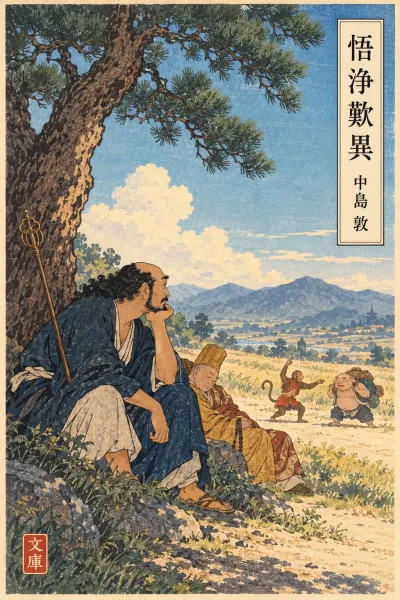
Part 6 of 7 · JLPT N1
悟浄歎異 Gojōtanni, part 6: Necessity, Freedom, and a Pleasure-Loving Pig
In this part
Gojō observes that Gokū does not understand his master's superiority and the master is unaware of it himself, yet the two share one trait of genius: they treat whatever is given as necessary, perfect and free. He compares how differently the three disciples think, then turns to Hakkai, whose long list of earthly pleasures shows him that enjoyment itself takes talent. He also senses a hidden fear beneath Hakkai's hedonism, but decides that for now he must focus on learning from Gokū.
AI translation · independently checked
おかしいことに、悟空は、師の自分より優っているこの点を理解していない。The odd thing is that Gokū does not understand this way in which his master is superior to him.
ただなんとなく師父から離れられないのだと思っている。He simply thinks that, for some reason or other, he just can't bring himself to leave the master.
機嫌の悪いときには、自分が三蔵法師に随っているのは、ただ緊箍咒(悟空の頭に箝められている金の輪で、悟空が三蔵法師の命に従わぬときにはこの輪が肉に喰い入って彼の頭を緊め付け、堪えがたい痛みを起こすのだ。)のためだ、などと考えたりしている。When he is in a bad mood, he will sometimes think that the only reason he follows Sanzō Hōshi is the Tightening-Band Spell (a gold ring fitted around Gokū's head: whenever Gokū disobeys Sanzō Hōshi's commands, the ring bites into his flesh and squeezes his head, causing unbearable pain).
そして「世話の焼ける先生だ。」などとブツブツ言いながら、妖怪に捕えられた師父を救い出しに行くのだ。And then, grumbling things like "What a teacher, always needing to be looked after," he goes off to rescue the master from whatever monster has captured him.
「あぶなくて見ちゃいられない。どうして先生はああなんだろうなあ!」と言うとき、悟空はそれを弱きものへの憐愍だと自惚れているらしいが、実は、悟空の師に対する気持の中に、生き物のすべてがもつ・優者に対する本能的な畏敬、美と貴さへの憧憬がたぶんに加わっていることを、彼はみずから知らぬのである。"It's too dangerous, I can't bear to watch. Why is the teacher like that?" When he says this, Gokū seems to flatter himself that he feels pity for the weak. In truth, he does not himself know that his feelings toward the master contain a large measure of the instinctive awe every living creature feels toward a superior being, and of longing for beauty and nobility.
もっとおかしいのは、師父自身が、自分の悟空に対する優越をご存じないことだ。Odder still, the master himself is unaware of his own superiority over Gokū.
妖怪の手から救い出されるたびごとに、師は涙を流して悟空に感謝される。Every time he is rescued from a monster's clutches, the master weeps and thanks Gokū.
「お前が助けてくれなかったら、わしの生命はなかったろうに!」と。"If you hadn't saved me, my life would have been over!" he says.
だが、実際は、どんな妖怪に喰われようと、師の生命は死にはせぬのだ。But in reality, no matter what monster eats him, the master's life will never perish.
二人とも自分たちの真の関係を知らずに、互いに敬愛し合って(もちろん、ときにはちょっとしたいさかいはあるにしても)いるのは、おもしろい眺めである。It is an amusing sight: the two of them, without knowing their true relationship, respecting and loving each other (though of course there are small quarrels now and then).
およそ対蹠的なこの二人の間に、しかし、たった一つ共通点があることに、俺は気がついた。Yet between these two, opposites in nearly every way, I have noticed that there is just one thing in common.
それは、二人がその生き方において、ともに、所与を必然と考え、必然を完全と感じていることだ。It is that in the way they live, both of them take what is given as necessary, and feel what is necessary to be perfect.
さらには、その必然を自由と看做していることだ。And further, that they regard that necessity as freedom.
金剛石と炭とは同じ物質からでき上がっているのだそうだが、その金剛石と炭よりももっと違い方のはなはだしいこの二人の生き方が、ともにこうした現実の受取り方の上に立っているのはおもしろい。They say diamond and charcoal are made of the same substance. It is interesting that the ways of life of these two, more different from each other even than diamond and charcoal, both rest on this same way of accepting reality.
そして、この「必然と自由の等置」こそ、彼らが天才であることの徴でなくてなんであろうか?And what is this "equating of necessity with freedom" if not the mark of their genius?
悟空、八戒、俺と我々三人は、まったくおかしいくらいそれぞれに違っている。Gokū, Hakkai and I: the three of us are so different from one another that it is almost comical.
日が暮れて宿がなく、路傍の廃寺に泊まることに相談が一決するときでも、三人はそれぞれ違った考えのもとに一致しているのである。Even when night falls with no lodging in sight and we agree to stay at some ruined temple by the roadside, each of the three of us agrees for an entirely different reason.
悟空はかかる廃寺こそ究竟の妖怪退治の場所だとして、進んで選ぶのだ。Gokū chooses it eagerly, reckoning that a ruined temple like this is the perfect place for slaying monsters.
八戒は、いまさらよそを尋ねるのも億劫だし、早く家にはいって食事もしたいし、眠くもあるし、というのだし、俺の場合は、「どうせこのへんは邪悪な妖精に満ちているのだろう。どこへ行ったって災難に遭うのだとすれば、ここを災難の場所として選んでもいいではないか」と考えるのだ。Hakkai says it's too much bother to go looking elsewhere at this point, and he wants to get indoors and eat soon, and he's sleepy besides. As for me, I think, "This area is probably full of evil spirits anyway. If we're going to meet with disaster wherever we go, why not choose this place as the place for our disaster?"
生きものが三人寄れば、皆このように違うものであろうか?Put any three living creatures together, and are they always this different?
生きものの生き方ほどおもしろいものはない。Nothing is as interesting as the ways in which living creatures live.
孫行者の華やかさに圧倒されて、すっかり影の薄らいだ感じだが、猪悟能八戒もまた特色のある男には違いない。Overwhelmed by Son Gyōja's brilliance, he seems to have faded almost completely into the background, but Cho Gonō Hakkai is certainly a man of distinctive character too.
とにかく、この豚は恐ろしくこの生を、この世を愛しておる。Anyway, this pig loves this life, this world, tremendously.
嗅覚・味覚・触覚のすべてを挙げて、この世に執しておる。With every sense he has, smell, taste and touch, he clings to this world.
あるとき八戒が俺に言ったことがある。Hakkai once said to me:
「我々が天竺へ行くのはなんのためだ? 善業を修して来世に極楽に生まれんがためだろうか?"What are we going to Tenjiku for? Is it to practise good deeds so we'll be reborn in Paradise in the next life?
ところで、その極楽とはどんなところだろう。蓮の葉の上に乗っかってただゆらゆら揺れているだけではしようがないじゃないか。But then, what sort of place is this Paradise? If all you do is sit on a lotus leaf and sway back and forth, what's the point?
極楽にも、あの湯気の立つ羹をフウフウ吹きながら吸う楽しみや、こりこり皮の焦げた香ばしい焼肉を頬張る楽しみがあるのだろうか?Will there be pleasures in Paradise too, like sipping a steaming hot broth while you blow on it, or stuffing your cheeks with fragrant roast meat with crisp, charred skin?
そうでなくて、話に聞く仙人のようにただ霞を吸って生きていくだけだったら、ああ、厭だ、厭だ。If not, and you just live on breathing mist like the hermits in the stories, ugh, I hate it, I hate it.
そんな極楽なんか、まっぴらだ! たとえ、辛いことがあっても、またそれを忘れさせてくれる・堪えられぬ怡しさのあるこの世がいちばんいいよ。I want nothing to do with a Paradise like that! Even if there are hard times, this world is the best, with its irresistible delights that make you forget them again.
少なくとも俺にはね。」そう言ってから八戒は、自分がこの世で楽しいと思う事柄を一つ一つ数え立てた。For me, at least." Having said that, Hakkai listed, one by one, the things he found enjoyable in this world.
夏の木蔭の午睡。A nap in the shade of a tree in summer.
渓流の水浴。Bathing in a mountain stream.
月夜の吹笛。Playing the flute on a moonlit night.
春暁の朝寐。Sleeping in at spring dawn.
冬夜の炉辺歓談。Pleasant talk by the hearth on a winter night.
……なんと愉しげに、また、なんと数多くの項目を彼は数え立てたことだろう!…How happily he reeled them off, and how many there were!
ことに、若い女人の肉体の美しさと、四季それぞれの食物の味に言い及んだとき、彼の言葉はいつまで経っても尽きぬもののように思われた。Above all, when he got onto the beauty of young women's bodies and the flavours of the foods of each of the four seasons, it seemed his words would never run out.
俺はたまげてしまった。I was astounded.
この世にかくも多くの怡しきことがあり、それをまた、かくも余すところなく味わっているやつがいようなどとは、考えもしなかったからである。I had never imagined that this world held so many delights, or that anyone could savour them so completely.
なるほど、楽しむにも才能の要るものだなと俺は気がつき、爾来、この豚を軽蔑することを止めた。I realised that, sure enough, even enjoying yourself takes talent, and from then on I stopped despising this pig.
だが、八戒と語ることが繁くなるにつれ、最近妙なことに気がついてきた。But as I've talked with Hakkai more often, lately I've begun to notice something strange.
それは、八戒の享楽主義の底に、ときどき、妙に不気味なものの影がちらりと覗くことだ。It is that beneath Hakkai's hedonism, the shadow of something strangely eerie sometimes flickers into view.
「師父に対する尊敬と、孫行者への畏怖とがなかったら、俺はとっくにこんな辛い旅なんか止めてしまっていたろう。」などと口では言っている癖に、実際はその享楽家的な外貌の下に戦々兢々として薄氷を履むような思いの潜んでいることを、俺は確かに見抜いたのだ。He says things like, "If it weren't for my respect for the master and my fear of Son Gyōja, I'd have quit this miserable journey long ago." Yet I have clearly seen that beneath that pleasure-seeker's exterior there lurks a trembling dread, the feeling of a man treading on thin ice.
いわば、天竺へのこの旅が、あの豚にとっても(俺にとってと同様)、幻滅と絶望との果てに、最後に縋り付いたただ一筋の糸に違いないと思われる節が確かにあるのだ。In other words, there are certainly signs that make me think this journey to Tenjiku must be, for that pig too (just as for me), the single thread he finally clutched at after disillusionment and despair.
だが、今は八戒の享楽主義の秘密への考察に耽っているわけにはいかぬ。But right now I cannot afford to lose myself in pondering the secret of Hakkai's hedonism.
とにかく、今のところ、俺は孫行者からあらゆるものを学び取らねばならぬのだ。In any case, for the time being I must learn everything I can from Son Gyōja.
他のことを顧みている暇はない。I have no time to give thought to anything else.
三蔵法師の智慧や八戒の生き方は、孫行者を卒業してからのことだ。Sanzō Hōshi's wisdom and Hakkai's way of living will have to wait until I have graduated from Son Gyōja.
Vocabulary
| Word | Meaning | JLPT |
|---|---|---|
| 優っているまさる | to surpass, be superior todictionary form: 優るUsually written 勝る today; Aは Bより優る = A is better than B. | N1 |
| 機嫌きげん | mood, temper機嫌が悪い = in a bad mood; ご機嫌 = good mood. | N3 |
| 緊箍咒きんそうじゅ | the Tightening-Band SpellFrom Journey to the West: a spell that makes the gold band on Gokū's head contract; the text explains it in brackets. | — |
| 自惚れているうぬぼれる | to flatter oneself, be conceiteddictionary form: 自惚れるHere it means Gokū wrongly assumes his motive is a noble one. | — |
| 畏敬いけい | awe, reverence畏 (fear) + 敬 (respect): respect mixed with fear. | — |
| 対蹠的たいせきてき | diametrically oppositeLiterally 'sole to sole', like the antipodes; also read たいしょてき. | — |
| 所与しょよ | what is given; the given conditionsPhilosophical term, used here for one's circumstances as they come. | — |
| 看做しているみなす | to regard as, consider to bedictionary form: 看做すCommonly written みなす or 見なす; AをBと看做す. | — |
| 億劫おっくう | bothersome, too much troubleOriginally a Buddhist word for an immense span of time. | — |
| 圧倒されてあっとうする | to overwhelm, overshadowdictionary form: 圧倒する | — |
| 執してしゅうする | to cling to, be attached todictionary form: 執するLiterary; compare 執着 (しゅうちゃく, attachment). | — |
| たまげてたまげる | to be astoundeddictionary form: たまげるColloquial, slightly old-fashioned; kanji 魂消る. | — |
| 爾来じらい | since then, from then onLiterary; everyday equivalent is それ以来. | — |
| 戦々兢々せんせんきょうきょう | trembling with fearFour-character idiom, here paired with 薄氷を履む 'treading on thin ice', which comes from the same classical source. | — |
Grammar
〜ちゃいられない N3 can't (bear to) keep doing ~
A contraction of 〜てはいられない. 見ちゃいられない is a set phrase meaning the sight is too painful or worrying to watch.
あぶなくて見ちゃいられない。
It's too dangerous, I can't bear to watch.
どんな〜ようと N2 no matter what / however ~
The volitional form plus と gives a concessive 'whatever happens'. With どんな, it means the result stays the same in every case.
どんな妖怪に喰われようと、師の生命は死にはせぬのだ。
No matter what monster might eat him, the master's life would never die.
〜でなくてなんであろうか N1 what is it if not ~? (it must be ~)
A literary rhetorical question that strongly asserts something. The speaker means it can only be the thing named.
彼らが天才であることの徴でなくてなんであろうか?
What is it, if not the mark of their genius?
〜んがため N1 in order to ~
A classical purpose form: the ない-stem plus んがため (here 生まれ → 生まれんがため). It sounds formal and slightly grand.
善業を修して来世に極楽に生まれんがためだろうか?
Is it to practise good deeds so we'll be reborn in Paradise in the next life?
〜につれ(て) N3 as ~, in proportion to ~
Shows that one change brings about another. Here, the more Gojō talks with Hakkai, the more he notices.
八戒と語ることが繁くなるにつれ、最近妙なことに気がついてきた。
As I've talked with Hakkai more often, lately I've begun to notice something strange.
〜わけにはいかぬ N3 cannot (afford to) ~
Means something is not possible for practical or moral reasons, not physical ones. いかぬ is the literary form of いかない.
今は八戒の享楽主義の秘密への考察に耽っているわけにはいかぬ。
Right now I cannot afford to lose myself in pondering the secret of Hakkai's hedonism.