Part 1 of 7 · JLPT N1
悟浄歎異 Gojōtanni, part 1: Hakkai's Failed Transformations
In this part
After the midday meal, while their master rests, Gokū makes Hakkai practise transforming into a dragon, but Hakkai only produces a rat snake and then an absurd lizard-like python. When Hakkai protests that Gokū is judging only by results, Gokū concedes the point but explains his theory that transformation depends on pure, intense concentration of will. The narrator, Gojō, then reflects on Gokū's genius and the fire of self-confidence that burns in him and spreads to those near him.
AI translation · independently checked
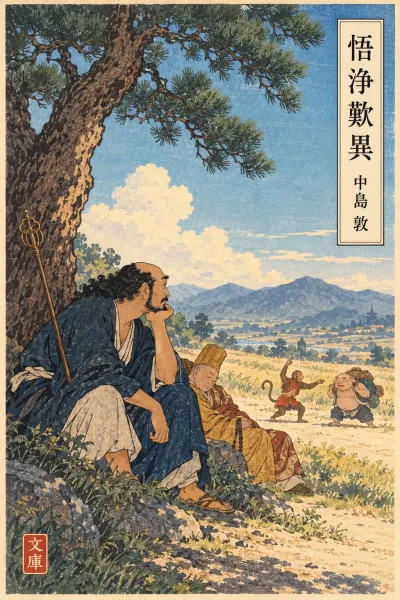
昼餉ののち、師父が道ばたの松の樹の下でしばらく憩うておられる間、悟空は八戒を近くの原っぱに連出して、変身の術の練習をさせていた。After the midday meal, while our master was resting for a while beneath a pine tree by the roadside, Gokū took Hakkai out to a nearby field and made him practise the art of transformation.
「やってみろ!」と悟空が言う。"Go on, try it!" said Gokū.
「竜になりたいとほんとうに思うんだ。いいか。ほんとうにだぜ。この上なしの、突きつめた気持で、そう思うんだ。ほかの雑念はみんな棄ててだよ。いいか。本気にだぜ。この上なしの・とことんの・本気にだぜ。」"You've got to really want to become a dragon. Got it? I mean really. With nothing above it, with your feelings pushed to the very limit, that's how you've got to want it. Throw away every other stray thought. Got it? I mean seriously. Seriously to the max, all the way, nothing held back!"
「よし!」と八戒は眼を閉じ、印を結んだ。"Right!" said Hakkai, and he closed his eyes and formed a mudra with his hands.
八戒の姿が消え、五尺ばかりの青大将が現われた。Hakkai's figure vanished, and a rat snake about five feet long appeared.
そばで見ていた俺は思わず吹出してしまった。Watching from nearby, I couldn't help bursting out laughing.
「ばか! 青大将にしかなれないのか!」と悟空が叱った。"Idiot! Is a rat snake the best you can do?" Gokū scolded.
青大将が消えて八戒が現われた。The rat snake vanished and Hakkai appeared.
「だめだよ、俺は。まったくどうしてかな?」と八戒は面目なげに鼻を鳴らした。"It's no good, I'm hopeless. Why on earth can't I do it?" said Hakkai, snorting sheepishly.
「だめだめ。てんで気持が凝らないんじゃないか、お前は。もう一度やってみろ。いいか。真剣に、かけ値なしの真剣になって、竜になりたい竜になりたいと思うんだ。竜になりたいという気持だけになって、お前というものが消えてしまえばいいんだ。」"No good, no good. You just can't concentrate your feelings at all, can you? Try it once more. Got it? Get serious, dead serious, no messing about, and think 'I want to be a dragon, I want to be a dragon.' Turn into nothing but the wish to become a dragon, until the thing called 'you' just disappears."
よし、もう一度と八戒は印を結ぶ。"Right, once more," said Hakkai, forming the mudra.
今度は前と違って奇怪なものが現われた。This time, unlike before, something bizarre appeared.
錦蛇には違いないが、小さな前肢が生えていて、大蜥蜴のようでもある。It was a python, no doubt about that, but it had small front legs sprouting from it, so it also looked like a big lizard.
しかし、腹部は八戒自身に似てブヨブヨ膨れており、短い前肢で二、三歩匍うと、なんとも言えない無恰好さであった。Its belly, though, was swollen and flabby, just like Hakkai himself, and when it crawled a few steps on its short front legs it looked clumsy beyond words.
俺はまたゲラゲラ笑えてきた。Again I found myself roaring with laughter.
「もういい。もういい。止めろ!」と悟空が怒鳴る。"That's enough. That's enough. Stop!" Gokū shouted.
頭を掻き掻き八戒が現われる。Hakkai reappeared, scratching and scratching his head.
悟空。GOKŪ:
お前の竜になりたいという気持が、まだまだ突きつめていないからだ。It's because your wish to become a dragon still isn't pushed far enough.
だからだめなんだ。That's why it's no good.
八戒。HAKKAI:
そんなことはない。That's not true.
これほど一生懸命に、竜になりたい竜になりたいと思いつめているんだぜ。I'm putting everything I've got into it, wishing and wishing I could be a dragon, I tell you.
こんなに強く、こんなにひたむきに。This hard, this single-mindedly.
悟空。GOKŪ:
お前にそれができないということが、つまり、お前の気持の統一がまだ成っていないということになるんだ。The fact that you can't do it simply means that your feelings still aren't unified.
八戒。HAKKAI:
そりゃひどいよ。That's not fair!
それは結果論じゃないか。You're just judging by the result, aren't you?
悟空。GOKŪ:
なるほどね。Fair enough.
結果からだけ見て原因を批判することは、けっして最上のやり方じゃないさ。Criticising the cause by looking only at the result is certainly not the best way of doing things.
しかし、この世では、どうやらそれがいちばん実際的に確かな方法のようだぜ。But in this world it seems to be the most reliable method in practice, you know.
今のお前の場合なんか、明らかにそうだからな。In your case just now, for instance, it's obviously true.
悟空によれば、変化の法とは次のごときものである。According to Gokū, the method of transformation is as follows.
すなわち、あるものになりたいという気持が、この上なく純粋に、この上なく強烈であれば、ついにはそのものになれる。Namely, if the wish to become a certain thing is pure beyond measure and intense beyond measure, one can in the end become that thing.
なれないのは、まだその気持がそこまで至っていないからだ。If one cannot, it is because the wish has not yet reached that point.
法術の修行とは、かくのごとく己の気持を純一無垢、かつ強烈なものに統一する法を学ぶに在る。Training in the magic arts consists in learning how to unify one's feelings in this way into something pure, unalloyed and intense.
この修行は、かなりむずかしいものには違いないが、いったんその境に達したのちは、もはや以前のような大努力を必要とせず、ただ心をその形に置くことによって容易に目的を達しうる。This training is no doubt quite difficult, but once one has reached that state, great effort like before is no longer needed, and one can easily achieve one's aim simply by setting one's mind on the desired form.
これは、他の諸芸におけると同様である。This is just as it is in the other arts.
変化の術が人間にできずして狐狸にできるのは、つまり、人間には関心すべき種々の事柄があまりに多いがゆえに精神統一が至難であるに反し、野獣は心を労すべき多くの瑣事を有たず、したがってこの統一が容易だからである、云々。The reason why humans cannot transform while foxes and badgers can is that humans have so very many different matters demanding their attention that concentration of mind is extremely difficult for them, whereas wild beasts have few petty things to trouble their minds about, and so this unification comes easily to them; and so on and so forth.
悟空は確かに天才だ。Gokū is certainly a genius.
これは疑いない。There's no doubt about that.
それははじめてこの猿を見た瞬間にすぐ感じ取られたことである。I sensed it the very moment I first set eyes on this monkey.
初め、赭顔・鬚面のその容貌を醜いと感じた俺も、次の瞬間には、彼の内から溢れ出るものに圧倒されて、容貌のことなど、すっかり忘れてしまった。At first I found his red-faced, bearded features ugly, but the next moment I was overwhelmed by what came pouring out from inside him, and I completely forgot about his looks.
今では、ときにこの猿の容貌を美しい(とは言えぬまでも少なくともりっぱだ)とさえ感じるくらいだ。These days I sometimes even find this monkey's face beautiful (or if not quite that, at least magnificent).
その面魂にもその言葉つきにも、悟空が自己に対して抱いている信頼が、生き生きと溢れている。In his fierce face and in his way of speaking alike, the trust Gokū has in himself overflows with life.
この男は嘘のつけない男だ。This is a man who cannot lie.
誰に対してよりも、まず自分に対して。Not to himself, first of all, even before anyone else.
この男の中には常に火が燃えている。A fire is always burning inside this man.
豊かな、激しい火が。A rich, fierce fire.
その火はすぐにかたわらにいる者に移る。That fire quickly spreads to whoever is beside him.
彼の言葉を聞いているうちに、自然にこちらも彼の信ずるとおりに信じないではいられなくなってくる。As you listen to him talk, you naturally find you can't help believing just what he believes.
彼のかたわらにいるだけで、こちらまでが何か豊かな自信に充ちてくる。Just being beside him, you too somehow fill up with a rich self-confidence.
彼は火種。He is the spark.
世界は彼のために用意された薪。The world is the firewood laid ready for him.
世界は彼によって燃されるために在る。The world exists to be set ablaze by him.
Vocabulary
| Word | Meaning | JLPT |
|---|---|---|
| 昼餉ひるげ | midday meal, lunchOld-fashioned word; 餉 means a meal. Compare 夕餉 (supper). | — |
| 憩うていこう | to rest, to relaxdictionary form: 憩う憩うて is the old-style て-form (modern 憩って), common in literary writing. | — |
| 突きつめたつきつめる | to push to the limit; to think something through to the enddictionary form: 突き詰めるHere it describes a feeling made as intense and focused as possible. | — |
| 雑念ざつねん | stray thoughts, distractionsOften used in Buddhist or meditation contexts. | — |
| 印を結んだいんをむすぶ | to form a mudra (a ritual hand gesture used in magic or Buddhist practice)dictionary form: 印を結ぶ | — |
| 青大将あおだいしょう | Japanese rat snakeA common, harmless snake, so a comically poor substitute for a dragon. | — |
| 吹出してふきだす | to burst out laughingdictionary form: 吹き出すAlso means 'to spout, gush out'. | — |
| 面目なげにめんぼくない | ashamed, embarrasseddictionary form: 面目ない〜げ adds 'looking ~', so 面目なげに = 'with a sheepish look'. | — |
| てんでてんで | (not) at allColloquial; used with negatives. | N1 |
| かけ値なしかけねなし | genuine, without exaggerationdictionary form: 掛け値なし掛け値 is an inflated asking price, so 'no mark-up' means 'the real thing'. | — |
| 結果論けっかろん | judging by results; hindsight argument | — |
| 変化へんげ | magical transformation, shape-shiftingRead へんげ in this supernatural sense, not へんか (change). | N3 |
| 狐狸こり | foxes and tanuki (raccoon dogs)In Japanese folklore both animals are famous shape-shifters. | — |
| 火種ひだね | a live coal or spark used to start a fire; a source of something spreading | — |
Grammar
〜ておられる N3 honorific progressive (is doing)
〜ておられる is a respectful form of 〜ている, made with おられる (honorific of おる/いる). It describes an ongoing state, here 'is resting'. 憩うて is the older te-form of 憩う (modern 憩って), so 憩うておられる means 'while the master is resting' and shows the narrator's respect toward Sanzō.
師父が道ばたの松の樹の下でしばらく憩うておられる間
while our master was resting for a while beneath a pine tree by the roadside
〜には違いない N3 it is certainly ~, no doubt ~
Affirms that something is definitely the case, usually before a contrasting が clause. Here it admits the creature is a python before adding what is strange about it.
錦蛇には違いないが、小さな前肢が生えていて
It was a python, no doubt about that, but it had small front legs sprouting from it
〜うる N2 can ~, be able to ~
Attached to the verb stem, うる (also える) expresses possibility in written style. 達しうる means 'can achieve'.
ただ心をその形に置くことによって容易に目的を達しうる
one can easily achieve one's aim simply by setting one's mind on the desired form
〜ずして / 〜がゆえに N1 without doing ~ / because of ~
〜ずして is a literary negative linking form ('not being able to, yet...'), and がゆえに is formal 'because'. Together they give this sentence its stiff, treatise-like tone.
変化の術が人間にできずして狐狸にできるのは、つまり、人間には関心すべき種々の事柄があまりに多いがゆえに精神統一が至難である
The reason why humans cannot transform while foxes and badgers can is that humans have so very many matters demanding their attention that concentration of mind is extremely difficult
〜ないではいられない N2 can't help doing ~
Expresses an urge one cannot resist. With なくなってくる it describes gradually reaching the point where one cannot help believing.
自然にこちらも彼の信ずるとおりに信じないではいられなくなってくる
you naturally find you can't help believing just what he believes
〜のごとき N1 like ~, such as ~
A literary form of のような. 次のごときもの means 'something like the following', and it introduces Gokū's theory.
変化の法とは次のごときものである
the method of transformation is as follows