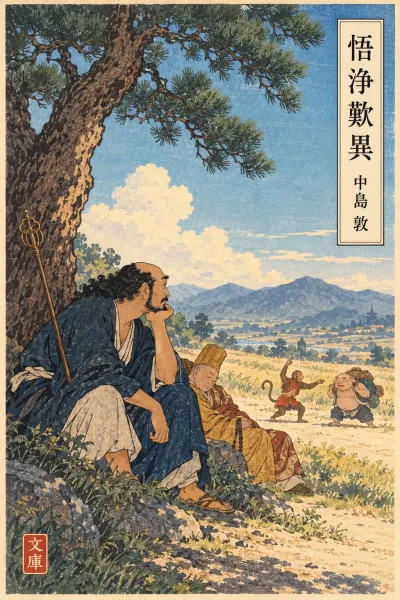
Part 4 of 7 · JLPT N1
悟浄歎異 Gojōtanni, part 4: The Monkey in the Buddha's Palm
In this part
Gojō reflects that Gokū never imitates others and forgets his past, yet absorbs every lesson it taught him. The one experience Gokū cannot forget is his first meeting with the Buddha: after rampaging through Heaven, he boasted that he could fly beyond the Buddha's palm, only to find he had never left it, and he was imprisoned under Mount Gogyō for five hundred years. When Sanzō freed him, Gokū wept for joy, and his pure gratitude is why he follows Sanzō to Tenjiku.
AI translation · independently checked
猿は人真似をするというのに、これはまた、なんと人真似をしない猴だろう!Monkeys are supposed to imitate people, and yet what a monkey this is, one who never imitates anyone!
真似どころか、他人から押付けられた考えは、たといそれが何千年の昔から万人に認められている考え方であっても、絶対に受付けないのだ。Far from imitating, he flatly refuses any idea pushed on him by others, even if it is a way of thinking that everyone has accepted for thousands of years.
自分で充分に納得できないかぎりは。Unless, that is, he can fully convince himself of it.
因襲も世間的名声もこの男の前にはなんの権威もない。Custom and worldly reputation carry no authority whatsoever in front of this fellow.
悟空の今一つの特色は、けっして過去を語らぬことである。Another of Gokū's peculiarities is that he never talks about the past.
というより、彼は、過去ったことは一切忘れてしまうらしい。Or rather, he seems to forget completely whatever has gone by.
少なくとも個々の出来事は忘れてしまうのだ。At the very least, he forgets the individual events.
その代わり、一つ一つの経験の与えた教訓はその都度、彼の血液の中に吸収され、ただちに彼の精神および肉体の一部と化してしまう。Instead, the lesson each experience taught him is absorbed into his blood at the time, and at once becomes part of his mind and body.
いまさら、個々の出来事を一つ一つ記憶している必要はなくなるのである。There is no longer any need for him to remember each event one by one.
彼が戦略上の同じ誤りをけっして二度と繰返さないのを見ても、これは判る。You can tell this just from the fact that he never repeats the same strategic mistake twice.
しかも彼はその教訓を、いつ、どんな苦い経験によって得たのかは、すっかり忘れ果てている。And yet he has entirely forgotten when, and through what bitter experience, he learned each lesson.
無意識のうちに体験を完全に吸収する不思議な力をこの猴は有っているのだ。This monkey has a strange power to absorb experience completely without even being aware of it.
ただし、彼にもけっして忘れることのできぬ怖ろしい体験がたった一つあった。Still, there was a single terrifying experience that even he could never forget.
あるとき彼はそのときの恐ろしさを俺に向かってしみじみと語ったことがある。Once he told me, with deep feeling, how frightening it had been.
それは、彼が始めて釈迦如来に知遇し奉ったときのことだ。It happened when he first had the honour of meeting the Buddha Shakyamuni.
そのころ、悟空は自分の力の限界を知らなかった。In those days Gokū did not know the limits of his own strength.
彼が藕糸歩雲の履を穿き鎖子黄金の甲を着け、東海竜王から奪った一万三千五百斤の如意金箍棒を揮って闘うところ、天上にも天下にもこれに敵する者がないのである。When he fought wearing his lotus-thread cloud-walking shoes and his golden chain-mail armour, swinging the As-You-Will Gold-Banded Staff of thirteen thousand five hundred catties that he had seized from the Dragon King of the Eastern Sea, there was no one in Heaven or on earth who could match him.
列仙の集まる蟠桃会を擾がし、その罰として閉じ込められた八卦炉をも打破って飛出すや、天上界も狭しとばかり荒れ狂うた。He threw into uproar the Peach Banquet where the immortals were gathered, and when, shut in the Eight Trigrams Furnace as punishment, he smashed his way out of it too and burst forth, he raged as though the Heavenly Realm itself were too small for him.
群がる天兵を打倒し薙ぎ倒し、三十六員の雷将を率いた討手の大将祐聖真君を相手に、霊霄殿の前に戦うこと半日余り。He struck down and mowed down the swarming heavenly soldiers, and before Reishō Hall he did battle for more than half a day with Yūsei Shinkun, commander of the punitive force, who led thirty-six thunder generals.
そのときちょうど、迦葉・阿難の二尊者を連れた釈迦牟尼如来がそこを通りかかり、悟空の前に立ち塞がって闘いを停めたもうた。Just then the Buddha Shakyamuni, accompanied by his two venerable disciples Kashō and Anan, happened to pass that way, and he stood in Gokū's path and put a stop to the fighting.
悟空が怫然として喰ってかかる。Gokū, indignant, lashes out at him.
如来が笑いながら言う。The Buddha says with a smile:
「たいそう威張っているようだが、いったい、お前はいかなる道を修しえたというのか?"You seem very full of yourself, but just what Way is it you claim to have mastered?
」悟空曰く「東勝神州傲来国華果山に石卵より生まれたるこの俺の力を知らぬとは、さてさて愚かなやつ。" Gokū said: "You don't know the power of me, born from a stone egg on Mount Kaka in Gōrai, in Tōshō Shinshū? What a fool you are.
俺はすでに不老長生の法を修し畢り、雲に乗り風に御し一瞬に十万八千里を行く者だ。」如来曰く、「大きなことを言うものではない。I've already mastered the art of eternal youth and long life, and I'm one who rides the clouds, drives the wind, and covers a hundred and eight thousand leagues in an instant." The Buddha said, "You should not talk so big.
十万八千里はおろかわが掌に上って、さて、その外へ飛出すことすらできまいに。」「何を!Never mind a hundred and eight thousand leagues: climb onto my palm, and I doubt you could even fly off the edge of it." "What!
」と腹を立てた悟空は、いきなり如来の掌の上に跳り上がった。" Furious, Gokū leapt straight up onto the Buddha's palm.
「俺は通力によって八十万里を飛行するのに、儞の掌の外に飛出せまいとは何事だ!」言いも終わらず觔斗雲に打乗ってたちまち二、三十万里も来たかと思われるころ、赤く大いなる五本の柱を見た。"I can fly eight hundred thousand leagues by my magic power, and you say I can't get off your palm? What kind of talk is that!" Before the words were even out, he jumped onto his somersault cloud, and when he seemed to have gone some two or three hundred thousand leagues in a flash, he saw five great red pillars.
渠はこの柱のもとに立寄り、真中の一本に、斉天大聖到此一遊と墨くろぐろと書きしるした。He stopped at the foot of these pillars and on the middle one wrote, in deep black ink, "Seiten Taisei Came Here."
さてふたたび雲に乗って如来の掌に飛帰り、得々として言った。Then he mounted his cloud again, flew back to the Buddha's palm, and said triumphantly:
「掌どころか、すでに三十万里の遠くに飛行して、柱にしるしを留めてきたぞ!」「愚かな山猿よ!」と如来は笑った。"Palm? I've already flown three hundred thousand leagues away and left my mark on a pillar!" "Foolish mountain monkey!" laughed the Buddha.
「汝の通力がそもそも何事を成しうるというのか? 汝は先刻からわが掌の内を往返したにすぎぬではないか。嘘と思わば、この指を見るがよい。」悟空が異しんで、よくよく見れば、如来の右手の中指に、まだ墨痕も新しく、斉天大聖到此一遊と己の筆跡で書き付けてある。"What, after all, can your magic power accomplish? All this while you have done nothing but go back and forth within my palm. If you think I lie, look at this finger." Puzzled, Gokū looked closely, and there on the middle finger of the Buddha's right hand, the ink still fresh, was written in his own hand: "Seiten Taisei Came Here."
「これは?」と驚いて振仰ぐ如来の顔から、今までの微笑が消えた。"What's this?" Startled, he looked up, and the smile that had been there vanished from the Buddha's face.
急に厳粛に変わった如来の目が悟空をキッと見据えたまま、たちまち天をも隠すかと思われるほどの大きさに拡がって、悟空の上にのしかかってきた。The Buddha's eyes, suddenly grown stern, stayed fixed hard on Gokū, and at once spread to a size that seemed to blot out the very sky, bearing down on him from above.
悟空は総身の血が凍るような怖ろしさを覚え、慌てて掌の外へ跳び出そうとしたとたんに、如来が手を翻して彼を取抑え、そのまま五指を化して五行山とし、悟空をその山の下に押込め、唵嘛呢叭𠺗吽の六字を金書して山頂に貼りたもうた。Gokū felt a terror as if all the blood in his body had frozen, and the moment he tried in panic to leap off the palm, the Buddha turned his hand over and pinned him down, then turned his five fingers into Mount Gogyō, shut Gokū beneath that mountain, and wrote the six syllables Om Mani Padme Hum in gold and pasted them on its summit.
世界が根柢から覆り、今までの自分が自分でなくなったような昏迷に、悟空はなおしばらく顫えていた。In a daze, as though the world had been overturned from its foundations and the self he had been until then were no longer himself, Gokū went on trembling for some time.
事実、世界は彼にとってそのとき以来一変したのである。In fact, from that moment on the world was utterly changed for him.
爾後、餓うるときは鉄丸を喰い、渇するときは銅汁を飲んで、岩窟の中に封じられたまま、贖罪の期の充ちるのを待たねばならなかった。Thereafter, eating iron pellets when hungry and drinking molten copper when thirsty, he had to wait, sealed in a rock cave, until his term of atonement was fulfilled.
悟空は、今までの極度の増上慢から、一転して極度の自信のなさに堕ちた。Gokū fell abruptly from the most extreme arrogance into the most extreme lack of confidence.
彼は気が弱くなり、ときには苦しさのあまり、恥も外聞も構わずワアワアと大声で哭いた。He grew timid, and sometimes, from sheer misery, he wailed aloud, caring nothing for shame or for what others might think.
五百年経って、天竺への旅の途中にたまたま通りかかった三蔵法師が五行山頂の呪符を剥がして悟空を解き放ってくれたとき、彼はまたワアワアと哭いた。Five hundred years later, when Sanzō Hōshi, happening to pass by on his journey to Tenjiku, peeled off the charm on the summit of Mount Gogyō and set Gokū free, he wailed aloud again.
今度のは嬉し涙であった。This time they were tears of joy.
悟空が三蔵に随ってはるばる天竺までついて行こうというのも、ただこの嬉しさありがたさからである。The reason Gokū follows Sanzō all the long way to Tenjiku is simply this joy and gratitude.
実に純粋で、かつ、最も強烈な感謝であった。It was a gratitude truly pure, and the most intense there could be.
Vocabulary
| Word | Meaning | JLPT |
|---|---|---|
| 納得なっとく | being convinced; accepting something as reasonable納得できる = to be able to accept or agree with something. | N3 |
| 因襲いんしゅう | established custom; convention (often with a negative nuance)Literary; also written 因習. | — |
| 権威けんい | authority; prestige | N1 |
| 教訓きょうくん | lesson (learned from experience) | N1 |
| 吸収きゅうしゅう | absorption; taking in吸 'suck in' + 収 'gather'. | N3 |
| 知遇ちぐう | meeting and being recognized by a superiorPaired here with the humble 奉る to show respect toward the Buddha. | — |
| 怫然ふつぜん | indignantly; flushed with angerLiterary; used as 怫然として. | — |
| 掌てのひら | palm of the handThe key image of the episode; also read たなごころ in old texts. | N1 |
| 通力つうりき | supernatural powerBuddhist term; also 神通力 じんずうりき. | — |
| 得々とくとく | triumphantly; smuglyUsed as 得々として. | — |
| 見据えみすえる | to stare fixedly atdictionary form: 見据えるキッと adds sharpness and severity to the stare. | — |
| 贖罪しょくざい | atonement; expiation of sin | — |
| 増上慢ぞうじょうまん | overweening pride; arroganceOriginally a Buddhist term for claiming enlightenment one has not reached. | — |
| 外聞がいぶん | reputation; what others think恥も外聞も構わず = with no regard for shame or appearances (set phrase). | — |
Grammar
〜ないかぎりは N2 unless; as long as ~ does not happen
Sets the only condition under which the previous statement would change. Here it is added as a separate afterthought to the previous sentence.
自分で充分に納得できないかぎりは。
Unless, that is, he can fully convince himself of it.
〜はおろか N1 not to mention ~; never mind ~
Dismisses the bigger case and stresses that even a smaller one is impossible, often with すら or さえ later in the sentence.
十万八千里はおろかわが掌に上って、さて、その外へ飛出すことすらできまいに。
Never mind a hundred and eight thousand leagues: climb onto my palm, and I doubt you could even fly off the edge of it.
〜まい N2 probably not; surely cannot
A literary negative of conjecture, equivalent to 〜ないだろう. できまい means 'surely you cannot', and Gokū echoes it with 飛出せまい.
その外へ飛出すことすらできまいに。
I doubt you could even fly off the edge of it.
〜にすぎぬ N2 nothing more than ~; merely
The classical form of 〜にすぎない. It reduces Gokū's great flight to mere back-and-forth movement inside the palm.
汝は先刻からわが掌の内を往返したにすぎぬではないか。
All this while you have done nothing but go back and forth within my palm.
〜たもうた(給うた) N1 honorific: (the exalted one) did ~
From the classical honorific 給う, attached to a verb's stem to show respect for the person acting, here the Buddha. It gives the passage a reverent, scriptural tone.
悟空の前に立ち塞がって闘いを停めたもうた。
He stood in Gokū's path and put a stop to the fighting.