Part 1 of 7 · JLPT N2
葉 Ha, part 1: Fragments of a Man Who Meant to Die
In this part
A man who had meant to die decides to live until summer after receiving a summer kimono as a New Year's gift. Loosely connected fragments follow: lonely drinking in lodgings, a stone that seems to crawl along a pavement, a younger brother overjoyed when his older brother pats his shoulder, and an older brother's views on fiction and suicide. The narrator then introduces 'Awarega', a story he wrote at nineteen, which opens with its speaker recalling a strange ghost seen in early childhood.
AI translation · independently checked
撰ばれてあることのThe ecstasy and the dread
恍惚と不安とof being chosen:
二つわれにありthese two dwell in me.
ヴェルレエヌVerlaine
死のうと思っていた。I had been meaning to die.
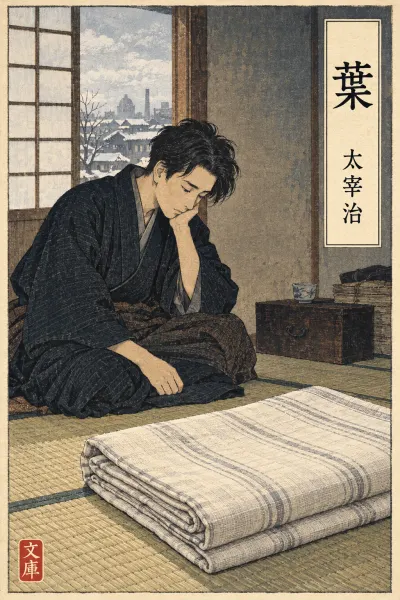
ことしの正月、よそから着物を一反もらった。This New Year, someone outside the family gave me a bolt of kimono cloth.
お年玉としてである。It was a New Year's gift.
着物の布地は麻であった。The cloth was hemp.
鼠色のこまかい縞目が織りこめられていた。Fine grey stripes were woven into it.
これは夏に着る着物であろう。This must be a kimono for wearing in summer.
夏まで生きていようと思った。I decided I would stay alive until summer.
ノラもまた考えた。Nora had thoughts too.
廊下へ出てうしろの扉をばたんとしめたときに考えた。She had them when she stepped out into the hallway and slammed the door shut behind her.
帰ろうかしら。Maybe I should go back.
私がわるいことをしないで帰ったら、妻は笑顔をもって迎えた。When I came home without having done anything bad, my wife greeted me with a smile.
その日その日を引きずられて暮しているだけであった。He was merely being dragged along from one day to the next.
下宿屋で、たった独りして酒を飲み、独りで酔い、そうしてこそこそ蒲団を延べて寝る夜はことにつらかった。The nights were especially hard, when he drank alone in his lodging house, got drunk alone, and then furtively spread out his bedding and went to sleep.
夢をさえ見なかった。He did not even dream.
疲れ切っていた。He was utterly exhausted.
何をするにも物憂かった。Whatever he did, it all felt dreary.
「汲み取り便所は如何に改善すべきか?」という書物を買って来て本気に研究したこともあった。Once he even bought a book called 'How Should the Cesspit Toilet Be Improved?' and studied it in earnest.
彼はその当時、従来の人糞の処置には可成まいっていた。At the time, he was quite worn down by the conventional ways of disposing of human waste.
新宿の歩道の上で、こぶしほどの石塊がのろのろ這って歩いているのを見たのだ。On a pavement in Shinjuku, he saw a stone the size of a fist crawling slowly along.
石が這って歩いているな。So, a stone is crawling along.
ただそう思うていた。That was all he thought.
しかし、その石塊は彼のまえを歩いている薄汚い子供が、糸で結んで引摺っているのだということが直ぐに判った。But he soon realised that a grubby child walking ahead of him had tied the stone with string and was dragging it.
子供に欺かれたのが淋しいのではない。It was not that being fooled by a child made him sad.
そんな天変地異をも平気で受け入れ得た彼自身の自棄が淋しかったのだ。What saddened him was his own despair, which had let him calmly accept even such a disruption of the natural order.
そんなら自分は、一生涯こんな憂鬱と戦い、そうして死んで行くということに成るんだな、と思えばおのが身がいじらしくもあった。So this is how it will be, then: I will fight this gloom my whole life long and then die. When he thought of it that way, he felt a touch of pity for himself.
青い稲田が一時にぽっと霞んだ。The green rice fields blurred all at once.
泣いたのだ。He had wept.
彼は狼狽えだした。He grew flustered.
こんな安価な殉情的な事柄に涕を流したのが少し恥かしかったのだ。He was a little ashamed to have shed tears over something so cheap and sentimental.
電車から降りるとき兄は笑うた。As they got off the train, his older brother laughed.
「莫迦にしょげてるな。おい、元気を出せよ」"You're awfully down in the mouth. Come on, cheer up."
そうして竜の小さな肩を扇子でポンと叩いた。And he gave Ryū's small shoulder a light tap with his folding fan.
夕闇のなかでその扇子が恐ろしいほど白っぽかった。In the dusk, the fan looked frighteningly pale.
竜は頬のあからむほど嬉しくなった。Ryū was so happy that his cheeks turned red.
兄に肩をたたいて貰ったのが有難かったのだ。He was grateful to have had his shoulder tapped by his brother.
いつもせめて、これぐらいにでも打ち解けて呉れるといいが、と果敢なくも願うのだった。'If only he would always open up to me at least this much,' Ryū would wish, forlornly.
訪ねる人は不在であった。The person he had come to see was not at home.
兄はこう言った。My older brother said this:
「小説を、くだらないとは思わぬ。おれには、ただ少しまだるっこいだけである。たった一行の真実を言いたいばかりに百頁の雰囲気をこしらえている」私は言い憎そうに、考え考えしながら答えた。"I don't think novels are worthless. To me they're just a little long-winded, that's all. They build up a hundred pages of atmosphere just to say one single line of truth." I answered haltingly, thinking it over as I went.
「ほんとうに、言葉は短いほどよい。それだけで、信じさせることができるならば」"Truly, the shorter the words, the better, if that alone can make people believe."
また兄は、自殺をいい気なものとして嫌った。My brother also despised suicide as something self-indulgent.
けれども私は、自殺を処世術みたいな打算的なものとして考えていた矢先であったから、兄のこの言葉を意外に感じた。But I had just been thinking of suicide as something calculating, a sort of technique for getting on in the world, so his words took me by surprise.
白状し給え。Come on, confess.
え?Eh?
誰の真似なの?Who are you imitating?
水到りて渠成る。Where the water comes, the channel forms.
彼は十九歳の冬、「哀蚊」という短篇を書いた。In the winter when he was nineteen, he wrote a short story called 'Awarega'.
それは、よい作品であった。It was a good piece of work.
同時に、それは彼の生涯の渾沌を解くだいじな鍵となった。At the same time, it became an important key to unravelling the chaos of his whole life.
形式には、「雛」の影響が認められた。In its form, the influence of 'The Dolls' could be seen.
けれども心は、彼のものであった。But its heart was his own.
原文のまま。Given here exactly as written.
おかしな幽霊を見たことがございます。I once saw a most peculiar ghost.
あれは、私が小学校にあがって間もなくのことでございますから、どうせ幻燈のようにとろんと霞んでいるに違いございませぬ。It was not long after I had entered elementary school, and so, I daresay, the memory must be hazy and dim, like a magic-lantern picture.
いいえ、でも、その青蚊帳に写した幻燈のような、ぼやけた思い出が奇妙にも私には年一年と愈々はっきりして参るような気がするのでございます。And yet, no — strange to say, I have the feeling that this blurred memory, like a magic-lantern picture cast upon a green mosquito net, grows ever clearer to me with each passing year.
Vocabulary
| Word | Meaning | JLPT |
|---|---|---|
| 恍惚こうこつ | ecstasy, raptureLiterary word; 恍惚とする means to be entranced. | — |
| 反たん | counter for bolts of cloth (enough for one kimono)一反 is read いったん. | N1 |
| 下宿屋げしゅくや | boarding house, lodgings下宿 alone means lodging in a rented room. | — |
| 物憂かったものうい | listless, dreary, wearydictionary form: 物憂いLiterary; describes a heavy, unwilling mood. | — |
| 欺かれたあざむく | to deceive, to fooldictionary form: 欺くHere in the passive: 'was fooled'. | N1 |
| 自棄やけ | despair, self-abandonmentUsually written やけ; also read じき. Compare やけ酒 (drinking to drown one's sorrows). | — |
| いじらしくいじらしい | pitiable, touchingdictionary form: いじらしいUsed for someone weak or struggling who arouses sympathy; here he feels this way toward himself. | — |
| 狼狽えうろたえる | to be flustered, to lose one's composuredictionary form: 狼狽えるThe kanji 狼狽 is also read ろうばい as a noun. | — |
| 打ち解けてうちとける | to open up, to become friendlydictionary form: 打ち解けるLiterally 'to melt away (reserve)'. | — |
| 果敢なくはかない | fleeting, transient; vain, faint (of a hope). 果敢なくも願う = to wish forlornly, in vaindictionary form: 儚いUsually written 儚い; 果敢ない is an old phonetic spelling. | N1 |
| まだるっこいまだるっこい | tedious, roundabout, long-windedColloquial; also まどろっこしい. | — |
| 矢先やさき | just at the moment whenOften 〜ていた矢先: 'just when (I) had been doing'. | — |
| 幽霊ゆうれい | ghost | N1 |
| 青蚊帳かや | (green) mosquito netdictionary form: 蚊帳A net hung over bedding in summer; becomes がや after 青. | — |
Grammar
〜(よ)うと思う N4 to decide / intend to do
The volitional form plus と思う expresses a decision or intention. Here 生きていよう is the volitional of 生きている, so the narrator resolves to go on living.
夏まで生きていようと思った。
I decided I would stay alive until summer.
〜得る(える/うる) N2 to be able to do
Attached to a verb stem, 得る adds possibility, much like 〜ことができる but more formal and written. 受け入れ得た means 'was able to accept'.
そんな天変地異をも平気で受け入れ得た彼自身の自棄が淋しかったのだ。
What saddened him was his own despair, which had let him calmly accept even such a disruption of the natural order.
〜たいばかりに N2 simply because one wants to; just in order to
ばかりに after a desire shows that one wish drives a great deal of effort or trouble. Novels pile up a hundred pages only because they want to say one line of truth.
たった一行の真実を言いたいばかりに百頁の雰囲気をこしらえている
They build up a hundred pages of atmosphere just to say one single line of truth.
〜給え N1 do ~ (mild command, man to an equal or junior)
The verb stem plus 給え is a somewhat old-fashioned, masculine imperative. It sounds intimate, a little superior, and slightly teasing.
白状し給え。
Come on, confess.
〜に違いない(違いございませぬ) N3 must be; there is no doubt that
に違いない expresses strong certainty. The speaker turns it into the very polite, archaic 違いございませぬ, with ぬ as an old negative, to fit the story's antique, deferential voice.
どうせ幻燈のようにとろんと霞んでいるに違いございませぬ。
I daresay the memory must be hazy and dim, like a magic-lantern picture.
〜ほど(〜ば〜ほど) N3 the more ~, the more ~
Adjective plus ほど plus よい means 'the more ~, the better'. It is the shortened form of 短ければ短いほど.
ほんとうに、言葉は短いほどよい。
Yes, truly, the shorter the words, the better.