Part 1 of 7 · JLPT N2
神神の微笑 Kamigami no Bishō, part 1: A Missionary Haunted by Cherry Blossoms
In this part
One spring evening Padre Organtino walks alone in the garden of the Nanbanji, homesick and weighed down by a melancholy that is more than homesickness: beautiful as the country is, he wants to leave Japan for anywhere at all. A weeping cherry tree in the dusk briefly unnerves him, seeming to embody Japan itself. Half an hour later he is praying in the church sanctuary.
AI translation · independently checked
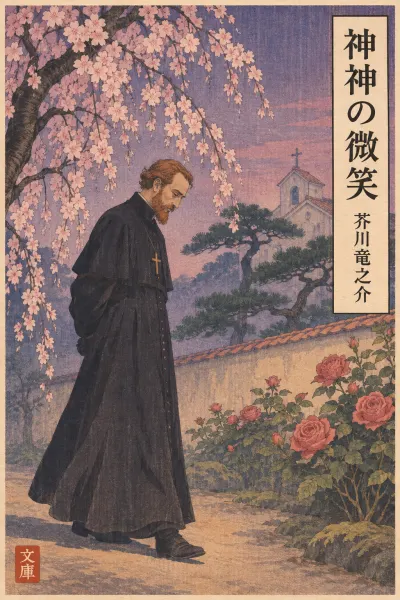
ある春の夕、Padre Organtino はたった一人、長いアビト(法衣)の裾を引きながら、南蛮寺の庭を歩いていた。One spring evening, Padre Organtino was walking all alone in the garden of the Nanbanji, trailing the hem of his long habit (his priestly robe).
庭には松や檜の間に、薔薇だの、橄欖だの、月桂だの、西洋の植物が植えてあった。In the garden, among the pines and cypresses, Western plants had been set out: roses, olives, laurels and the like.
殊に咲き始めた薔薇の花は、木々を幽かにする夕明りの中に、薄甘い匂を漂わせていた。The roses in particular, just beginning to bloom, sent a faint sweet scent drifting through the evening light that was making the trees grow dim.
それはこの庭の静寂に、何か日本とは思われない、不可思議な魅力を添えるようだった。It seemed to lend the stillness of this garden a strange, mysterious charm that somehow did not feel like Japan at all.
オルガンティノは寂しそうに、砂の赤い小径を歩きながら、ぼんやり追憶に耽っていた。Organtino, looking lonely, walked along the path of red sand, lost in vague remembrance.
羅馬の大本山、リスポアの港、羅面琴の音、巴旦杏の味、「御主、わがアニマ(霊魂)の鏡」の歌――そう云う思い出はいつのまにか、この紅毛の沙門の心へ、懐郷の悲しみを運んで来た。The great mother church of Rome, the harbour of Lisbon, the sound of the rebec, the taste of almonds, the hymn "O Lord, mirror of my anima (my soul)": before he knew it, such memories had borne the sorrow of homesickness into the heart of this red-haired monk.
彼はその悲しみを払うために、そっと泥烏須(神)の御名を唱えた。To drive that sorrow away, he softly called upon the holy name of Deusu (God).
が、悲しみは消えないばかりか、前よりは一層彼の胸へ、重苦しい空気を拡げ出した。But far from fading, the sorrow began to spread an air even heavier and more oppressive than before through his breast.
「この国の風景は美しい――。」"The scenery of this country is beautiful..."
オルガンティノは反省した。Organtino reflected.
「この国の風景は美しい。気候もまず温和である。土人は、――あの黄面の小人よりも、まだしも黒ん坊がましかも知れない。"The scenery of this country is beautiful. The climate, too, is mild enough. As for the natives... perhaps even blackamoors are preferable to those yellow-faced little men.
しかしこれも大体の気質は、親しみ易いところがある。のみならず信徒も近頃では、何万かを数えるほどになった。Still, in their general temperament there is something easy to warm to. What is more, the faithful have lately grown to number some tens of thousands.
現にこの首府のまん中にも、こう云う寺院が聳えている。して見ればここに住んでいるのは、たとい愉快ではないにしても、不快にはならない筈ではないか?Indeed, in the very heart of this capital a church like this one rises up. That being so, surely living here, even if it is not delightful, ought not to be unpleasant?
が、自分はどうかすると、憂鬱の底に沈む事がある。リスポアの市へ帰りたい、この国を去りたいと思う事がある。And yet at times I sink to the depths of melancholy. At times I long to go back to the city of Lisbon, to leave this country.
これは懐郷の悲しみだけであろうか? いや、自分はリスポアでなくとも、この国を去る事が出来さえすれば、どんな土地へでも行きたいと思う。Is this only the sorrow of homesickness? No: even if it were not Lisbon, if only I could leave this country, I would gladly go to any land at all.
支那でも、沙室でも、印度でも、――つまり懐郷の悲しみは、自分の憂鬱の全部ではない。China, Siam, India... in short, homesickness is not the whole of my melancholy.
自分はただこの国から、一日も早く逃れたい気がする。しかし――しかしこの国の風景は美しい。気候もまず温和である。……」I simply feel I want to escape from this country, even a single day sooner. And yet... and yet the scenery of this country is beautiful. The climate, too, is mild enough..."
オルガンティノは吐息をした。Organtino sighed.
この時偶然彼の眼は、点々と木かげの苔に落ちた、仄白い桜の花を捉えた。Just then his eye happened to fall on pale white cherry blossoms that had dropped here and there onto the moss in the shade of the trees.
桜!Cherry blossoms!
オルガンティノは驚いたように、薄暗い木立ちの間を見つめた。As if startled, Organtino stared in among the dusky trees.
そこには四五本の棕櫚の中に、枝を垂らした糸桜が一本、夢のように花を煙らせていた。There, among four or five hemp palms, a single weeping cherry with drooping branches was veiling its blossoms in haze, like a dream.
「御主守らせ給え!」"O Lord, protect me!"
オルガンティノは一瞬間、降魔の十字を切ろうとした。For an instant Organtino was on the point of making the sign of the cross that wards off devils.
実際その瞬間彼の眼には、この夕闇に咲いた枝垂桜が、それほど無気味に見えたのだった。For in that moment the weeping cherry blooming in the dusk truly looked that sinister to his eyes.
無気味に、――と云うよりもむしろこの桜が、何故か彼を不安にする、日本そのもののように見えたのだった。Sinister, or rather, this cherry tree looked to him like Japan itself, which for some reason filled him with unease.
が、彼は刹那の後、それが不思議でも何でもない、ただの桜だった事を発見すると、恥しそうに苦笑しながら、静かにまたもと来た小径へ、力のない歩みを返して行った。But when, a moment later, he found that it was nothing strange at all, only an ordinary cherry tree, he smiled wryly as though ashamed, and quietly retraced his listless steps along the path he had come.
× × ×× × ×
三十分の後、彼は南蛮寺の内陣に、泥烏須へ祈祷を捧げていた。Thirty minutes later he was offering prayers to Deusu in the sanctuary of the Nanbanji.
そこにはただ円天井から吊るされたランプがあるだけだった。There was nothing there but a lamp hanging from the domed ceiling.
そのランプの光の中に、内陣を囲んだフレスコの壁には、サン・ミグエルが地獄の悪魔と、モオゼの屍骸を争っていた。In the light of that lamp, on the frescoed walls surrounding the sanctuary, Saint Michael was contending with the Devil of Hell for the body of Moses.
が、勇ましい大天使は勿論、吼り立った悪魔さえも、今夜は朧げな光の加減か、妙にふだんよりは優美に見えた。Yet tonight, perhaps because of the dim light, not only the valiant archangel but even the raging Devil looked strangely more graceful than usual.
それはまた事によると、祭壇の前に捧げられた、水々しい薔薇や金雀花が、匂っているせいかも知れなかった。Or perhaps, too, it was because of the fragrance of the fresh roses and broom offered before the altar.
彼はその祭壇の後に、じっと頭を垂れたまま、熱心にこう云う祈祷を凝らした。Behind that altar, his head bowed and still, he poured himself fervently into this prayer:
Vocabulary
| Word | Meaning | JLPT |
|---|---|---|
| 漂わせていたただよわせる | to let (a scent) drift, to give offdictionary form: 漂わせるCausative of 漂う (to drift, float). | — |
| 添えるそえる | to add, to lend (an extra quality)Adds something as an accompaniment, e.g. 魅力を添える 'lend charm'. | N1 |
| 追憶ついおく | remembrance, reminiscenceLiterary; everyday Japanese would say 思い出. | — |
| 耽っていたふける | to be absorbed in, lost indictionary form: 耽るUsually with に: 追憶に耽る, 読書に耽る. | — |
| 懐郷かいきょう | homesickness, longing for homeLiterary; the common word is ホームシック or 郷愁. | — |
| 沙門しゃもん | monk, priestA Buddhist word applied ironically to a Christian priest; 紅毛 'red hair' was an old term for Europeans. | — |
| 一層いっそう | even more, all the moreOften paired with より: 前よりは一層 'even more than before'. | N3 |
| 聳えているそびえる | to rise up, to towerdictionary form: 聳えるUsed for tall buildings and mountains. | N1 |
| 逃れたいのがれる | to escape, to get away fromdictionary form: 逃れるMore formal than 逃げる; often for escaping a place or situation. | N1 |
| 吐息といき | a sigh吐息をする = to sigh; ため息 is the everyday equivalent. | — |
| 無気味ぶきみ | eerie, sinister, uncannyNow usually written 不気味. | — |
| 刹那せつな | an instant, a momentBuddhist term for the smallest unit of time; 刹那の後 'a moment later'. | — |
| 苦笑くしょう | a wry or bitter smile苦 'bitter' + 笑 'laugh'; also read as 苦笑い (にがわらい). | — |
| 祈祷きとう | prayerFormal or religious word; 祈祷を捧げる 'offer a prayer'. | — |
Grammar
〜てある N4 has been done (resulting state)
A transitive verb in the て-form plus ある describes a state left by someone's deliberate action. Here the plants are in the garden because someone planted them there.
西洋の植物が植えてあった。
Western plants had been set out.
〜だの〜だの N2 things like A and B, A and B and so on
Lists examples loosely, suggesting there are others. It is more colloquial and enumerative than 〜や〜など.
薔薇だの、橄欖だの、月桂だの、西洋の植物が植えてあった。
Western plants had been set out: roses, olives, laurels and the like.
〜ばかりか N2 not only... but also; far from...
Attached to a clause, it means that the first point is true and something further, often stronger, is also true. Here the sorrow not only fails to disappear but actually grows worse.
悲しみは消えないばかりか、前よりは一層彼の胸へ、重苦しい空気を拡げ出した。
Far from fading, the sorrow began to spread an air even heavier than before through his breast.
たとい〜にしても N1 even if, granted that
たとい (modern たとえ) sets up a concession, completed by にしても. The speaker grants a point (life is not delightful) before insisting on another (it should not be unpleasant).
たとい愉快ではないにしても、不快にはならない筈ではないか?
Even if it is not delightful, ought it not to be free of unpleasantness?
〜さえ〜ば N3 if only, as long as
さえ inside a conditional marks the one thing that would be enough. Here leaving Japan is the only condition Organtino needs; any destination would do.
この国を去る事が出来さえすれば、どんな土地へでも行きたいと思う。
If only I could leave this country, I would gladly go to any land at all.
〜せ給え N1 please (do), O (Lord) grant... (archaic honorific imperative)
給え is the classical honorific imperative of 給う, used in prayers to ask a superior being to act. 守らせ給え is a reverent 'protect me', typical of Kirishitan devotional language.
「御主守らせ給え!」
"O Lord, protect me!"