Part 3 of 7 · JLPT N2
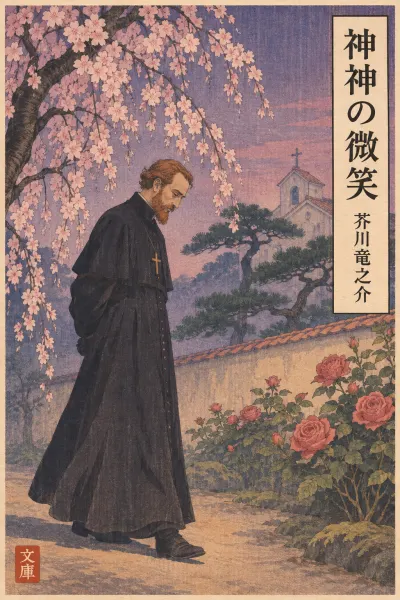
神神の微笑 Kamigami no Bishō, part 3: The Sun Goddess Leaves Her Cave
In this part
Organtino watches a vision of ancient Japanese gods feasting before a rock cave while a powerful woman dances wildly on an upturned tub. A voice from inside the cave asks why the gods are rejoicing, and the dancer replies that a new god greater than her has appeared. Organtino briefly hopes this means Deusu, but the cave opens, dazzling light pours out, and the crowd hails Ōhirumemuchi, crying that there is no new god.
AI translation · independently checked
日本の Bacchanalia は、呆気にとられたオルガンティノの前へ、蜃気楼のように漂って来た。The Bacchanalia of Japan came drifting like a mirage before the dumbfounded Organtino.
彼は赤い篝の火影に、古代の服装をした日本人たちが、互いに酒を酌み交しながら、車座をつくっているのを見た。In the glow of red bonfires he saw Japanese people in ancient dress sitting in a circle, pouring wine for one another.
そのまん中には女が一人、――日本ではまだ見た事のない、堂々とした体格の女が一人、大きな桶を伏せた上に、踊り狂っているのを見た。He saw that in their midst a woman, a woman of imposing build such as he had never yet seen in Japan, was dancing in a frenzy on top of a large tub turned upside down.
桶の後ろには小山のように、これもまた逞しい男が一人、根こぎにしたらしい榊の枝に、玉だの鏡だのが下ったのを、悠然と押し立てているのを見た。He saw that behind the tub a man, he too as sturdy as a small hill, was calmly holding up a sakaki branch, apparently torn out by the roots, hung with jewels and mirrors and the like.
彼等のまわりには数百の鶏が、尾羽根や鶏冠をすり合せながら、絶えず嬉しそうに鳴いているのを見た。He saw that around them several hundred cockerels, rubbing their tail feathers and combs together, were crowing joyfully without pause.
そのまた向うには、――オルガンティノは、今更のように、彼の眼を疑わずにはいられなかった。And beyond them... Organtino could not help doubting his own eyes, as though for the first time.
――そのまた向うには夜霧の中に、岩屋の戸らしい一枚岩が、どっしりと聳えているのだった。...Beyond them, in the night mist, a single massive rock, seemingly the door of a cave, towered heavily.
桶の上にのった女は、いつまでも踊をやめなかった。The woman on the tub would not stop her dance.
彼女の髪を巻いた蔓は、ひらひらと空に翻った。The vines wound in her hair fluttered and streamed in the air.
彼女の頸に垂れた玉は、何度も霰のように響き合った。The jewels hanging at her neck rang against each other again and again like hailstones.
彼女の手にとった小笹の枝は、縦横に風を打ちまわった。The little bamboo branch in her hand lashed the wind this way and that.
しかもその露わにした胸!And her breast, laid bare!
赤い篝火の光の中に、艶々と浮び出た二つの乳房は、ほとんどオルガンティノの眼には、情欲そのものとしか思われなかった。To Organtino's eyes the two breasts that rose glistening in the light of the red bonfires seemed nothing other than lust itself.
彼は泥烏須を念じながら、一心に顔をそむけようとした。Praying inwardly to Deusu, he strove with all his heart to turn his face away.
が、やはり彼の体は、どう云う神秘な呪の力か、身動きさえ楽には出来なかった。But again his body, by some mysterious power of a curse, could not move freely in the slightest.
その内に突然沈黙が、幻の男女たちの上へ降った。Then all at once a silence fell upon the phantom men and women.
桶の上に乗った女も、もう一度正気に返ったように、やっと狂わしい踊をやめた。The woman on the tub, too, as if she had come to her senses once more, at last stopped her frenzied dance.
いや、鳴き競っていた鶏さえ、この瞬間は頸を伸ばしたまま、一度にひっそりとなってしまった。No, even the cockerels that had been crowing in rivalry fell hushed together in that instant, their necks still stretched out.
するとその沈黙の中に、永久に美しい女の声が、どこからか厳かに伝わって来た。Then, into that silence, a woman's voice of eternal beauty came solemnly from somewhere.
「私がここに隠っていれば、世界は暗闇になった筈ではないか? それを神々は楽しそうに、笑い興じていると見える。」"If I shut myself away in here, should the world not have fallen into darkness? Yet the gods, it seems, are laughing and making merry quite happily."
その声が夜空に消えた時、桶の上にのった女は、ちらりと一同を見渡しながら、意外なほどしとやかに返事をした。When that voice had faded into the night sky, the woman on the tub glanced around at the whole company and answered with surprising gentleness.
「それはあなたにも立ち勝った、新しい神がおられますから、喜び合っておるのでございます。」"It is because there is a new god, one who surpasses even you, that we are rejoicing together."
その新しい神と云うのは、泥烏須を指しているのかも知れない。Perhaps that new god meant Deusu.
――オルガンティノはちょいとの間、そう云う気もちに励まされながら、この怪しい幻の変化に、やや興味のある目を注いだ。For a little while, encouraged by this thought, Organtino turned somewhat interested eyes upon the changes in this strange vision.
沈黙はしばらく破れなかった。For some time the silence was not broken.
が、たちまち鶏の群が、一斉に鬨をつくったと思うと、向うに夜霧を堰き止めていた、岩屋の戸らしい一枚岩が、徐ろに左右へ開き出した。But suddenly the flock of cockerels crowed all together, and at that the single great rock beyond, seemingly the door of a cave, which had been holding back the night mist, slowly began to open to left and right.
そうしてその裂け目からは、言句に絶した万道の霞光が、洪水のように漲り出した。And from the crack, ten thousand rays of radiant light beyond all words came surging out like a flood.
オルガンティノは叫ぼうとした。Organtino tried to cry out.
が、舌は動かなかった。But his tongue would not move.
オルガンティノは逃げようとした。Organtino tried to flee.
が、足も動かなかった。But his legs would not move either.
彼はただ大光明のために、烈しく眩暈が起るのを感じた。He only felt a violent dizziness come over him from the great radiance.
そうしてその光の中に、大勢の男女の歓喜する声が、澎湃と天に昇るのを聞いた。And within that light he heard the joyful voices of a multitude of men and women rise surging up to the heavens.
「大日孁貴! 大日孁貴! 大日孁貴!」"Ōhirumemuchi! Ōhirumemuchi! Ōhirumemuchi!"
「新しい神なぞはおりません。新しい神なぞはおりません。」"There is no new god. There is no new god."
「あなたに逆うものは亡びます。」"Those who oppose you shall perish."
「御覧なさい。闇が消え失せるのを。」"Behold, how the darkness vanishes away!"
「見渡す限り、あなたの山、あなたの森、あなたの川、あなたの町、あなたの海です。」"As far as the eye can see, these are your mountains, your forests, your rivers, your towns, your seas."
Vocabulary
| Word | Meaning | JLPT |
|---|---|---|
| 呆気にとられたあっけにとられる | to be dumbfounded, taken abackdictionary form: 呆気にとられるFixed expression; 呆気 is rarely used on its own. | — |
| 蜃気楼しんきろう | mirage | — |
| 車座くるまざ | sitting in a circleLiterally 'wheel seating': people sit facing inward like the spokes of a wheel. | — |
| 酌み交くみかわす | to pour drinks for one anotherdictionary form: 酌み交わす | — |
| 逞しいたくましい | sturdy, brawny | N1 |
| 榊さかき | sakaki, a sacred evergreen tree used in Shinto ritesThe kanji combines 木 'tree' and 神 'god'. In this myth the branch is hung with jewels and a mirror to lure the goddess out. | — |
| 悠然ゆうぜん | calm, composed, unhurried | — |
| 聳えてそびえる | to tower, rise highdictionary form: 聳える | N1 |
| 翻ったひるがえる | to flutter, wave in the airdictionary form: 翻る | — |
| 念じねんじる | to pray silently, invoke in one's heartdictionary form: 念じる | — |
| 厳かおごそか | solemn, majestic | N1 |
| 立ち勝ったたちまさる | to surpass, be superior todictionary form: 立ち勝るOld-fashioned; the modern equivalent is 勝る or 上回る. | — |
| 鬨をつくったときをつくる | to raise a war cry; here, of the cocks, to crow loudly all togetherdictionary form: 鬨をつくる鬨 originally means a war cry. | — |
| 漲り出みなぎる | to surge, overflow, be filled to burstingdictionary form: 漲る | — |
Grammar
〜ずにはいられない N2 cannot help doing
The negative stem with ず + には + いられない expresses an urge so strong that it cannot be resisted. Here Organtino cannot stop himself from doubting what he sees.
彼の眼を疑わずにはいられなかった
he could not help doubting his own eyes
〜だの〜だの N2 things like A and B
This lists examples loosely and implies there may be more. It is often slightly informal or dismissive, while here it is simply descriptive.
玉だの鏡だのが下ったのを
hung with jewels and mirrors and the like
〜としか思われない N3 can only seem to be ~, nothing but ~
しか + negative means 'only'. With 思われる, the spontaneous form of 思う, it means the impression forces itself on him: he cannot see the breasts as anything but lust.
情欲そのものとしか思われなかった
seemed nothing other than lust itself
〜筈ではないか N3 shouldn't it be that ~?
はず expresses a logical expectation, and ではないか turns it into a challenging rhetorical question. The goddess expects the world to have gone dark and wonders why it has not.
世界は暗闇になった筈ではないか?
should the world not have fallen into darkness?
〜たと思うと N2 no sooner had ~ than ~
Past tense + と思うと links two events that happen in immediate succession, and the second is often surprising. The crowing is instantly followed by the rock opening.
一斉に鬨をつくったと思うと
crowed all together, and at that
〜ようとした N4 tried to ~ (but failed)
〜ようとした — tried to ~, was about to ~. The volitional form + とする describes an attempt or intention to act; it does not itself imply the outcome. Here the next sentence (が、舌は動かなかった) shows that the attempt failed.
オルガンティノは叫ぼうとした。
Organtino tried to cry out.