Part 5 of 7 · JLPT N2
神神の微笑 Kamigami no Bishō, part 5: The Old Man's Tale of Conquered Conquerors
In this part
The old man walks with Organtino and warns him that even Deusu will be defeated in Japan, just as earlier arrivals were. Chinese writing, calligraphy and Confucian teaching all came to Japan, but the gods of the country quietly reshaped each of them into something Japanese. Organtino follows only half of this, and when the old man plucks a rose, the flower stays on the bush while the one in his hand is only a misty copy.
AI translation · independently checked
オルガンティノはやむを得ず、不愉快そうに腕組をしたまま、老人と一しょに歩き出した。Having no other choice, Organtino set off walking beside the old man, his arms still folded and a look of displeasure on his face.
「あなたは天主教を弘めに来ていますね、――」"You have come to spread the faith of the Lord of Heaven, I believe——"
老人は静かに話し出した。The old man began to speak, quietly.
「それも悪い事ではないかも知れません。しかし泥烏須もこの国へ来ては、きっと最後には負けてしまいますよ。」"Perhaps that is no bad thing in itself. But once Deusu comes to this country, he too will surely be defeated in the end."
「泥烏須は全能の御主だから、泥烏須に、――」"Deusu is the Lord Almighty, and so, against Deusu——"
オルガンティノはこう云いかけてから、ふと思いついたように、いつもこの国の信徒に対する、叮嚀な口調を使い出した。Organtino had begun to say this when, as though something had just occurred to him, he slipped into the courteous tone he always used with the faithful of this country.
「泥烏須に勝つものはない筈です。」——there can surely be nothing that prevails over Deusu.
「ところが実際はあるのです。まあ、御聞きなさい。はるばるこの国へ渡って来たのは、泥烏須ばかりではありません。"And yet, in truth, there is. Now, do hear me out. Deusu is not the only one to have crossed the seas all the long way to this country.
孔子、孟子、荘子、――そのほか支那からは哲人たちが、何人もこの国へ渡って来ました。Confucius, Mencius, Zhuangzi——and many other philosophers besides came across to this country from China.
しかも当時はこの国が、まだ生まれたばかりだったのです。支那の哲人たちは道のほかにも、呉の国の絹だの秦の国の玉だの、いろいろな物を持って来ました。What is more, in those days this country had only just been born. Besides their Way, the Chinese philosophers brought all manner of things: silk from the land of Wu, jewels from the land of Qin.
いや、そう云う宝よりも尊い、霊妙な文字さえ持って来たのです。が、支那はそのために、我々を征服出来たでしょうか?No, they brought even writing, a wondrous thing more precious than any such treasure. But did China, for all that, manage to conquer us?
たとえば文字を御覧なさい。文字は我々を征服する代りに、我々のために征服されました。Consider writing, for instance. Instead of conquering us, writing was conquered by us.
私が昔知っていた土人に、柿の本の人麻呂と云う詩人があります。その男の作った七夕の歌は、今でもこの国に残っていますが、あれを読んで御覧なさい。Among the natives I knew long ago was a poet called Kakinomoto no Hitomaro. The Tanabata poem that man made still survives in this country today. Read it and see.
牽牛織女はあの中に見出す事は出来ません。あそこに歌われた恋人同士は飽くまでも彦星と棚機津女とです。You will not find the Herdboy and the Weaver Girl anywhere in it. The lovers sung of there are Hikoboshi and Tanabatatsume, through and through.
彼等の枕に響いたのは、ちょうどこの国の川のように、清い天の川の瀬音でした。支那の黄河や揚子江に似た、銀河の浪音ではなかったのです。What sounded at their pillows was the murmur of the shallows of a pure River of Heaven, just like the rivers of this country. It was not the roar of waves on a Milky Way like China's Yellow River or Yangtze.
しかし私は歌の事より、文字の事を話さなければなりません。人麻呂はあの歌を記すために、支那の文字を使いました。But I must speak of writing rather than of poems. To set that poem down, Hitomaro used Chinese characters.
が、それは意味のためより、発音のための文字だったのです。舟と云う文字がはいった後も、「ふね」は常に「ふね」だったのです。Yet he used those characters for their sound rather than for their meaning. Even after the character for "boat," read shū, had come in, a "fune" was always a "fune."
さもなければ我々の言葉は、支那語になっていたかも知れません。これは勿論人麻呂よりも、人麻呂の心を守っていた、我々この国の神の力です。Otherwise our language might well have turned into Chinese. That, of course, was the work not so much of Hitomaro as of us, the gods of this country, who watched over Hitomaro's heart.
のみならず支那の哲人たちは、書道をもこの国に伝えました。空海、道風、佐理、行成――私は彼等のいる所に、いつも人知れず行っていました。Moreover, the Chinese philosophers also brought the art of calligraphy to this country. Kūkai, Tōfū, Sari, Kōzei——I always went, unseen by anyone, wherever they were.
彼等が手本にしていたのは、皆支那人の墨蹟です。しかし彼等の筆先からは、次第に新しい美が生れました。The models they copied were all the brushwork of Chinese hands. Yet from the tips of their brushes a new beauty was gradually born.
彼等の文字はいつのまにか、王羲之でもなければ褚 遂良でもない、日本人の文字になり出したのです。Before anyone noticed, their writing had begun to be neither Wang Xizhi's nor Chu Suiliang's, but the writing of the Japanese.
しかし我々が勝ったのは、文字ばかりではありません。我々の息吹きは潮風のように、老儒の道さえも和げました。But writing was not the only thing we conquered. Our breath, like the sea breeze, softened even the Way of the old Confucian scholars.
この国の土人に尋ねて御覧なさい。彼等は皆孟子の著書は、我々の怒に触れ易いために、それを積んだ船があれば、必ず覆ると信じています。Ask the natives of this country, and see. They all believe that the books of Mencius so readily provoke our anger that any ship carrying them is bound to capsize.
科戸の神はまだ一度も、そんな悪戯はしていません。が、そう云う信仰の中にも、この国に住んでいる我々の力は、朧げながら感じられる筈です。あなたはそう思いませんか?」Shinato no Kami has never once played such a trick. Yet even within a belief like that, you should be able to sense, however dimly, the power of us who dwell in this country. Do you not think so?"
オルガンティノは茫然と、老人の顔を眺め返した。Organtino gazed back blankly at the old man's face.
この国の歴史に疎い彼には、折角の相手の雄弁も、半分はわからずにしまったのだった。Knowing little of this country's history, he had understood barely half of his companion's eloquence, fine as it was.
「支那の哲人たちの後に来たのは、印度の王子悉達多です。――」"After the Chinese philosophers came Siddhārtha, a prince of India——"
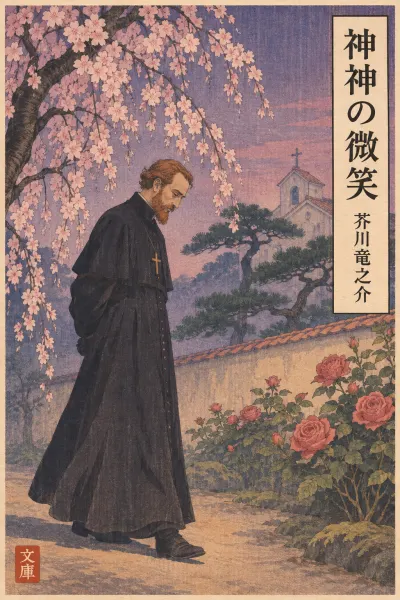
老人は言葉を続けながら、径ばたの薔薇の花をむしると、嬉しそうにその匂を嗅いだ。As he went on speaking, the old man plucked a rose from beside the path and breathed in its fragrance with evident delight.
が、薔薇はむしられた跡にも、ちゃんとその花が残っていた。Yet even where the rose had been plucked, its flower was still there, perfectly whole.
ただ老人の手にある花は色や形は同じに見えても、どこか霧のように煙っていた。Only the flower in the old man's hand, though it looked the same in colour and in shape, seemed somehow blurred, like a wisp of mist.
Vocabulary
| Word | Meaning | JLPT |
|---|---|---|
| やむを得ずやむをえず | unavoidably; having no choicedictionary form: やむを得ないThe ず form is a literary adverb meaning "reluctantly, because there was no other way". | N2 |
| 腕組うでぐみ | folding one's armsdictionary form: 腕組み腕組みをする: to fold one's arms. Often a sign of displeasure or deep thought. | — |
| 弘めひろめる | to spread (a teaching or religion)dictionary form: 弘めるUsually written 広める today. 弘 is used especially for spreading a faith. | N2 |
| 全能ぜんのう | almighty, omnipotent全 (all) + 能 (ability). 全知全能: all-knowing and all-powerful. | — |
| 叮嚀ていねい | polite, courteousdictionary form: 丁寧An old spelling of 丁寧. 丁寧な口調 means a polite manner of speaking. | N4 |
| 哲人てつじん | philosopher, sageA more literary word than 哲学者. | — |
| 征服せいふく | conquest; to conquer (with する)The key idea of the old man's speech: foreign things come to conquer and end up conquered. | N1 |
| 土人どじん | native, local inhabitantOld usage. It is now considered offensive and should be avoided. | — |
| 飽くまでもあくまで | through and through; to the very enddictionary form: 飽くまでStresses that something stays true no matter what. | N2 |
| 瀬音せおと | the murmur of water over shallows瀬 means rapids or shallows. A poetic word. | — |
| 墨蹟ぼくせき | brushwork; specimens of calligraphydictionary form: 墨跡Literally "ink traces". | — |
| 覆るくつがえる | to capsize, to be overturnedAlso used figuratively, as in a verdict or theory being overturned. | — |
| 茫然ぼうぜん | blankly, in a dazeAlso written 呆然. Often used as 茫然と + verb. | N1 |
| 疎いうとい | poorly acquainted with, ignorant ofUsed in the pattern 〜に疎い, meaning "to know little about ~". | — |
Grammar
〜かける N3 to start to do; to be about to do
Attached to the verb stem, かける marks an action that has begun but is broken off. Here Organtino starts his sentence and then changes his tone partway through.
オルガンティノはこう云いかけてから
Organtino had begun to say this when
〜筈だ N4 should be; is supposed to be
筈 expresses the speaker's confident expectation based on reasoning. Organtino states as a matter of doctrine that nothing can beat God.
泥烏須に勝つものはない筈です。
There can surely be nothing that prevails over Deusu.
〜たばかり N4 to have just done
The past form + ばかり means that very little time has passed since the action. The country had only just come into being.
当時はこの国が、まだ生まれたばかりだったのです。
In those days this country had only just been born.
〜代りに N3 instead of ~
After a dictionary-form verb, 代りに means "instead of doing ~" and introduces the opposite outcome. It sets up the reversal between conquering and being conquered.
文字は我々を征服する代りに、我々のために征服されました。
Instead of conquering us, writing was conquered by us.
〜易い / 〜ために (reason) N3 easily ~; because ~
On a verb stem, 易い means "easy to" or "apt to". ために after a clause gives a reason. Together they say the books tend to anger the gods, and that this is why ships carrying them sink.
孟子の著書は、我々の怒に触れ易いために
because the books of Mencius so readily provoke our anger
〜ながら (concessive) N2 though; while still being ~
On a na-adjective stem or noun, ながら can mean "although" instead of "while doing". 朧げながら means "dimly, but still".
朧げながら感じられる筈です。
you should be able to sense, however dimly.