Part 4 of 7 · JLPT N2
神神の微笑 Kamigami no Bishō, part 4: An Old Spirit in the Garden
In this part
Overwhelmed by the vision of the cheering gods, Organtino collapses. When he comes to, he admits that fighting the spirits of Japan may be harder than he thought, and a voice whispers that he will lose. The next evening, cheered by a few new samurai converts, he dismisses the vision as a devil's trick, but an old man wearing jewels round his neck appears beside him and calmly introduces himself as one of the spirits of this country.
AI translation · independently checked
「新しい神なぞはおりません。誰も皆あなたの召使です。」"There are no such things as new gods. Every one of them is your servant."
「大日孁貴! 大日孁貴! 大日孁貴!」"Ōhirumemuchi! Ōhirumemuchi! Ōhirumemuchi!"
そう云う声の湧き上る中に、冷汗になったオルガンティノは、何か苦しそうに叫んだきりとうとうそこへ倒れてしまった。As these cries welled up all around him, Organtino, drenched in a cold sweat, gave one anguished cry and at last collapsed where he stood.
……………
その夜も三更に近づいた頃、オルガンティノは失心の底から、やっと意識を恢復した。That night, as the hour drew close to midnight, Organtino at last rose out of the depths of his swoon and came back to his senses.
彼の耳には神々の声が、未だに鳴り響いているようだった。The voices of the gods still seemed to be ringing in his ears.
が、あたりを見廻すと、人音も聞えない内陣には、円天井のランプの光が、さっきの通り朦朧と壁画を照らしているばかりだった。But when he looked about him, the inner sanctuary was without a sound of any living soul, and the lamp hanging from the domed ceiling was only casting its dim light over the murals, just as before.
オルガンティノは呻き呻き、そろそろ祭壇の後を離れた。Groaning again and again, Organtino slowly moved away from behind the altar.
あの幻にどんな意味があるか、それは彼にはのみこめなかった。What that vision might mean, he could not grasp.
しかしあの幻を見せたものが、泥烏須でない事だけは確かだった。Yet one thing alone was certain: whatever had shown him that vision, it was not Deusu.
「この国の霊と戦うのは、……」"To do battle with the spirits of this land…"
オルガンティノは歩きながら、思わずそっと独り語を洩らした。As he walked, Organtino found himself murmuring softly to himself.
「この国の霊と戦うのは、思ったよりもっと困難らしい。勝つか、それともまた負けるか、――」"To do battle with the spirits of this land seems far harder than I had thought. Shall I win, or else shall I lose—"
するとその時彼の耳に、こう云う囁きを送るものがあった。Just then, something breathed a whisper into his ear.
「負けですよ!」"You will lose!"
オルガンティノは気味悪そうに、声のした方を透かして見た。Uneasily, Organtino peered toward the place the voice had come from.
が、そこには不相変、仄暗い薔薇や金雀花のほかに、人影らしいものも見えなかった。But there, as ever, he could see nothing that looked like a human figure, only the roses and the broom in the dusk.
× × ×× × ×
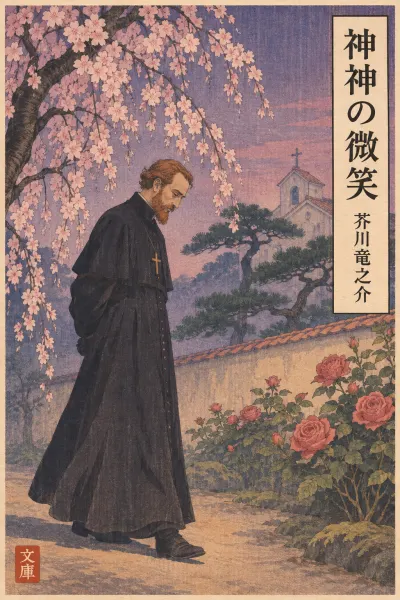
オルガンティノは翌日の夕も、南蛮寺の庭を歩いていた。The next evening, too, Organtino was walking in the garden of the Nanbanji.
しかし彼の碧眼には、どこか嬉しそうな色があった。Yet there was something like gladness in his blue eyes.
それは今日一日の内に、日本の侍が三四人、奉教人の列にはいったからだった。For in the course of that single day, three or four Japanese samurai had joined the ranks of the faithful.
庭の橄欖や月桂は、ひっそりと夕闇に聳えていた。The olive trees and laurels in the garden rose silently into the evening dusk.
ただその沈黙が擾されるのは、寺の鳩が軒へ帰るらしい、中空の羽音よりほかはなかった。The only thing that broke that silence was the beating of wings high in the air, as the church's doves seemed to be returning to the eaves.
薔薇の匂、砂の湿り、――一切は翼のある天使たちが、「人の女子の美しきを見て、」妻を求めに降って来た、古代の日の暮のように平和だった。The scent of roses, the dampness of the sand—all was as peaceful as the close of a day in ancient times, when the winged angels, "seeing the daughters of men that they were fair," came down to take wives.
「やはり十字架の御威光の前には、穢らわしい日本の霊の力も、勝利を占める事はむずかしいと見える。しかし昨夜見た幻は?――いや、あれは幻に過ぎない。悪魔はアントニオ上人にも、ああ云う幻を見せたではないか? その証拠には今日になると、一度に何人かの信徒さえ出来た。やがてはこの国も至る所に、天主の御寺が建てられるであろう。」"It seems that, before the glory of the Cross, even the power of the foul spirits of Japan can hardly win the victory after all. But what of the vision I saw last night?—No, that was nothing but a vision. Did not the Devil show visions such as that to Saint Anthony as well? And as proof of it, today we have even gained several believers at once. In time, in every corner of this land too, the churches of the Lord of Heaven will surely be built."
オルガンティノはそう思いながら、砂の赤い小径を歩いて行った。Thinking thus, Organtino walked on along the little path of red sand.
すると誰か後から、そっと肩を打つものがあった。Then someone behind him tapped him gently on the shoulder.
彼はすぐに振り返った。He turned round at once.
しかし後には夕明りが、径を挟んだ篠懸の若葉に、うっすりと漂っているだけだった。But behind him there was only the evening glow, drifting faintly among the young leaves of the plane trees that lined both sides of the path.
「御主。守らせ給え!」"O Lord, protect me!"
彼はこう呟いてから、徐ろに頭をもとへ返した。Having murmured this, he slowly turned his head back again.
と、彼の傍には、いつのまにそこへ忍び寄ったか、昨夜の幻に見えた通り、頸に玉を巻いた老人が一人、ぼんやり姿を煙らせたまま、徐ろに歩みを運んでいた。And there beside him—when had he crept up?—just as he had appeared in last night's vision, was an old man with jewels strung around his neck, his figure hazy as if veiled in smoke, walking slowly along.
「誰だ、お前は?」"Who are you?"
不意を打たれたオルガンティノは、思わずそこへ立ち止まった。Caught off guard, Organtino stopped short where he was.
「私は、――誰でもかまいません。この国の霊の一人です。」"I am—well, it matters little who I am. I am one of the spirits of this land."
老人は微笑を浮べながら、親切そうに返事をした。The old man answered kindly, a smile on his face.
「まあ、御一緒に歩きましょう。私はあなたとしばらくの間、御話しするために出て来たのです。」"Come, let us walk together. I have come out to have a little talk with you."
オルガンティノは十字を切った。Organtino made the sign of the cross.
が、老人はその印に、少しも恐怖を示さなかった。But the old man showed not the slightest fear at that sign.
「私は悪魔ではないのです。御覧なさい、この玉やこの剣を。地獄の炎に焼かれた物なら、こんなに清浄ではいない筈です。さあ、もう呪文なぞを唱えるのはおやめなさい。」"I am not the Devil, you know. Look at these jewels, and at this sword. If they had been scorched in the flames of Hell, they could hardly be so pure as this. Now, do stop chanting your spells."
Vocabulary
| Word | Meaning | JLPT |
|---|---|---|
| 冷汗ひやあせ | cold sweat冷汗になる: to break out in a cold sweat, from fear or shock. | — |
| 失心しっしん | fainting; loss of consciousnessOlder spelling; today usually written 失神. | — |
| 恢復かいふく | recovery (of consciousness)Old kanji form of 回復. | N3 |
| 朦朧もうろう | dim, hazyAlso used for a clouded mind: 意識が朦朧とする. | — |
| 幻まぼろし | vision; phantom, illusionA key word in this part of the story. | — |
| のみこめなかったのみこめる | to grasp, to understanddictionary form: 呑み込めるLiterally 'to be able to swallow'; used figuratively for understanding. | — |
| 独り語ひとりごと | words spoken to oneselfUsually written 独り言 today. | — |
| 囁きささやき | a whisperFrom the verb 囁く, 'to whisper'. | — |
| 碧眼へきがん | blue eyesLiterary; once a standard way to refer to Westerners. | — |
| 奉教人ほうきょうにん | Christian believerKirishitan-era term: 'one who serves the teaching'. | — |
| 威光いこう | glory, majestic powerHere with the honorific 御 for the Cross. | — |
| 穢らわしいけがらわしい | foul, unclean, impureExpresses strong moral or religious disgust. | N1 |
| 忍び寄ったしのびよる | to creep up on quietlydictionary form: 忍び寄る | — |
| 清浄せいじょう | pure, undefiledIn Buddhist contexts often read しょうじょう. | — |
Grammar
〜たきり N2 did ~ and then nothing more
After a past-tense verb, きり means that one action happened and nothing else followed. Organtino gives a single cry and then collapses.
何か苦しそうに叫んだきりとうとうそこへ倒れてしまった
gave one anguished cry and at last collapsed where he stood
〜ばかりだ N3 only ~, nothing but ~
Attached to a verb in the ている form, it says that this was the only thing happening. Nothing in the hall is moving except the lamplight.
円天井のランプの光が、さっきの通り朦朧と壁画を照らしているばかりだった
the lamp hanging from the domed ceiling was only casting its dim light over the murals, just as before
〜と見える N1 it seems that ~
A written, somewhat formal way to draw a conclusion from evidence, much like 〜らしい or 〜ようだ. Organtino reasons from the new converts to his own victory.
穢らわしい日本の霊の力も、勝利を占める事はむずかしいと見える
even the power of the foul spirits of Japan can hardly win the victory, it seems
〜に過ぎない N2 nothing more than ~
Follows a noun or a plain-form verb and plays something down as 'merely' that. Organtino uses it to brush aside the vision.
あれは幻に過ぎない
that was nothing but a vision
〜給え N1 please (deign to) ~
給え is the imperative of the classical honorific 給う. Here it makes a reverent request to God in archaic prayer language.
御主。守らせ給え!
O Lord, protect me!
〜筈だ N4 should be ~, ought to be ~
Expresses a logical expectation. With a negative, as here, it means 'surely would not be'. The old man argues that anything from Hell could not look so pure.
地獄の炎に焼かれた物なら、こんなに清浄ではいない筈です
If they had been scorched in the flames of Hell, they could hardly be so pure as this