Upper intermediate · JLPT N2
神神の微笑Kamigami no Bishō — The Gods, Smiling
- JLPT N2
- 8,843 characters
- 7 parts
- about 74 minutes
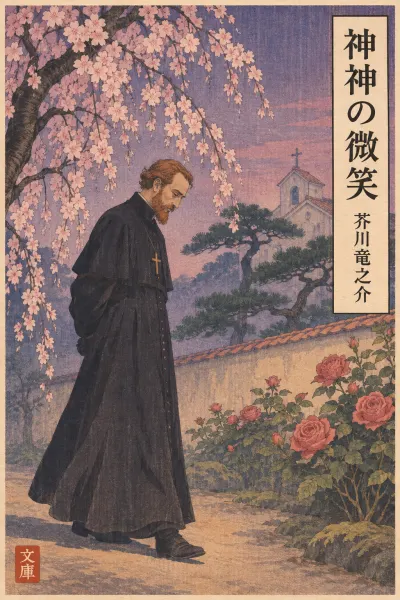
This is one of Akutagawa's "Kirishitan" stories, set in the age of the European missionaries. Padre Organtino lives at the Nanbanji, the Christian church in the capital. One spring evening, homesick and uneasy, he begins to sense that something hidden throughout Japan is quietly resisting his mission. Through a strange vision and a long conversation with a courteous old man, the story asks whether a foreign faith can ever stay unchanged in Japan, or whether the country slowly turns everything it receives into something of its own. The tone is dreamlike and gently ironic rather than dramatic. Much of the story is argument: the old man calmly lists Chinese writing, calligraphy, Confucian teaching and Buddhism as earlier arrivals that Japan absorbed and remade. For a learner, the challenge is the density of proper names, including Chinese sages, Japanese calligraphers, Shinto deities and biblical figures, together with archaic Christian vocabulary such as 泥烏須 and 御主. The reward is a short, thoughtful piece whose central idea is stated clearly in polite spoken Japanese, so you can follow the argument even when the allusions are unfamiliar.
Contents
Before you read
- Learn a few key names before you start: 泥烏須 (でうす, the Christian God), 大日孁貴 (おおひるめむち, the sun goddess) and 南蛮寺 (なんばんじ). Many other names, such as 王羲之 and 褚遂良, appear only once inside lists. You can treat them as examples without memorising them.
- Organtino's prayers use archaic devotional forms such as 守らせ給え (〜せ給え, a respectful request to God) and the word 御主. Read them as fixed prayer formulas, like "Thou" and "vouchsafe" in old English prayers.
- The old man's argument relies on listing and contrast patterns: 〜だの〜だの for examples, 〜ばかりか ("not only... but also"), 〜に過ぎない ("is nothing more than"), and concessive たとい〜にしても ("even if"). Spotting these makes the logic of parts 5 and 6 much easier to follow.
- Watch for 〜たと思うと ("no sooner had... than") in the vision scenes of parts 2 and 3. Akutagawa uses it to make events follow each other suddenly.
- Notice the change of voice in the final section. The narrator steps out of the story and speaks to Organtino directly as 君, looking back from his own era. This frame explains why the story ends with the folding screen.
Words to know
The most useful words from the notes across the story.
| Word | Meaning | JLPT |
|---|---|---|
| 土人どじん | native, local inhabitantOld usage. It is now considered offensive and should be avoided. | — |
| 聳えているそびえる | to rise up, to towerdictionary form: 聳えるUsed for tall buildings and mountains. | N1 |
| 威光いこう | glory, majesty, powerHere with honorific 御 (ご威光). | — |
| 叮嚀ていねい | polite, courteousdictionary form: 丁寧An old spelling of 丁寧. 丁寧な口調 means a polite manner of speaking. | N4 |
| 一層いっそう | even more, all the moreOften paired with より: 前よりは一層 'even more than before'. | N3 |
| 恢復かいふく | recovery (of consciousness)Old kanji form of 回復. | N3 |
| 妨げてさまたげる | to obstruct, to hinderdictionary form: 妨げる | N2 |
| やむを得ずやむをえず | unavoidably; having no choicedictionary form: やむを得ないThe ず form is a literary adverb meaning "reluctantly, because there was no other way". | N2 |
| 弘めひろめる | to spread (a teaching or religion)dictionary form: 弘めるUsually written 広める today. 弘 is used especially for spreading a faith. | N2 |
| 飽くまでもあくまで | through and through; to the very enddictionary form: 飽くまでStresses that something stays true no matter what. | N2 |
| 油断ゆだん | carelessness, letting one's guard down油断はならない means 'you mustn't be off guard'. | N2 |
| 断定だんてい | a firm conclusion, a definite judgement | N2 |
| 添えるそえる | to add, to lend (an extra quality)Adds something as an accompaniment, e.g. 魅力を添える 'lend charm'. | N1 |
| 逃れたいのがれる | to escape, to get away fromdictionary form: 逃れるMore formal than 逃げる; often for escaping a place or situation. | N1 |
| 奉ってたてまつる | to offer up (to a superior or deity)dictionary form: 奉るVery humble verb; also used as a humble auxiliary in old texts. | N1 |
Plot summary
Show the full summary (contains spoilers)
On a spring evening Organtino, a missionary priest, walks in the Nanbanji garden. He is weighed down by a melancholy deeper than homesickness. In the church he prays for strength against a mysterious power in Japan. Then roosters crowd the sanctuary, and the wall dissolves into a vision. The ancient gods are feasting before a rock cave, and when the sun goddess Ōhirumemuchi emerges, they shout that there is no new god. Organtino collapses. The next evening he dismisses the vision as a devil's trick. An old man wearing jewels then appears and introduces himself as one of the spirits of the country. He explains that Japan does not destroy foreign teachings but transforms them, and he warns that Deusu may be changed too. Then he vanishes. In the end the narrator returns Organtino to an old folding screen. He says the contest is still undecided, but that modern cannon will one day break Organtino's old dreams.
About the author
Akutagawa Ryūnosuke (1892–1927) was one of the most important writers of modern Japanese short fiction. Born in Tokyo, he studied English literature at Tokyo Imperial University, and his early story 鼻 (The Nose) won praise from Natsume Sōseki. Many of his works retell older Japanese and Chinese tales with modern psychological insight, including 羅生門 (Rashōmon) and 藪の中 (In a Grove), which later inspired Kurosawa Akira's film Rashomon. He died by suicide at the age of 35. The Akutagawa Prize was named in his honour by his friend Kikuchi Kan.