Part 7 of 7 · JLPT N2
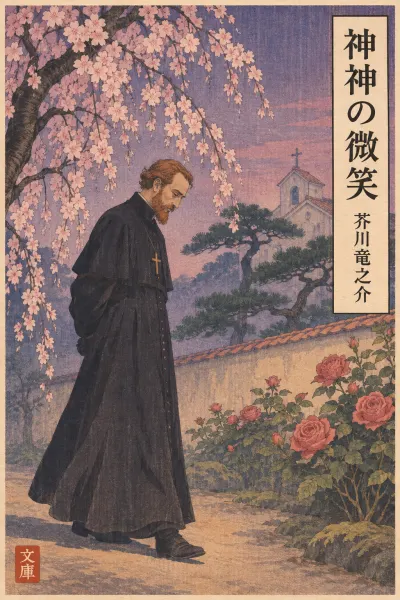
神神の微笑 Kamigami no Bishō, part 7: Farewell to Padre Organtino
In this part
The old man warns that even Deusu may one day be changed by Japan, then vanishes into the dusk as the Ave Maria bell rings. In the closing section, Organtino goes back into the old folding screen, a painting of a foreign ship arriving in port. The narrator bids him farewell, saying the contest between Deusu and Ōhirumemuchi is still undecided, and that one day the cannon of the narrator's own age will break the old-fashioned dreams of Organtino and his companions.
AI translation · independently checked
「事によると泥烏須自身も、この国の土人に変るでしょう。支那や印度も変ったのです。西洋も変らなければなりません。我々は木々の中にもいます。浅い水の流れにもいます。薔薇の花を渡る風にもいます。寺の壁に残る夕明りにもいます。どこにでも、またいつでもいます。御気をつけなさい。御気をつけなさい。………」"It may be that Deusu himself will become a native of this land. China and India were changed as well. The West, too, must change. We are in the trees. We are in the shallow running water. We are in the wind that passes over the roses. We are in the evening light that lingers on the temple walls. We are everywhere, and at all times. Have a care. Have a care. ………"
その声がとうとう絶えたと思うと、老人の姿も夕闇の中へ、影が消えるように消えてしまった。Just as the voice at last died away, the old man's figure also vanished into the dusk, the way a shadow fades.
と同時に寺の塔からは、眉をひそめたオルガンティノの上へ、アヴェ・マリアの鐘が響き始めた。At that same moment, from the church tower, the Ave Maria bell began to ring out over Organtino, who stood there frowning.
× × ×× × ×
南蛮寺のパアドレ・オルガンティノは、――いや、オルガンティノに限った事ではない。Padre Organtino of the Nanbanji — no, this is not true of Organtino alone.
悠々とアビトの裾を引いた、鼻の高い紅毛人は、黄昏の光の漂った、架空の月桂や薔薇の中から、一双の屏風へ帰って行った。The long-nosed, red-haired foreigner, unhurriedly trailing the hem of his habit, went back out of the imaginary laurels and roses steeped in the glow of twilight, and into a pair of folding screens.
南蛮船入津の図を描いた、三世紀以前の古屏風へ。Into an old screen, painted three centuries ago, depicting a Southern Barbarian ship entering port.
さようなら。Farewell.
パアドレ・オルガンティノ!Padre Organtino!
君は今君の仲間と、日本の海辺を歩きながら、金泥の霞に旗を挙げた、大きい南蛮船を眺めている。You are walking now with your companions along a Japanese shore, gazing at a great Southern Barbarian ship with its flags raised against a haze of gold paint.
泥烏須が勝つか、大日孁貴が勝つか――それはまだ現在でも、容易に断定は出来ないかも知れない。Will Deusu win, or will Ōhirumemuchi? Even now, perhaps, that cannot easily be decided.
が、やがては我々の事業が、断定を与うべき問題である。But it is a question on which, in time, our own labours must pass judgement.
君はその過去の海辺から、静かに我々を見てい給え。From that shore of the past, watch us quietly.
たとい君は同じ屏風の、犬を曳いた甲比丹や、日傘をさしかけた黒ん坊の子供と、忘却の眠に沈んでいても、新たに水平へ現れた、我々の黒船の石火矢の音は、必ず古めかしい君等の夢を破る時があるに違いない。Even if you lie sunk in the sleep of oblivion, together with the captain leading his dog and the Black child holding out a parasol on that same screen, there must surely come a time when the roar of the cannon of our black ships, newly risen over the horizon, breaks your old-fashioned dreams.
それまでは、――さようなら。Until then — farewell.
パアドレ・オルガンティノ!Padre Organtino!
さようなら。Farewell.
南蛮寺のウルガン伴天連!Urugan Bateren of the Nanbanji!
(大正十年十二月)(December, Taishō 10)
Vocabulary
| Word | Meaning | JLPT |
|---|---|---|
| 土人どじん | native, local inhabitantOld word. It is now considered offensive, so avoid using it. | — |
| 夕明りゆうあかり | the last light of evening, afterglow | — |
| 絶えたたえる | to die away, to ceasedictionary form: 絶えるUsed for sounds, breath or family lines that come to an end. | N1 |
| 夕闇ゆうやみ | dusk, evening darkness | — |
| 眉をひそめたまゆをひそめる | to frown, to knit one's browsdictionary form: 眉をひそめるShows displeasure or worry. | — |
| 紅毛人こうもうじん | red-haired foreigner (a European)Edo-period word, originally used mainly for the Dutch. | — |
| 黄昏たそがれ | twilight, duskSpecial reading. The individual kanji do not give たそがれ. | — |
| 屏風びょうぶ | folding screenScreens are counted in pairs with 双 (そう). | — |
| 入津にゅうしん | a ship's entry into portOld-fashioned. 津 means 'harbour'. | — |
| 金泥きんでい | gold paint (powdered gold mixed with glue)Typical of decorative screen painting. Also read こんでい. | — |
| 断定だんてい | a firm conclusion, a definite judgement | N2 |
| 忘却ぼうきゃく | oblivion, forgettingFormal, written word. | — |
| 黒船くろふね | black ship(s), Western steamship(s)Brings to mind Perry's fleet of 1853, which forced Japan to open up. | — |
| 石火矢いしびや | cannon (old word) | — |
Grammar
〜たと思うと N2 just as …; no sooner had … than
This pattern links two events that happen almost at once. The second event follows right after the first.
その声がとうとう絶えたと思うと、老人の姿も夕闇の中へ、影が消えるように消えてしまった。
Just as the voice at last died away, the old man's figure also vanished into the dusk, the way a shadow fades.
〜に限ったことではない N2 it is not only true of …
It says that something is not limited to the person or thing named. Here the narrator widens the statement from Organtino alone to the other red-haired foreigners in the scene, as the following sentence shows.
オルガンティノに限った事ではない。
This is not true of Organtino alone.
〜べき N2 should; must; is to
Attached to the dictionary form, べき expresses what ought to happen or is destined to happen. 与う is the classical form of 与える, so 与うべき means 'which must give'.
やがては我々の事業が、断定を与うべき問題である。
In time, it is a question on which our own labours must pass judgement.
〜て給え(たまえ) N1 do …, please … (lofty command)
This is the imperative of the old honorific verb 給う. It gives a mild, somewhat lofty instruction to an equal or a junior, and it goes naturally with the narrator calling Organtino 君.
君はその過去の海辺から、静かに我々を見てい給え。
From that shore of the past, watch us quietly.
たとい〜ても N1 even if …
たとい (たとえ) strengthens a concession that is completed by 〜ても. Whatever happens in the first clause, the outcome stays the same.
たとい君は同じ屏風の、犬を曳いた甲比丹や、日傘をさしかけた黒ん坊の子供と、忘却の眠に沈んでいても
Even if you lie sunk in the sleep of oblivion, together with the captain leading his dog and the Black child holding out a parasol on that same screen
〜に違いない N3 must surely …; there is no doubt that …
It expresses the speaker's strong conviction. Here it is combined with 必ず to make a confident prophecy.
必ず古めかしい君等の夢を破る時があるに違いない。
There must surely come a time when it breaks your old-fashioned dreams.