Upper intermediate · JLPT N2
夏の花Natsu no Hana — Flowers of High Summer
- JLPT N2
- 12,722 characters
- 9 parts
- about 106 minutes
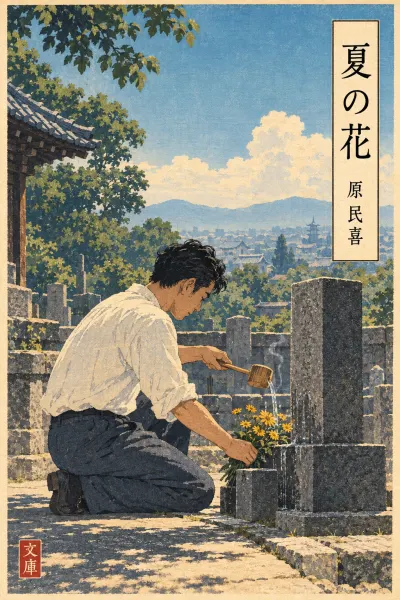
夏の花 is a first-person account of the atomic bombing of Hiroshima on 6 August 1945, written by a survivor who was inside his family home when the bomb fell. It opens quietly, with the narrator buying flowers for his late wife's grave. It then follows him through the collapse of the house, his escape to the riverside garden of Sentei, and the nights and days that follow among the injured and dying. The tone is restrained and almost documentary. Hara records what he saw, heard and did in plain, exact sentences, rarely commenting, and the horror comes from the accumulation of detail rather than from emotional language. For a learner, this restraint is both the reward and the challenge. The grammar is mostly straightforward plain-form narration. The vocabulary, however, is dense and written: injuries, ruins, fire, water, and many Hiroshima place names. A few older kanji and spellings also appear. One passage breaks into a fragmented poem written in katakana. The dialogue is short and casual, with a light western-Japanese flavour. It is a slow, demanding read, best taken one part at a time.
Contents
Before you read
- Get used to the narrative ending 〜のであった. It marks explanation or reflection rather than simple past events, and it gives the text its sober, retrospective voice. Note also 〜らしい, used for what the narrator infers but cannot confirm in the confusion.
- Learn the core vocabulary of the disaster before you start: 火傷 (やけど, burn), 負傷者 (injured person), 川原 / 河原 (riverbank), 土手 (embankment), 筏 (raft), 救護所 (first-aid station), 崩れる / 潰れる (collapse). These words recur in almost every part.
- Keep the list of names at hand. Most proper nouns are real Hiroshima bridges, parks, shrines and districts, such as 栄橋, 泉邸, 東照宮 and 己斐. Readings like 饒津 (にぎつ) and 己斐 (こい) are hard to guess. Treat them as place markers rather than vocabulary to memorise.
- Read the katakana poem in Part 8 aloud and slowly. It is written in old-style katakana with particles such as ヤ and ノ. Mentally converting it to hiragana first makes the words easier to recognise. Its broken lines are deliberate, so don't try to force them into full sentences.
- The dialogue is brief and colloquial, with western-Japanese touches such as 〜じゃ for だ (膝じゃ) and spoken contractions like 〜なきゃ. Use the speaker and situation to fill in what is left unsaid, because the narration rarely explains it.
Words to know
The most useful words from the notes across the story.
| Word | Meaning | JLPT |
|---|---|---|
| 炎天えんてん | blazing (summer) sun, scorching heatLiterally 'flame sky'; a written word. | — |
| 蹲ってうずくまる | to crouch, huddle downdictionary form: 蹲るUsually written in kana today. | — |
| 化膿かのう | festering, suppuration (of a wound) | — |
| 嫂あによめ | elder brother's wife, sister-in-law | — |
| 焼跡やけあと | burned-out ruins, site of a firedictionary form: 焼け跡A key word of postwar Japanese writing. | — |
| 境内けいだい | grounds of a shrine or temple | — |
| 気配けはい | sign, indicationSomething sensed rather than clearly seen. | N2 |
| 漸くようやく | at last, finally (after a long wait)Usually written in kana today. | N2 |
| 屍体したい | corpseOlder, starker spelling of 死体; the text uses both. | N2 |
| 重態じゅうたい | critical conditionThis is now usually written 重体. | N2 |
| 縁側えんがわ | veranda; wooden corridor along the garden side of a house | N1 |
| 急かしせかす | to hurry someone, press someone to be quickdictionary form: 急かすSame kanji as 急ぐ, but a different reading. | N1 |
| 郷里きょうり | one's home town, native placeMore formal and literary than 故郷・ふるさと. | N1 |
| 出喰わしたでくわす | to come across, run into by chancedictionary form: 出喰わすNow usually written 出くわす. | N1 |
| 呟いたつぶやく | to murmur, mutterdictionary form: 呟く | N1 |
Plot summary
Show the full summary (contains spoilers)
Two days before the bombing, the narrator visits his wife's grave with summer flowers. On the morning of 6 August he is in the toilet when the house collapses around him. He finds his sister, gathers clothes, and flees with K, an older man from the family office. They cross the wreckage to Sentei and the riverbank, where he rejoins his brothers and resolves to record what he sees. Fire, black rain and a whirlwind follow. Crowds of burned people beg for water. After a night on the embankment and a day at the Tōshōgū first-aid site, the eldest brother brings a horse cart. On the way out of the city, the second brother finds his son Fumihiko's body and takes his nails and belt as keepsakes. In Yahata village the family weaken from hunger, and the burned maid dies. A missing nephew reappears with radiation symptoms but clings to life. N searches the ruins for his wife in vain.
About the author
Hara Tamiki (1905–1951) was a poet and fiction writer born in Hiroshima. He studied English literature at Keiō University in Tokyo and began publishing poetry and short prose before the war. His wife died before the end of the war, and he returned to his family home in Hiroshima, where he survived the atomic bombing. 夏の花, based closely on that experience, became his best-known work and is regarded as a central text of Japanese atomic-bomb literature. He continued to write about the bombing and its aftermath in prose and poetry. In 1951 he took his own life in Tokyo.