Part 1 of 9 · JLPT N2
夏の花 Natsu no Hana, part 1: Flowers for a Grave, Then the Blast
In this part
Two days before the atomic bombing, the narrator buys summer flowers and visits his wife's grave in Hiroshima, where his parents' remains also lie. On the morning of 6 August he is in the toilet when a sudden blow plunges everything into darkness, and the house collapses around him. He stumbles out into the ruins, where his frantic sister finds him, tells him to wash the blood from his eyes, and finds him some clothes, while a bloodied man from the factory rushes past to make a phone call.
AI translation · independently checked
わが愛する者よ請う急ぎはしれO my beloved, hasten, I pray you, and run,
香わしき山々の上にありて獐のbe upon the fragrant mountains, like a roe deer,
ごとく小鹿のごとくあれlike a young fawn.
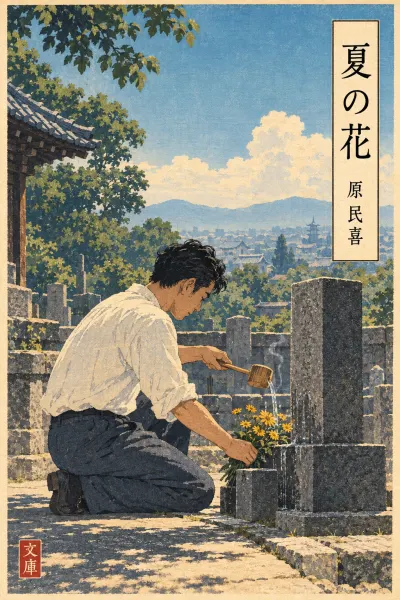
私は街に出て花を買うと、妻の墓を訪れようと思った。I went out into town and bought flowers, and then I thought I would visit my wife's grave.
ポケットには仏壇からとり出した線香が一束あった。In my pocket was a bundle of incense sticks I had taken from the family altar.
八月十五日は妻にとって初盆にあたるのだが、それまでこのふるさとの街が無事かどうかは疑わしかった。The fifteenth of August would be my wife's first Bon since her death, but it was doubtful whether this home town of mine would survive until then.
恰度、休電日ではあったが、朝から花をもって街を歩いている男は、私のほかに見あたらなかった。It happened to be a day when the electricity was off, yet apart from me I saw no other man walking the streets with flowers that morning.
その花は何という名称なのか知らないが、黄色の小瓣の可憐な野趣を帯び、いかにも夏の花らしかった。I did not know what the flowers were called, but they had a sweet, wild charm about their small yellow petals and seemed every inch a flower of summer.
炎天に曝されている墓石に水を打ち、その花を二つに分けて左右の花たてに差すと、墓のおもてが何となく清々しくなったようで、私はしばらく花と石に視入った。I sprinkled water over the gravestone, which stood exposed to the blazing sun, divided the flowers into two and put them in the vases on either side; the face of the grave seemed somehow refreshed, and for a while I gazed at the flowers and the stone.
この墓の下には妻ばかりか、父母の骨も納っているのだった。Beneath this grave lay not only my wife but also the bones of my father and mother.
持って来た線香にマッチをつけ、黙礼を済ますと私はかたわらの井戸で水を呑んだ。I lit the incense I had brought with a match, and when I had finished my silent bow, I drank water from the well beside the grave.
それから、饒津公園の方を廻って家に戻ったのであるが、その日も、その翌日も、私のポケットは線香の匂いがしみこんでいた。Then I went home by way of Nigitsu Park, and that day and the next my pocket was steeped in the smell of incense.
原子爆弾に襲われたのは、その翌々日のことであった。It was the day after that when the atomic bomb struck.
私は厠にいたため一命を拾った。I escaped with my life because I was in the toilet.
八月六日の朝、私は八時頃床を離れた。On the morning of the sixth of August, I got out of bed at around eight o'clock.
前の晩二回も空襲警報が出、何事もなかったので、夜明前には服を全部脱いで、久し振りに寝間着に着替えて睡った。The night before, the air-raid alarm had sounded twice and nothing had happened, so shortly before dawn I had taken off all my clothes, changed into nightclothes for the first time in a long while, and gone to sleep.
それで、起き出した時もパンツ一つであった。So when I got up I was wearing nothing but my underpants.
妹はこの姿をみると、朝寝したことをぶつぶつ難じていたが、私は黙って便所へ這入った。Seeing me like this, my sister grumbled reproachfully about my sleeping late, but I said nothing and went into the toilet.
それから何秒後のことかはっきりしないが、突然、私の頭上に一撃が加えられ、眼の前に暗闇がすべり墜ちた。I cannot say exactly how many seconds later it was, but suddenly a blow fell upon my head and darkness slid down before my eyes.
私は思わずうわあと喚き、頭に手をやって立上った。Without meaning to, I cried out "Waaah!" and stood up with my hands on my head.
嵐のようなものの墜落する音のほかは真暗でなにもわからない。Apart from a sound like a storm of something crashing down, it was pitch dark and I could make out nothing.
手探りで扉を開けると、縁側があった。I groped for the door and opened it, and there was the veranda.
その時まで、私はうわあという自分の声を、ざあーというもの音の中にはっきり耳にきき、眼が見えないので悶えていた。Until then I had heard my own voice crying "Waaah!" distinctly through the roaring noise, and since I could not see, I had been writhing in distress.
しかし、縁側に出ると、間もなく薄らあかりの中に破壊された家屋が浮び出し、気持もはっきりして来た。But once I stepped out onto the veranda, the wrecked house soon emerged in the faint light, and my mind grew clearer.
それはひどく厭な夢のなかの出来事に似ていた。It was like something happening in a thoroughly unpleasant dream.
最初、私の頭に一撃が加えられ眼が見えなくなった時、私は自分が斃れてはいないことを知った。At first, when the blow fell on my head and I could no longer see, I knew that I had not been struck down.
それから、ひどく面倒なことになったと思い腹立たしかった。Then I felt angry, thinking that things had become terribly troublesome.
そして、うわあと叫んでいる自分の声が何だか別人の声のように耳にきこえた。And my own voice shouting "Waaah!" sounded in my ears somehow like the voice of someone else.
しかし、あたりの様子が朧ながら目に見えだして来ると、今度は惨劇の舞台の中に立っているような気持であった。But as the surroundings began to come dimly into view, I felt this time as if I were standing on the stage of a tragedy.
たしか、こういう光景は映画などで見たことがある。Surely I had seen scenes like this in films or somewhere.
濛々と煙る砂塵のむこうに青い空間が見え、つづいてその空間の数が増えた。Beyond the thick, billowing dust a patch of blue sky appeared, and then the patches of sky grew more numerous.
壁の脱落した処や、思いがけない方向から明りが射して来る。Light came streaming in where walls had fallen away, and from unexpected directions.
畳の飛散った坐板の上をそろそろ歩いて行くと、向うから凄さまじい勢で妹が駈けつけて来た。As I walked cautiously over the floorboards, from which the tatami mats had been scattered, my sister came rushing towards me at a tremendous pace.
「やられなかった、やられなかったの、大丈夫」と妹は叫び、「眼から血が出ている、早く洗いなさい」と台所の流しに水道が出ていることを教えてくれた。"I wasn't hit, I wasn't hit, I'm all right," my sister cried. "Your eyes are bleeding—wash them, quickly," and she told me that the tap at the kitchen sink was still running.
私は自分が全裸体でいることを気付いたので、「とにかく着るものはないか」と妹を顧ると、妹は壊れ残った押入からうまくパンツを取出してくれた。Realising that I was stark naked, I turned to my sister and said, "Isn't there something to put on, anyway?", and she managed to pull out a pair of underpants from the closet, which had partly survived.
そこへ誰か奇妙な身振りで闖入して来たものがあった。Just then someone came bursting in, moving in a strange way.
顔を血だらけにし、シャツ一枚の男は工場の人であったが、私の姿を見ると、「あなたは無事でよかったですな」と云い捨て、「電話、電話、電話をかけなきゃ」と呟きながら忙しそうに何処かへ立去った。The man, his face covered in blood and wearing only a shirt, was from the factory; seeing me, he threw out, "Glad to see you're safe," and, muttering "The phone, the phone, I've got to make a call," hurried off somewhere.
Vocabulary
| Word | Meaning | JLPT |
|---|---|---|
| 線香せんこう | incense stickBurned at Buddhist altars and graves; its smell recurs as a quiet link to the dead. | — |
| 初盆にいぼん | the first Bon after a person's deathBon is the midsummer Buddhist festival when the spirits of the dead are believed to return home. Also read はつぼん. | — |
| 疑わしかったうたがわしい | doubtful, uncertaindictionary form: 疑わしい | — |
| 炎天えんてん | blazing (summer) sun, scorching heatLiterally 'flame sky'; a written word. | — |
| 水を打ちみずをうつ | to sprinkle water (on the ground, a stone)dictionary form: 水を打つCustomary when cleaning a grave or cooling a path in summer. | — |
| 黙礼もくれい | a silent bow | — |
| 厠かわや | toilet, privyOld-fashioned word; later in the passage the ordinary 便所 is used. | — |
| 一命を拾ったいちめいをひろう | to narrowly escape deathdictionary form: 一命を拾うLiterally 'to pick up one's one life'. | — |
| 空襲警報くうしゅうけいほう | air-raid alarm | — |
| 難じてなんじる | to reproach, to find fault withdictionary form: 難じるFormal, written verb; ぶつぶつ adds 'grumbling'. | — |
| 惨劇さんげき | tragedy, horrific scene | — |
| 砂塵さじん | dust (clouds of sand and dirt) | — |
| 凄さまじいすさまじい | tremendous, terrific (in force)dictionary form: 凄まじいModern spelling is 凄まじい. | — |
| 闖入ちんにゅう | bursting in, intrusionRare, literary word for entering abruptly and uninvited. | — |
Grammar
〜(よ)うと思う N4 intend to, think of doing
Volitional form + と思う expresses an intention or plan ('I think I'll …'). Here 訪れようと思った means 'I thought I would visit (my wife's grave)'. The earlier 花を買うと is a separate use of と: plain form + と marks the action that happens first ('having bought / once I bought flowers'). It is not part of what was 'thought'.
私は街に出て花を買うと、妻の墓を訪れようと思った。
I went out into town and bought flowers, and then I thought I would visit my wife's grave.
〜かどうか N4 whether or not
Turns a yes/no question into a noun clause. Here 無事かどうか ('whether it would be safe') is the subject of 疑わしかった.
それまでこのふるさとの街が無事かどうかは疑わしかった。
It was doubtful whether this home town of mine would survive until then.
〜ばかりか N2 not only … but also
Attached to a noun, ばかりか introduces a first item and prepares for an addition, usually marked with も. Here it adds the parents' bones to the wife's.
この墓の下には妻ばかりか、父母の骨も納っているのだった。
Beneath this grave lay not only my wife but also the bones of my father and mother.
〜ため(に) N3 because of, owing to
After a plain-form verb in the past, ため gives a cause rather than a purpose. Being in the toilet is the reason he survived.
私は厠にいたため一命を拾った。
I escaped with my life because I was in the toilet.
〜ながら (concessive) N2 though, albeit
Attached to an adjective stem or noun, ながら means 'although' rather than 'while doing'. 朧ながら means 'though only dimly'.
あたりの様子が朧ながら目に見えだして来ると
As the surroundings began to come dimly into view
〜なきゃ N4 have to, must (casual)
A spoken contraction of なければ(ならない). The final 'must' part is dropped, as is typical in muttered speech.
「電話、電話、電話をかけなきゃ」と呟きながら
Muttering "The phone, the phone, I've got to make a call"