Upper intermediate · JLPT N2
猫町Nekomachi — The Cats' Town
- JLPT N2
- 10,337 characters
- 8 parts
- about 86 minutes
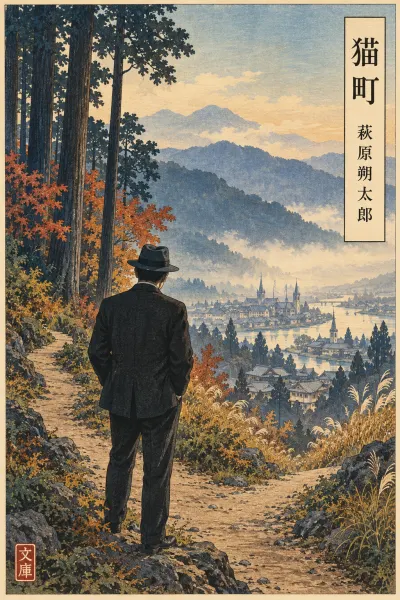
"The Cats' Town" is a short prose work by the poet Hagiwara Sakutarō, part essay and part strange tale. The first-person narrator, tired of ordinary travel, looks for ways to escape the dull everyday world. His real interest is how a familiar place can suddenly look completely unfamiliar. He begins with small experiences of getting lost near his home in Tōkyō. Then he tells of one autumn day in the mountains of Hokuetsu when he lost his way and walked into a town he did not recognise. The tone is calm and reflective, but it becomes uneasy as the story goes on. The narrator often stops to think about perception, dreams and the limits of reason. For a learner, the plot is easy to follow, and much of the pleasure comes from the slow build of atmosphere. The language is the main challenge. The plain だ/である style is full of Sino-Japanese compounds, katakana loanwords such as メタフィジック and older spellings. Some sentences are long and philosophical. The text is short and divided into eight parts, so you can read it in manageable sections.
Contents
- Journeys Without Leaving Home (1)
- A Familiar Town Seen in Reverse (1(つづき))
- A Story That May Be Real (1(つづき))
- Possessed Villages in the Northern Mountains (2)
- Lost on the Mountain, Found a Town (2(つづき))
- A Town Held Together by Glass (2(つづき))
- A Street Full of Cats (2(つづき))
- Butterfly, Dream, and the Cats' Town (3)
Before you read
- Learn the words for direction and confusion before you start, because the whole story depends on them: 方角 (direction), 迷う (to get lost), 錯覚 (illusion), 散歩 (walk), 狐に化かされる (to be bewitched by a fox) and 憑き (possession by a spirit, as in 猫憑き and 犬神憑き).
- The narrator often states his conclusions with expressions of certainty and limitation. Watch for 〜にちがいない (must be), 〜にすぎない (is nothing more than), 〜であろう (probably) and 〜得る (can). They show how far he believes his own experience.
- Katakana loanwords use older spellings, such as ショウペンハウエル for Schopenhauer and シベリヤ for Siberia. Abstract words like メタフィジック (metaphysics) and アトモスフィア (atmosphere) also appear. If a katakana word looks strange, read it aloud and try to match it to the English or German original.
- The narrator sometimes speaks directly to the reader with 諸君 (you, my readers) and the old command form 見給え (look!). These lines are not part of the events. They are the essay voice stepping forward, so treat them as signposts for his argument.
- Parts 1–3 are mostly reflection, and Parts 4–7 contain the actual story. If the early philosophy feels heavy, read Parts 4–7 first for the plot, then go back to the framing sections. They are easier to follow once you know what the narrator is explaining.
Words to know
The most useful words from the notes across the story.
| Word | Meaning | JLPT |
|---|---|---|
| 謎なぞ | riddle, mystery | N3 |
| 化かされたばかす | to bewitch, trick (of foxes, badgers)dictionary form: 化かすIn Japanese folklore, foxes and tanuki trick people into getting lost. | — |
| 錯覚さっかく | to misperceive; an illusionThis is a key word of the story. | N1 |
| 往来おうらい | street, roadOlder word for a street with passing traffic; also means 'coming and going'. | — |
| 耽るふける | to be absorbed in, indulge inUsually takes に: 瞑想に耽る 'be lost in meditation'. | — |
| 口碑こうひ | oral tradition, folk taleLiterally 'a monument of the mouth', meaning a story passed on by word of mouth. | — |
| 焦燥しょうそう | fretting, impatient anxietyLiterary; here used as a verb with する. | — |
| 雑鬧ざっとう | bustle, crowdingOld spelling; now written 雑踏. | — |
| 詰らないつまらない | dull, boringdictionary form: つまらないToday this is normally written in kana. | N5 |
| 迷児まいご | lost person; getting lostdictionary form: 迷子Older spelling of 迷子. 迷子になる = to get lost. | N3 |
| 醒めてさめる | to wake up (from a dream)dictionary form: 醒めるUsually written 覚める today; 醒 also suggests sobering up. | N3 |
| 欠伸あくび | a yawn欠伸をする means 'to yawn'. Here the goods themselves are pictured as yawning. | N2 |
| 引返してひきかえす | to turn back, to retrace one's stepsdictionary form: 引き返すOlder spelling without the okurigana き. | N2 |
| 麓ふもと | foot (base) of a mountain | N2 |
| 骨牌かるた | playing cardsAn old ateji spelling. Today it is written カルタ, from Portuguese 'carta'. | N2 |
Plot summary
Show the full summary (contains spoilers)
The narrator has used morphine and cocaine to take 'journeys' into dream worlds, but his health breaks down and he starts taking daily walks instead. His poor sense of direction sometimes makes his own dull suburb look like a beautiful unknown town. He offers one experience as the key to this riddle. In late September, staying at a hot spring in Hokuetsu, he walks over a mountain pass while thinking about local legends of villages possessed by cat-spirits. He gets lost and comes down into an elegant, crowded, strangely silent town. He feels that its fragile harmony is about to break. A black creature runs across the street, and suddenly cats fill every window and lane. When he looks again, he is standing in the ordinary town of U, turned inside out by his lost sense of direction. Others laugh at his story, but he still believes the cats' town exists somewhere in the universe.
About the author
Hagiwara Sakutarō was a Japanese poet from Maebashi in Gunma Prefecture. He is widely regarded as one of the founders of modern free verse in colloquial Japanese. His collections 月に吠える (Howling at the Moon) and 青猫 (Blue Cat) are known for their musical language and their moods of loneliness, unease and dreamlike perception. He was associated with the poet Murō Saisei and admired Kitahara Hakushū. He also wrote essays, aphorisms and criticism on poetry. "The Cats' Town" is one of his best-known prose works, and it shows the same interest in strange inner experience found in his poems.