Part 5 of 8 · JLPT N2
猫町(2(つづき)) Nekomachi, part 5: Lost on the Mountain, Found a Town
In this part
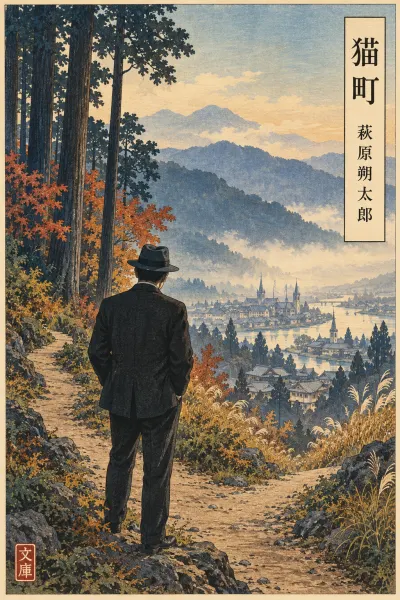
Absorbed in his thoughts, the narrator loses the railway line he was following and becomes hopelessly lost in the autumn mountains. After hours of anxious wandering, he follows a trail of footprints down to the foot of the mountain. There, instead of a poor village, he finds a beautiful, bustling old town of narrow winding lanes, flowering trees and wells, with shops such as a barbershop and a photographer's studio.
AI translation · independently checked
こうした思惟に耽りながら、私はひとり秋の山道を歩いていた。Lost in such reflections, I was walking alone along an autumn mountain path.
その細い山道は、径路に沿うて林の奥へ消えて行った。The narrow mountain path followed its course and vanished into the depths of the woods.
目的地への道標として、私が唯一のたよりにしていた汽車の軌道は、もはや何所にも見えなくなった。The railway track, which had been my one and only guide and signpost to my destination, was now nowhere to be seen.
私は道をなくしたのだ。I had lost my way.
「迷い子!」"A lost child!"
瞑想から醒めた時に、私の心に浮んだのは、この心細い言葉であった。When I woke from my meditation, it was this forlorn word that rose in my mind.
私は急に不安になり、道を探そうとしてあわて出した。Suddenly I grew uneasy and began to rush about in search of the road.
私は後へ引返して、逆に最初の道へ戻ろうとした。I turned back, trying to retrace my steps to the path I had started on.
そして一層地理を失い、多岐に別れた迷路の中へ、ぬきさしならず入ってしまった。And so I lost my bearings all the more, and found myself hopelessly caught in a maze that branched off in every direction.
山は次第に深くなり、小径は荊棘の中に消えてしまった。The mountains grew steadily deeper, and the little path disappeared among the brambles.
空しい時間が経過して行き、一人の樵夫にも逢わなかった。Empty time slipped by, and I did not meet so much as a single woodcutter.
私はだんだん不安になり、犬のように焦燥しながら、道を嗅ぎ出そうとして歩き廻った。Growing more and more anxious, fretting like a dog, I wandered about trying to sniff out the way.
そして最後に、漸く人馬の足跡のはっきりついた、一つの細い山道を発見した。Then at last I discovered a narrow mountain path clearly marked with the footprints of people and horses.
私はその足跡に注意しながら、次第に麓の方へ下って行った。Keeping a careful eye on those footprints, I gradually made my way down toward the foot of the mountain.
どっちの麓へ降りようとも、人家のある所へ着きさえすれば、とにかく安心ができるのである。Whichever side of the mountain I came down, if only I reached a place where people lived, I could at any rate feel safe.
幾時間かの後、私は麓へ到着した。Some hours later, I arrived at the foot of the mountain.
そして全く、思いがけない意外の人間世界を発見した。And there, quite unexpectedly, I discovered a human world I had never imagined.
そこには貧しい農家の代りに、繁華な美しい町があった。Instead of poor farmhouses, there stood a bustling and beautiful town.
かつて私の或る知人が、シベリヤ鉄道の旅行について話したことは、あの満目荒寥たる無人の曠野を、汽車で幾日も幾日も走った後、漸く停車した沿線の一小駅が、世にも賑わしく繁華な都会に見えるということだった。An acquaintance of mine once told me about a journey on the Siberian Railway: after travelling by train for day upon day across that uninhabited wilderness, desolate as far as the eye can see, the little wayside station where the train finally stopped looked like the liveliest, most bustling city in the world.
私の場合の印象もまた、おそらくはそれに類した驚きだった。The impression in my own case, too, was probably an astonishment of much the same kind.
麓の低い平地へかけて、無数の建築の家屋が並び、塔や高楼が日に輝やいていた。Countless buildings stood in rows stretching down to the low plain at the mountain's foot, and towers and tall pavilions gleamed in the sun.
こんな辺鄙な山の中に、こんな立派な大都会が存在しようとは、容易に信じられないほどであった。It was almost impossible to believe that so splendid a great city could exist in the middle of such remote mountains.
私は幻燈を見るような思いをしながら、次第に町の方へ近付いて行った。Feeling as if I were watching a magic-lantern show, I drew gradually nearer to the town.
そしてとうとう、自分でその幻燈の中へ這入って行った。And at last I walked right into that magic-lantern picture myself.
私は町の或る狭い横丁から、胎内めぐりのような路を通って、繁華な大通の中央へ出た。From a narrow alley in the town, I passed along a way like the passage of a temple womb-walk and came out in the middle of a bustling main street.
そこで目に映じた市街の印象は、非常に特殊な珍しいものであった。The impression the town made as it met my eyes there was something extremely peculiar and unusual.
すべての軒並の商店や建築物は、美術的に変った風情で意匠され、かつ町全体としての集合美を構成していた。All the shops and buildings lining the streets were designed with an artistic and unusual charm, and together they composed a collective beauty of the town as a whole.
しかもそれは意識的にしたのでなく、偶然の結果からして、年代の錆がついて出来てるのだった。What is more, this had not been done deliberately; it had come about by chance, with the patina of the years laid upon it.
それは古雅で奥床しく、町の古い過去の歴史と、住民の長い記憶を物語っていた。It was elegant in an old-fashioned way and full of quiet refinement, telling of the town's ancient past and the long memories of its inhabitants.
町幅は概して狭く、大通でさえも、漸く二、三間位であった。The streets were generally narrow; even the main street was barely twelve to eighteen feet across.
その他の小路は、軒と軒との間にはさまれていて、狭く入混んだ路地になってた。The other lanes were squeezed in between the eaves of the houses, forming narrow, tangled alleys.
それは迷路のように曲折しながら、石畳のある坂を下に降りたり、二階の張り出した出窓の影で、暗く隧道になった路をくぐったりした。They twisted and turned like a maze, now going down stone-paved slopes, now passing through lanes made into dark tunnels by the shadow of the overhanging second-floor bay windows.
南国の町のように、所々に茂った花樹が生え、その附近には井戸があった。As in a town of the warm south, flowering trees grew thickly here and there, and near them were wells.
至るところに日影が深く、町全体が青樹の蔭のようにしっとりしていた。Everywhere the shade lay deep, and the whole town was hushed and cool, as if beneath the shadow of green trees.
娼家らしい家が並んで、中庭のある奥の方から、閑雅な音楽の音が聴えて来た。There was a row of houses that seemed to be brothels, and from deep inside, where the courtyards were, came the sound of quiet, graceful music.
大通の街路の方には、硝子窓のある洋風の家が多かった。Along the main street there were many Western-style houses with glass windows.
理髪店の軒先には、紅白の丸い棒が突き出してあり、ペンキの看板に Barbershop と書いてあった。From the front of a barber's shop a round red-and-white pole jutted out, and a painted sign read "Barbershop".
旅館もあるし、洗濯屋もあった。There was an inn, and there was a laundry too.
町の四辻に写真屋があり、その気象台のような硝子の家屋に、秋の日の青空が侘しげに映っていた。At a crossroads stood a photographer's studio, and on its glass building, which looked like a weather station, the blue autumn sky was forlornly reflected.
時計屋の店先には、眼鏡をかけた主人が坐って、黙って熱心に仕事をしていた。In the front of a watchmaker's shop sat the owner, wearing spectacles, working silently and intently.
Vocabulary
| Word | Meaning | JLPT |
|---|---|---|
| 耽りふける | to be absorbed in, to indulge indictionary form: 耽るUsed with に: 思惟に耽る, 読書に耽る. | — |
| 心細いこころぼそい | forlorn, helpless, lonely and uneasyLiterally a 'thin heart': the feeling of having nothing to rely on. | N1 |
| 引返してひきかえす | to turn back, to retrace one's stepsdictionary form: 引き返すOlder spelling without the okurigana き. | N2 |
| ぬきさしならずぬきさしならない | hopelessly stuck, unable to get in or outdictionary form: 抜き差しならないFrom 抜く (pull out) and 差す (put in); ず is the literary negative. | — |
| 焦燥しょうそう | fretting, impatient anxietyLiterary; here used as a verb with する. | — |
| 麓ふもと | foot (base) of a mountain | N2 |
| 繁華はんか | bustling, prosperous, livelyCompare 繁華街 (busy shopping district). | — |
| 曠野こうや | wilderness, vast open plainNow usually written 荒野. | — |
| 辺鄙へんぴ | remote, out-of-the-way | — |
| 幻燈げんとう | magic lantern (early slide projector)Modern spelling 幻灯; often a symbol of dreamlike, unreal scenes. | — |
| 胎内めぐりたいないめぐり | womb-walk: walking through a pitch-dark passage inside a temple, statue or cavedictionary form: 胎内巡りA religious practice symbolising rebirth; suggests a dark, winding, enclosed path. | — |
| 風情ふぜい | charm, atmosphere, tasteful appearance | — |
| 奥床しくおくゆかしい | quietly refined, graceful and modestdictionary form: 奥床しいUsually written 奥ゆかしい today. | — |
| 侘しげわびしい | lonely, dreary, forlorndictionary form: 侘しい〜げ turns the adjective into 'seeming ~': 侘しげに = forlornly. | — |
Grammar
〜ながら N4 while doing ~
Attached to the verb stem, it shows two actions by the same person happening at once. Here the narrator walks while sunk in thought.
こうした思惟に耽りながら、私はひとり秋の山道を歩いていた。
Lost in such reflections, I was walking alone along an autumn mountain path.
〜さえ〜ば N3 if only ~, as long as ~
The verb stem + さえすれば states the one condition that is enough. Reaching any inhabited place is all the narrator needs to feel safe.
人家のある所へ着きさえすれば、とにかく安心ができるのである。
If only I reached a place where people lived, I could at any rate feel safe.
〜ようとも N1 no matter ~, whichever ~
The volitional form + とも means 'even if' or 'regardless of'. Combined with どっち it means 'whichever side'.
どっちの麓へ降りようとも
Whichever side of the mountain I came down
〜たる N1 literary adjectival ending: 'which is ~'
A classical form of である that turns certain Sino-Japanese words into modifiers before a noun. 荒寥たる means 'desolate'.
あの満目荒寥たる無人の曠野
that uninhabited wilderness, desolate as far as the eye can see
〜ようとは N1 that ~ should happen (expressing surprise)
The volitional form + とは presents a surprising possibility, usually followed by words like 思わない or 信じられない. Here the narrator can hardly believe such a city exists.
こんな立派な大都会が存在しようとは、容易に信じられないほどであった。
It was almost impossible to believe that so splendid a great city could exist.