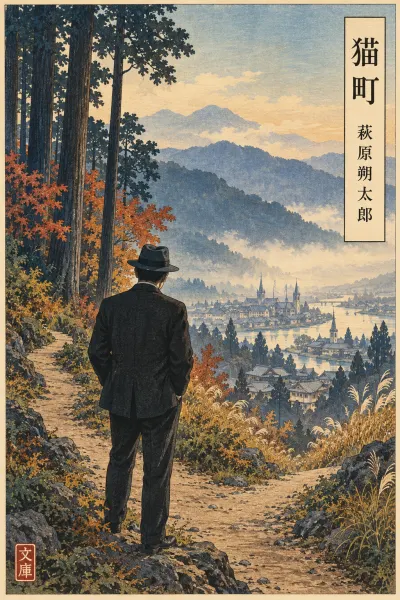
Part 2 of 8 · JLPT N2
猫町(1(つづき)) Nekomachi, part 2: A Familiar Town Seen in Reverse
In this part
Lost on a walk, the narrator suddenly finds himself in a beautiful, unknown town. Then his memory returns, and he sees it is only the dull suburb near his home, made strange because his sense of direction had flipped. He compares this to waking on a night train that seems to run backwards, and to his childhood wish to know what lay behind a framed painting.
AI translation · independently checked
余事はとにかく、私は道に迷って困惑しながら、当推量で見当をつけ、家の方へ帰ろうとして道を急いだ。Be that as it may, I had lost my way, and in my confusion I took a guess at the direction and hurried on, trying to get back home.
そして樹木の多い郊外の屋敷町を、幾度かぐるぐる廻ったあとで、ふと或る賑やかな往来へ出た。After going round and round several times through a leafy suburban district of large houses, I suddenly came out onto a certain lively street.
それは全く、私の知らない何所かの美しい町であった。It was a beautiful town, somewhere entirely unknown to me.
街路は清潔に掃除されて、鋪石がしっとりと露に濡れていた。The streets had been swept clean, and the paving stones were softly wet with dew.
どの商店も小綺麗にさっぱりして、磨いた硝子の飾窓には、様々の珍しい商品が並んでいた。Every shop was neat and fresh, and behind the polished glass of the display windows all kinds of unusual goods were laid out.
珈琲店の軒には花樹が茂り、町に日蔭のある情趣を添えていた。Flowering trees grew thick under the eaves of a coffee house, lending the town a shaded charm.
四つ辻の赤いポストも美しく、煙草屋の店にいる娘さえも、杏のように明るくて可憐であった。The red postbox at the crossroads was beautiful too, and even the girl in the tobacconist's shop was as bright and sweet as an apricot.
かつて私は、こんな情趣の深い町を見たことがなかった。Never before had I seen a town so full of charm.
一体こんな町が、東京の何所にあったのだろう。Where in Tōkyō could such a town possibly have been?
私は地理を忘れてしまった。I had lost all sense of where I was.
しかし時間の計算から、それが私の家の近所であること、徒歩で半時間位しか離れていないいつもの私の散歩区域、もしくはそのすぐ近い範囲にあることだけは、確実に疑いなく解っていた。Yet from the time I had spent walking, I knew with certainty, beyond any doubt, that it lay near my home, within my usual walking area no more than half an hour away on foot, or at least very close to it.
しかもそんな近いところに、今まで少しも人に知れずに、どうしてこんな町があったのだろう?And yet how could such a town have existed so close by, all this time, without anyone knowing of it?
私は夢を見ているような気がした。I felt as if I were dreaming.
それが現実の町ではなくって、幻燈の幕に映った、影絵の町のように思われた。It seemed not a real town at all, but a town of shadow pictures cast on the screen of a magic lantern.
だがその瞬間に、私の記憶と常識が回復した。But in that instant, my memory and my common sense returned.
気が付いて見れば、それは私のよく知っている、近所の詰らない、ありふれた郊外の町なのである。When I came to my senses, it was the dull, ordinary suburban town in my neighbourhood that I knew so well.
いつものように、四ツ辻にポストが立って、煙草屋には胃病の娘が坐っている。As always, the postbox stood at the crossroads, and in the tobacconist's sat the girl with the bad stomach.
そして店々の飾窓には、いつもの流行おくれの商品が、埃っぽく欠伸をして並んでいるし、珈琲店の軒には、田舎らしく造花のアーチが飾られている。In the shop windows the usual out-of-date goods sat in rows, dusty and yawning, and under the eaves of the coffee house hung an arch of artificial flowers, in true country style.
何もかも、すべて私が知っている通りの、いつもの退屈な町にすぎない。Everything, all of it, was just as I knew it: nothing more than the usual boring town.
一瞬間の中に、すっかり印象が変ってしまった。In a single instant my impression had changed completely.
そしてこの魔法のような不思議の変化は、単に私が道に迷って、方位を錯覚したことにだけ原因している。And this strange, magical change came about simply because I had lost my way and mistaken the directions.
いつも町の南はずれにあるポストが、反対の入口である北に見えた。The postbox that always stands at the southern edge of the town had appeared to be in the north, at the opposite entrance.
いつもは左側にある街路の町家が、逆に右側の方へ移ってしまった。The houses that are always on the left side of the street had moved over to the right.
そしてただこの変化が、すべての町を珍しく新しい物に見せたのだった。And this change alone had made the whole town look new and unfamiliar.
その時私は、未知の錯覚した町の中で、或る商店の看板を眺めていた。At that moment I had been gazing at a certain shop's signboard, in that unknown town of my mistaken senses.
その全く同じ看板の絵を、かつて何所かで見たことがあると思った。I thought I had seen the picture on exactly that signboard somewhere before.
そして記憶が回復された一瞬時に、すべての方角が逆転した。And in the instant my memory returned, every direction was reversed.
すぐ今まで、左側にあった往来が右側になり、北に向って歩いた自分が、南に向って歩いていることを発見した。The street that had been on my left until a moment before was now on my right, and I discovered that I, who had been walking north, was walking south.
その瞬間、磁石の針がくるりと廻って、東西南北の空間地位が、すっかり逆に変ってしまった。In that instant the needle of the compass swung round, and the spatial positions of east, west, south and north were turned completely the other way.
同時に、すべての宇宙が変化し、現象する町の情趣が、全く別の物になってしまった。At the same time, the whole universe changed, and the mood of the town as it appeared to me became something else entirely.
つまり前に見た不思議の町は、磁石を反対に裏返した、宇宙の逆空間に実在したのであった。In other words, the mysterious town I had seen before really existed in the reverse space of the universe, where the compass is turned inside out.
この偶然の発見から、私は故意に方位を錯覚させて、しばしばこのミステリイの空間を旅行し廻った。After this chance discovery, I often deliberately confused my sense of direction and went travelling about this mystery space.
特にまたこの旅行は、前に述べたような欠陥によって、私の目的に都合がよかった。What is more, because of the defect I described earlier, these journeys suited my purpose especially well.
だが普通の健全な方角知覚を持ってる人でも、時にはやはり私と同じく、こうした特殊の空間を、経験によって見たであろう。But even people with a normal, healthy sense of direction must sometimes, just like me, have seen such a peculiar space through experience.
たとえば諸君は、夜おそく家に帰る汽車に乗ってる。Suppose, for example, that you are on a train going home late at night.
始め停車場を出発した時、汽車はレールを真直に、東から西へ向って走っている。When it first leaves the station, the train is running straight along the rails from east to west.
だがしばらくする中に、諸君はうたた寝の夢から醒める。But after a while, you wake from the dream of your doze.
そして汽車の進行する方角が、いつのまにか反対になり、西から東へと、逆に走ってることに気が付いてくる。And you begin to notice that the train's direction has somehow reversed, and it is running backwards, from west to east.
諸君の理性は、決してそんなはずがないと思う。Your reason tells you that this cannot possibly be so.
しかも知覚上の事実として、汽車はたしかに反対に、諸君の目的地から遠ざかって行く。Yet as a fact of perception, the train is certainly running the wrong way, carrying you further from your destination.
そうした時、試みに窓から外を眺めて見給え。At such a moment, try looking out of the window.
いつも見慣れた途中の駅や風景やが、すっかり珍しく変ってしまって、記憶の一片さえも浮ばないほど、全く別のちがった世界に見えるだろう。The stations and scenery along the way, which you have seen so often, will have become completely unfamiliar; they will look like an altogether different world, so much so that not a single fragment of memory comes to mind.
だが最後に到着し、いつものプラットホームに降りた時、始めて諸君は夢から醒め、現実の正しい方位を認識する。But when at last you arrive and step down onto the usual platform, only then do you wake from the dream and recognise the true directions of reality.
そして一旦それが解れば、始めに見た異常の景色や事物やは、何でもない平常通りの、見慣れた詰らない物に変ってしまう。And once you understand that, the strange scenery and things you saw at first turn into the familiar, dull things they always were, nothing special at all.
つまり一つの同じ景色を、始めに諸君は裏側から見、後には平常の習慣通り、再度正面から見たのである。In other words, you first saw one and the same scene from the back, and afterwards, as you normally would, saw it again from the front.
このように一つの物が、視線の方角を換えることで、二つの別々の面を持ってること。That a single thing, by changing the direction of our gaze, has two separate faces.
同じ一つの現象が、その隠された「秘密の裏側」を持ってるということほど、メタフィジックの神秘を包んだ問題はない。There is no problem more wrapped in the mystery of metaphysics than this: that one and the same phenomenon has its hidden 'secret back side'.
私は昔子供の時、壁にかけた額の絵を見て、いつも熱心に考え続けた。Long ago, when I was a child, I would look at a framed picture hanging on the wall and think about it eagerly, over and over.
いったいこの額の景色の裏側には、どんな世界が秘密に隠されているのだろうと。What kind of world, I wondered, lay secretly hidden behind the scenery in this frame?
私は幾度か額をはずし、油絵の裏側を覗いたりした。Several times I took the frame down and peered at the back of the oil painting.
そしてこの子供の疑問は、大人になった今日でも、長く私の解きがたい謎になってる。And this childhood question, even today when I am a grown man, has long remained a riddle I find hard to solve.
Vocabulary
| Word | Meaning | JLPT |
|---|---|---|
| 当推量あてずいりょう | a guess, guessworkdictionary form: 当て推量A guess made without any real basis. | — |
| 往来おうらい | street, roadLiterally 'going and coming'. It is an older word for a public street. | — |
| 情趣じょうしゅ | charm, atmosphere, moodA literary word for the emotional flavour of a place. | — |
| 可憐かれん | sweet, lovely, delicateA na-adjective, often used of young girls or small flowers. | — |
| 幻燈げんとう | magic lantern (an early slide projector)dictionary form: 幻灯燈 is the old form of 灯. | — |
| 詰らないつまらない | dull, boringdictionary form: つまらないToday this is normally written in kana. | N5 |
| ありふれたありふれる | commonplace, ordinarydictionary form: ありふれるUsed mostly in the ta-form before a noun. | — |
| 欠伸あくび | a yawn欠伸をする means 'to yawn'. Here the goods themselves are pictured as yawning. | N2 |
| 錯覚さっかく | to misperceive; an illusionThis is a key word of the story. | N1 |
| 方位ほうい | direction, bearing (points of the compass) | — |
| 故意こい | on purpose, deliberately故意に is used as an adverb. | — |
| 諸君しょくん | you (addressing readers or listeners)A somewhat lofty, masculine form of address meaning 'all of you'. | N1 |
| うたた寝うたたね | a doze, a napIt means dozing off without meaning to. | — |
| 謎なぞ | riddle, mystery | N3 |
Grammar
〜にすぎない N2 nothing more than, merely
It follows a noun or a plain form and plays down what comes before it. Here the 'beautiful' town turns out to be only the boring usual one.
いつもの退屈な町にすぎない。
It was nothing more than the usual boring town.
〜であろう N2 probably, must have
This is the written, formal form of だろう and expresses the writer's conjecture. With a past verb (見たであろう) it means 'must have seen'.
こうした特殊の空間を、経験によって見たであろう。
...must have seen such a peculiar space through experience.
〜給え N1 do ~ (a command to an equal or junior)
It is the imperative of 給う attached to the verb stem. It is an old-fashioned, rather masculine command, used here to address the reader directly.
試みに窓から外を眺めて見給え。
Try looking out of the window.
〜ほど〜はない N3 nothing is as ~ as ...
It names one thing as the greatest example of a quality. Here nothing is more mysterious than the 'secret back side' of a phenomenon.
同じ一つの現象が、その隠された「秘密の裏側」を持ってるということほど、メタフィジックの神秘を包んだ問題はない。
There is no problem more wrapped in the mystery of metaphysics than this: that one and the same phenomenon has its hidden 'secret back side'.
〜がたい N2 hard to ~, almost impossible to ~
It attaches to the verb stem and makes an i-adjective. It sounds more literary than 〜にくい and suggests the action is close to impossible.
長く私の解きがたい謎になってる。
...has long been a riddle I find hard to solve.