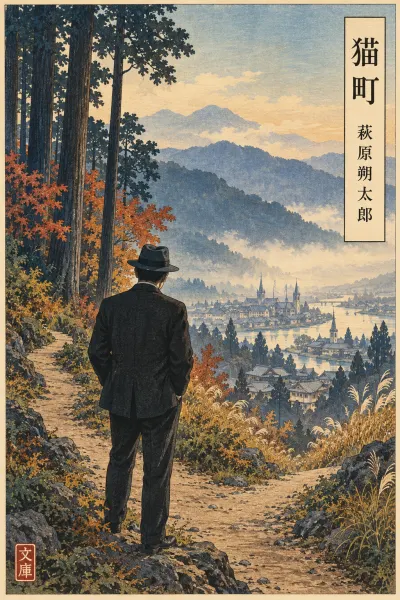
Part 8 of 8 · JLPT N2
猫町(3) Nekomachi, part 8: Butterfly, Dream, and the Cats' Town
In this part
The narrator ends his story and turns to the questions it leaves behind. He recalls Zhuangzi's butterfly dream and asks whether the true world lies behind the visible scenery or on its surface. People mock his tale as a poet's delusion, but he insists that he really saw the town of cats and still firmly believes that it exists somewhere in the universe.
AI translation · independently checked
私の物語は此所で終る。My story ends here.
だが私の不思議な疑問は、此所から新しく始まって来る。But my strange question begins anew from this very point.
支那の哲人荘子は、かつて夢に胡蝶となり、醒めて自ら怪しみ言った。The Chinese sage Zhuangzi once became a butterfly in a dream, and on waking he wondered at himself and said:
夢の胡蝶が自分であるか、今の自分が自分であるかと。"Is the butterfly in the dream myself, or is the self I am now myself?"
この一つの古い謎は、千古にわたってだれも解けない。No one through all the ages has solved this one ancient riddle.
錯覚された宇宙は、狐に化かされた人が見るのか。Is the illusory universe what a person bewitched by a fox sees?
理智の常識する目が見るのか。Or is it what the eye of reason and common sense sees?
そもそも形而上の実在世界は、景色の裏側にあるのか表にあるのか。Indeed, does the real world of metaphysics lie on the far side of the scenery, or on its surface?
だれもまた、おそらくこの謎を解答できない。Likewise, no one, it seems, can answer this riddle.
だがしかし、今もなお私の記憶に残っているものは、あの不可思議な人外の町。And yet what still remains in my memory even now is that mysterious town beyond the human world.
窓にも、軒にも、往来にも、猫の姿がありありと映像していた、あの奇怪な猫町の光景である。It is the scene of that uncanny cats' town, where the forms of cats appeared so vividly at the windows, under the eaves and in the streets.
私の生きた知覚は、既に十数年を経た今日でさえも、なおその恐ろしい印象を再現して、まざまざとすぐ眼の前に、はっきり見ることができるのである。Even today, after more than ten years have passed, my living senses can still call up that terrifying impression and see it clearly, vividly, right before my eyes.
人は私の物語を冷笑して、詩人の病的な錯覚であり、愚にもつかない妄想の幻影だと言う。People scoff at my story and say it was the morbid illusion of a poet, a phantom of absurd delusion.
だが私は、たしかに猫ばかりの住んでる町、猫が人間の姿をして、街路に群集している町を見たのである。But I truly did see a town where only cats lived, a town where cats in human form thronged the streets.
理窟や議論はどうにもあれ、宇宙の或る何所かで、私がそれを「見た」ということほど、私にとって絶対不惑の事実はない。Whatever logic and argument may say, for me there is no fact more absolute and beyond doubt than this: that somewhere in the universe I "saw" it.
あらゆる多くの人々の、あらゆる嘲笑の前に立って、私は今もなお固く心に信じている。Standing before all the ridicule of all the many people, I still believe firmly in my heart, even now,
あの裏日本の伝説が口碑している特殊な部落。in that peculiar settlement handed down in the legends of the Japan Sea coast—
猫の精霊ばかりの住んでる町が、確かに宇宙の或る何所かに、必らず実在しているにちがいないということを。that a town inhabited only by the spirits of cats must surely, without fail, exist somewhere in the universe.
Vocabulary
| Word | Meaning | JLPT |
|---|---|---|
| 胡蝶こちょう | butterflyLiterary word for 蝶 (ちょう), used famously in the 'butterfly dream' (胡蝶の夢). | — |
| 醒めてさめる | to wake up (from a dream)dictionary form: 醒めるUsually written 覚める today; 醒 also suggests sobering up. | N3 |
| 謎なぞ | riddle, mystery | N3 |
| 錯覚さっかく | illusion, misperception錯覚する = to perceive wrongly; here used in the passive, 'the universe as misperceived'. | N1 |
| 化かされたばかす | to bewitch, to trick by magicdictionary form: 化かすIn folklore foxes and raccoon dogs 化かす people; 狐に化かされる means 'to be bewitched by a fox'. | — |
| 形而上けいじじょう | metaphysical, beyond physical form形而上学 = metaphysics. | — |
| 人外じんがい | outside the human world; non-humanLiterary word for something beyond ordinary human existence. | — |
| ありありとありありと | vividly, distinctlySimilar to まざまざと in sentence 12; both describe something seen as if it were really there. | — |
| 奇怪きっかい | uncanny, bizarreAlso read きかい; きっかい sounds stronger and more literary. | — |
| 冷笑れいしょう | scornful laughter; to sneer atCompare 嘲笑 (ちょうしょう, ridicule) in sentence 16. | — |
| 愚にもつかないぐにもつかない | utterly foolish, absurdSet expression meaning 'too silly even to be called foolish'. | — |
| 妄想もうそう | delusion, wild fantasy | — |
| 口碑こうひ | oral tradition, legend passed by word of mouthLiterally 'a monument of the mouth'. Here it is used as a verb (口碑する), meaning 'to hand down orally'. | — |
| 精霊せいれい | spirit (of a creature or thing) | — |
Grammar
〜にわたって N3 throughout, over (a span of time or space)
This pattern marks the whole extent of a period or area. With 千古, it means 'through all the ages since ancient times'.
この一つの古い謎は、千古にわたってだれも解けない。
No one through all the ages has solved this one ancient riddle.
〜でさえ(も) N2 even
This pattern stresses an extreme case. Even today, long afterwards, the memory remains sharp, so it must be sharp at other times too. も adds further emphasis.
既に十数年を経た今日でさえも
even today, after more than ten years have passed
〜ほど…はない N3 nothing is as … as ~
This pattern states that nothing exceeds X to the degree mentioned. Here, no fact is as absolute for the narrator as the fact that he 'saw' the town.
私がそれを「見た」ということほど、私にとって絶対不惑の事実はない。
For me there is no fact more absolute and beyond doubt than that I "saw" it.
どうにもあれ N1 whatever ~ may be; be that as it may
This is a literary concessive built from あれ, the imperative of ある. It sets something aside as irrelevant to the main point: whatever reason and argument may conclude.
理窟や議論はどうにもあれ
Whatever logic and argument may say
〜にちがいない N3 must be, surely
This pattern expresses strong conviction. Together with 確かに and 必らず, it shows how certain the narrator is. The whole clause ending in ということを is placed after 信じている in sentence 16, an inversion for emphasis.
必らず実在しているにちがいないということを。
that it must surely, without fail, exist.