Part 5 of 5 · JLPT N3
伸び支度 Nobijitaku, part 5: A Girl at the Threshold
In this part
Sodeko now clearly sees the difference between men and women, and realises she must protect herself in a way her carefree brothers need not. She thinks of her mother, who died of bleeding soon after giving birth to her, and of the same tide now arriving in her own body fifteen years later. Still uneasy and caught between childhood and adulthood, she finds she can no longer hold little Kinnosuke the way she used to.
AI translation · independently checked
男と女の相違が、今は明らかに袖子に見えてきた。The difference between men and women was now plain for Sodeko to see.
さものんきそうな兄さん達とちがって、彼女は自分を護らねばならなかった。Unlike her elder brothers, who seemed so carefree, she had to protect herself.
大人の世界のことはすっかり分かってしまったとは言えないまでも、すくなくもそれを覗いて見た。Though she could not say she had come to understand the grown-up world entirely, she had at least caught a glimpse of it.
その心から、袖子は言いあらわしがたい驚きをも誘われた。From that feeling, Sodeko was also stirred to a wonder she could not put into words.
袖子の母さんは、彼女が生まれると間もなく激しい産後の出血で亡くなった人だ。Sodeko's mother had died of a violent haemorrhage soon after giving birth to her.
その母さんが亡くなる時には、人のからだに差したり引いたりする潮が三枚も四枚もの母さんの単衣を雫のようにした。When that mother died, the tide that flows and ebbs within the human body had soaked as many as three or four of her unlined robes until they dripped.
それほど恐ろしい勢いで母さんから引いて行った潮が――十五年の後になって――あの母さんと生命の取りかえっこをしたような人形娘に差して来た。That tide, which had ebbed from her mother with such terrible force, had now, fifteen years later, come flowing into this doll of a daughter, who seemed almost to have traded lives with her mother.
空にある月が満ちたり欠けたりする度に、それと呼吸を合わせるような、奇蹟でない奇蹟は、まだ袖子にはよく呑みこめなかった。This miracle that was no miracle, keeping time with the waxing and waning of the moon in the sky, was something Sodeko could not yet properly take in.
それが人の言うように規則的に溢れて来ようとは、信じられもしなかった。She could not even believe that it would come welling over regularly, as people said it would.
故もない不安はまだ続いていて、絶えず彼女を脅かした。A groundless unease still lingered and constantly unsettled her.
袖子は、その心配から、子供と大人の二つの世界の途中の道端に息づき震えていた。Out of that worry, Sodeko stood breathing hard and trembling by the roadside, halfway between the two worlds of child and grown-up.
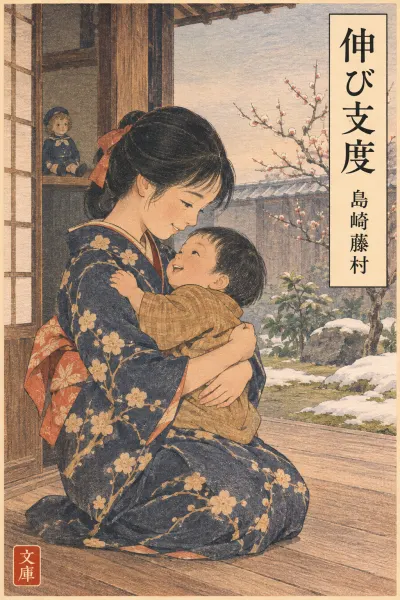
子供の好きなお初は相変わらず近所の家から金之助さんを抱いて来た。O-Hatsu, who was fond of children, still carried little Kinnosuke over from the house next door as before.
頑是ない子供は、以前にもまさる可愛げな表情を見せて、袖子の肩にすがったり、その後を追ったりした。The innocent little boy, looking even more adorable than before, would cling to Sodeko's shoulder or follow after her.
「ちゃあちゃん。」"Chā-chan."
親しげに呼ぶ金之助さんの声に変わりはなかった。There was no change in Kinnosuke's voice as he called to her so fondly.
しかし袖子はもう以前と同じようにはこの男の児を抱けなかった。But Sodeko could no longer hold the little boy in her arms the way she once had.
Vocabulary
| Word | Meaning | JLPT |
|---|---|---|
| 相違そうい | difference, disparityA more formal word than 違い. | N2 |
| 護らまもる | to protect, to guarddictionary form: 護る護 is a literary spelling of 守る, suggesting defence or shelter. | N3 |
| 覗いてのぞく | to peep into, to glimpsedictionary form: 覗くSeeing only part of something, as through a gap. | N2 |
| 言いあらわしがたいいいあらわす | to express in words; with 〜がたい: hard to put into wordsdictionary form: 言い表す | — |
| 産後さんご | after childbirth産 = birth, 後 = after; compare 産前 'before childbirth'. | N1 |
| 潮しお | tideUsed here as a veiled image for bleeding and, later, menstruation; 差す = flow in, 引く = ebb. | N1 |
| 単衣ひとえ | unlined kimonoA light kimono without lining, worn in warm weather. | — |
| 雫しずく | drop (of liquid), drip | N1 |
| 欠けたりかける | to wane (of the moon); to be chipped or missingdictionary form: 欠ける満ちる (wax) and 欠ける (wane) are the standard pair for the moon. | N3 |
| 奇蹟きせき | miracleOlder spelling of 奇跡. | — |
| 呑みこめなかったのみこむ | to grasp, to take in (understand)dictionary form: 呑み込むLiterally 'to swallow'; figuratively 'to understand fully'. | N1 |
| 脅かしたおびやかす | to threaten, to make uneasydictionary form: 脅かすAlso read おどかす 'to startle'; おびやかす is the more literary, ongoing sense. | N1 |
| 頑是ないがんぜない | too young to know better, innocentOld-fashioned word used of small children. | — |
| すがったりすがる | to cling to, to hang on todictionary form: 縋る | — |
Grammar
〜ねばならない N2 must, have to
A literary form of 〜なければならない, made from the negative stem plus ねば. In the past tense, ねばならなかった means 'had to'.
彼女は自分を護らねばならなかった。
She had to protect herself.
〜とは言えないまでも N1 even if one cannot say …, at least …
〜ないまでも grants that a higher degree is not reached and introduces a lesser claim that is still true. It is often followed by すくなくも / 少なくとも.
すっかり分かってしまったとは言えないまでも、すくなくもそれを覗いて見た。
Though she could not say she had understood it entirely, she had at least caught a glimpse of it.
〜がたい N2 hard to …, almost impossible to …
This attaches to the verb stem and means the action is difficult for emotional or psychological reasons rather than physical ones. It is a more formal relative of 〜にくい.
袖子は言いあらわしがたい驚きをも誘われた。
There rose in Sodeko a wonder she could not put into words.
〜度に N3 every time …, whenever …
This follows a dictionary-form verb or 名詞+の and marks something that happens on each occurrence. Here it links the body's rhythm to each change of the moon.
空にある月が満ちたり欠けたりする度に
each time the moon in the sky waxes and wanes
〜(よ)うとは N1 that it would (ever) … (surprise or disbelief)
A volitional or conjectural form followed by とは presents an idea the speaker finds hard to accept. With 信じられもしなかった it means 'she could not even believe that it would …'.
規則的に溢れて来ようとは、信じられもしなかった。
She could not even believe that it would come welling over regularly.