Upper intermediate · JLPT N2
小さき者へSasakimono e — A Letter to My Little Ones
- JLPT N2
- 10,114 characters
- 7 parts
- about 84 minutes
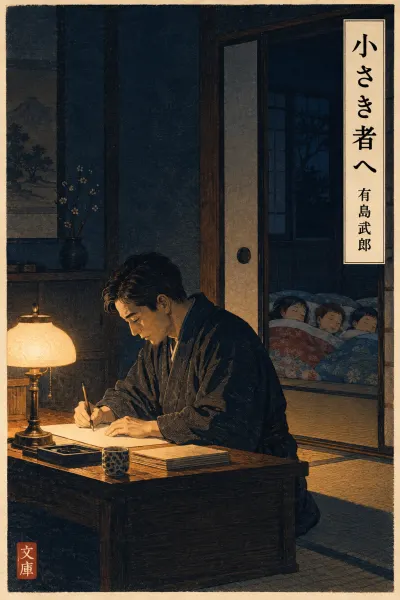
小さき者へ is a short work written as a letter. A father writes to his three small children, for them to read when they are grown, after their mother has died the previous year. Writing late at night while they sleep in the next room, he goes back to the blizzard-bound day of her first labour in Hokkaidō. He confesses that, restless and dissatisfied with his work, he came to resent his marriage and treated his wife and children harshly. He then follows the family through the mother's tuberculosis diagnosis, the move south to Tōkyō and her stays in hospital. Along the way he also remembers a poor neighbour, Mr. U. The tone is intimate but solemn, and the letter carries grief, guilt and gratitude. Throughout, the father insists that sorrow can give strength. For a learner, the reward is a single, emotionally direct voice telling a clear and moving story. The challenge is its Taishō-era written style: 然し, 〜ねばならぬ, archaic negatives and imperatives, dense kanji vocabulary, and long sentences that move between memory and the present moment of writing.
Contents
Before you read
- Keep track of who is being talked about. お前たち always means the children the letter is addressed to, 私 is the father, and their mother is referred to from the children's point of view. Many sentences drop the subject, so ask at each turn whether the father is describing 'you', himself, or your mother.
- Learn the literary negative and obligation forms before you start, because they carry the father's moral voice. 〜ねばならぬ means 'must', 〜てはならない means 'must not', 〜ずにおかない means 'cannot help but / will surely', and 知らん is a classical negative here. Expect blunt imperatives such as 行け toward the end.
- Expect older kanji spellings. Common words appear in forms like 然し (= しかし), and names are sometimes written in kanji rather than katakana, such as 希臘 (ぎりしゃ, Greece). The portraits in the mother's room (ゲーテ, クロムウェル, ナイティンゲール, ミネルバ) are in katakana and are easy anchors.
- Watch for the shifts in time. The letter moves between the present (the father writing at night, the children asleep next door) and past scenes of the birth, the illness and the move to Tōkyō. Time words and sentence-final tense usually signal the jump, so read the opening of each paragraph carefully.
- Part 6 turns aside to the neighbour Mr. U. Before reading it, learn the names 天理教 (the religion whose prayers he relied on) and 古賀液 (the medicine injected into him). The father's call to remember him is one of the letter's central points.
Words to know
The most useful words from the notes across the story.
| Word | Meaning | JLPT |
|---|---|---|
| 頑是ないがんぜない | too young to know right from wrong; innocent, helpless (of small children)Literary word used almost only of very young children. | — |
| 斃れてたおれる | to fall dead, to diedictionary form: 斃れるWritten with 斃 rather than 倒 to show death, not just falling down. | N4 |
| 一人前いちにんまえ | full-fledged, grown-up (adult)Read いちにんまえ in this sense; ひとりまえ is a rarer variant. | — |
| 陣痛じんつう | labour pains | — |
| 産婆さんば | midwifeOld-fashioned word; the modern term is 助産師. | — |
| 晴着はれぎ | one's best clothes; formal kimono for special occasionsdictionary form: 晴れ着 | — |
| 嗤いわらう | to laugh at, to sneer atdictionary form: 嗤うThis kanji is used for mocking laughter, unlike 笑う. | N4 |
| 恢復かいふく | recoveryOlder spelling of 回復. | N3 |
| 我儘わがまま | selfishness, self-indulgenceUsually written in kana today. | N3 |
| 罰するばっする | to punish罰 is read ばつ alone; it becomes ばっ before する. | N3 |
| 覚悟かくご | resolve; readiness to face the worst | N3 |
| 吹雪ふぶき | snowstorm, blizzardKanji: 吹 'blow' + 雪 'snow'. | N2 |
| 悪んだにくむ | to hate, to resentdictionary form: 憎むNormally written 憎む; here the older spelling 悪む is used. | N2 |
| 無沙汰ぶさた | failure to keep in touch; long silencePolite form ご無沙汰しています: 'I'm sorry I haven't been in touch'. | N2 |
| 足跡あしあと | footprints; the path one has walked in life | N2 |
Plot summary
Show the full summary (contains spoilers)
Writing to his three young children after their mother's death, a father recalls her long, dangerous first labour in snowy Hokkaidō. He admits that he later resented his marriage and treated his family harshly. The mother falls ill with tuberculosis. While she is in hospital, he cares for the children alone, and she comes home early out of loneliness. The family moves to Tōkyō, where her illness worsens. When she learns the truth, she resolves not to see the children again unless she is cured, and she leaves for hospital in tears while they salute her car. She dies a year and seven months later, and her will forbids the children from seeing her death. The father reflects on their grief and recalls the poor neighbour Mr. U, who died leaving his family behind. He ends by blessing his children and urging them to leave him behind and go boldly into life.
About the author
Arishima Takeo was a Japanese novelist and essayist associated with the Shirakaba (White Birch) literary group. He studied at Sapporo Agricultural College and later in the United States, and for a time he was a committed Christian. His best-known works include the novel 或る女 (A Certain Woman) and the stories カインの末裔 and 生れ出づる悩み. Troubled by his inherited wealth, he gave his family's farm in Hokkaido to the tenant farmers who worked it.