Part 7 of 7 · JLPT N2
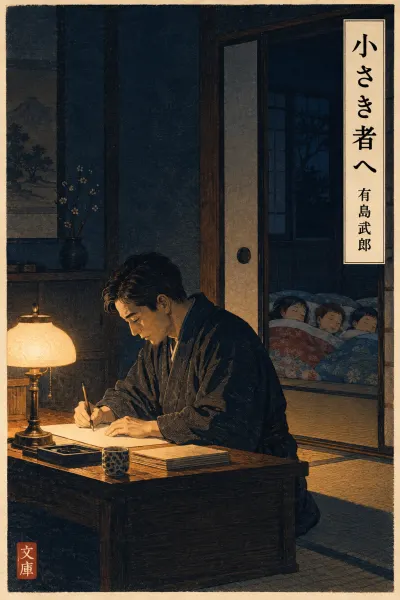
小さき者へ Sasakimono e, part 7: A Father's Blessing in the Night
In this part
Late at night, the father tells his sleeping children that he asks nothing of them except that they accept his gratitude, and that they must leave him behind and go boldly into life. Roses before their mother's photograph remind him of how she dressed for death before her first childbirth, a gesture he once laughed at but now takes seriously. He ends with a blessing, urging his little ones to set out without fear on the long, dark road ahead.
AI translation · independently checked
十分人世は淋しい。Human life is thoroughly lonely.
私たちは唯そういって澄ましている事が出来るだろうか。But can we merely say so and remain unmoved?
お前達と私とは、血を味った獣のように、愛を味った。You and I tasted love, like beasts that have tasted blood.
行こう、そして出来るだけ私たちの周囲を淋しさから救うために働こう。Let us go, and let us work as hard as we can to save those around us from loneliness.
私はお前たちを愛した。I have loved you.
そして永遠に愛する。And I will love you forever.
それはお前たちから親としての報酬を受けるためにいうのではない。I do not say this in order to receive from you any reward due to a parent.
お前たちを愛する事を教えてくれたお前たちに私の要求するものは、ただ私の感謝を受取って貰いたいという事だけだ。You taught me to love you, and all I ask of you is that you accept my gratitude.
お前たちが一人前に育ち上った時、私は死んでいるかも知れない。By the time you have grown into adults, I may be dead.
一生懸命に働いているかも知れない。I may be working with all my might.
老衰して物の役に立たないようになっているかも知れない。Or I may have grown old and feeble, of no use to anyone.
然し何れの場合にしろ、お前たちの助けなければならないものは私ではない。But whichever it may be, it is not I whom you must help.
お前たちの若々しい力は既に下り坂に向おうとする私などに煩わされていてはならない。Your youthful strength must not be burdened by someone like me, who is already about to start down the slope.
斃れた親を喰い尽して力を貯える獅子の子のように、力強く勇ましく私を振り捨てて人生に乗り出して行くがいい。Like the lion cubs that devour their fallen parent to build up their own strength, you should cast me aside, strongly and bravely, and set out into life.
今時計は夜中を過ぎて一時十五分を指している。The clock now shows a quarter past one, past midnight.
しんと静まった夜の沈黙の中にお前たちの平和な寝息だけが幽かにこの部屋に聞こえて来る。In the deep hush of the silent night, only the peaceful sound of your breathing as you sleep reaches this room, faintly.
私の眼の前にはお前たちの叔母が母上にとて贈られた薔薇の花が写真の前に置かれている。Before my eyes, set in front of the photograph, are the roses your aunt sent for your mother.
それにつけて思い出すのは私があの写真を撮ってやった時だ。They bring back to me the time when I took that photograph of her.
その時お前たちの中に一番年たけたものが母上の胎に宿っていた。At that time the eldest of you was dwelling in your mother's womb.
母上は自分でも分らない不思議な望みと恐れとで始終心をなやましていた。Your mother was constantly troubled by strange hopes and fears that she herself could not understand.
その頃の母上は殊に美しかった。In those days your mother was especially beautiful.
希臘の母の真似だといって、部屋の中にいい肖像を飾っていた。Saying that she was copying the mothers of Greece, she had decorated her room with fine portraits.
その中にはミネルバの像や、ゲーテや、クロムウェルや、ナイティンゲール女史やの肖像があった。Among them were an image of Minerva and portraits of Goethe, Cromwell and Miss Nightingale.
その少女じみた野心をその時の私は軽い皮肉の心で観ていたが、今から思うとただ笑い捨ててしまうことはどうしても出来ない。At the time I looked upon that girlish ambition with a touch of irony, but thinking of it now, I simply cannot laugh it away.
私がお前たちの母上の写真を撮ってやろうといったら、思う存分化粧をして一番の晴着を着て、私の二階の書斎に這入って来た。When I said I would take a photograph of your mother, she made herself up as carefully as she pleased, put on her very finest clothes, and came into my study on the upper floor.
私は寧ろ驚いてその姿を眺めた。I gazed at her figure, rather taken aback.
母上は淋しく笑って私にいった。Your mother smiled a lonely smile and said to me:
産は女の出陣だ。"Childbirth is a woman's going into battle."
いい子を生むか死ぬか、そのどっちかだ。"Either I give birth to a good child, or I die; it is one or the other."
だから死際の装いをしたのだ。"That is why I have dressed as one does at the moment of death."
――その時も私は心なく笑ってしまった。—Even then I thoughtlessly laughed.
然し、今はそれも笑ってはいられない。But now I cannot laugh at that either.
深夜の沈黙は私を厳粛にする。The silence of the deep night makes me solemn.
私の前には机を隔ててお前たちの母上が坐っているようにさえ思う。I even feel as though your mother were sitting before me, on the other side of the desk.
その母上の愛は遺書にあるようにお前たちを護らずにはいないだろう。Your mother's love, just as her last letter says, will surely never fail to protect you.
よく眠れ。Sleep well.
不可思議な時というものの作用にお前たちを打任してよく眠れ。Give yourselves over to the workings of that mysterious thing called time, and sleep well.
そうして明日は昨日よりも大きく賢くなって、寝床の中から跳り出して来い。And tomorrow, grown bigger and wiser than you were yesterday, come leaping out of your beds.
私は私の役目をなし遂げる事に全力を尽すだろう。I will put all my strength into fulfilling my task.
私の一生が如何に失敗であろうとも、又私が如何なる誘惑に打負けようとも、お前たちは私の足跡に不純な何物をも見出し得ないだけの事はする。However much of a failure my life may be, and to whatever temptations I may give way, I will at least make sure that you can find nothing impure in my footsteps.
きっとする。I surely will.
お前たちは私の斃れた所から新しく歩み出さねばならないのだ。You must set out afresh from the place where I have fallen.
然しどちらの方向にどう歩まねばならぬかは、かすかながらにもお前達は私の足跡から探し出す事が出来るだろう。But in which direction, and how, you must walk, you will be able to find out from my footsteps, however faintly.
小さき者よ。Little ones.
不幸なそして同時に幸福なお前たちの父と母との祝福を胸にしめて人の世の旅に登れ。Hold close to your hearts the blessing of your father and mother, unfortunate and at the same time fortunate, and set out on the journey of this human world.
前途は遠い。The road ahead is long.
そして暗い。And it is dark.
然し恐れてはならぬ。But you must not be afraid.
恐れない者の前に道は開ける。Before those who do not fear, the way opens.
行け。Go.
勇んで。Boldly.
小さき者よ。Little ones.
Vocabulary
| Word | Meaning | JLPT |
|---|---|---|
| 澄ましてすます | to remain unconcerned; to act composeddictionary form: 澄ますIn 澄ましている it means keeping a calm, detached face, not the literal 'make clear'. | N1 |
| 報酬ほうしゅう | reward; payment in return | N1 |
| 一人前いちにんまえ | full-grown adult; fully fledgedAlso 'one serving' of food; here it means mature and independent. | — |
| 老衰ろうすい | the feebleness of old age; senility | N1 |
| 煩わされてわずらわす | to trouble; to burdendictionary form: 煩わすPassive 煩わされる: to be troubled or weighed down by something. | — |
| 斃れたたおれる | to fall dead; to perishdictionary form: 斃れるLiterary kanji for たおれる, used for falling in death; everyday writing uses 倒れる. | N4 |
| 寝息ねいき | breathing of a sleeping person | — |
| 野心やしん | ambition | N1 |
| 晴着はれぎ | one's best clothes; formal wear for special occasionsdictionary form: 晴れ着晴れ means a special, festive occasion, as opposed to everyday life. | — |
| 出陣しゅつじん | going off to battle陣 means a military camp; a samurai-flavoured word. | — |
| 遺書いしょ | a letter left by someone who has died; last testament | — |
| 足跡あしあと | footprints; the path one has walked in life | N2 |
| 前途ぜんと | the road ahead; one's future | N1 |
| 勇んでいさむ | to be in high spirits; to go boldlydictionary form: 勇む勇んで works like an adverb: 'eagerly, courageously'. | — |
Grammar
〜てはならない N3 must not ~
The te-form plus はならない forbids something firmly. Here the father insists that the children's strength must not be held back by him.
お前たちの若々しい力は既に下り坂に向おうとする私などに煩わされていてはならない。
Your youthful strength must not be burdened by someone like me, who is already about to start down the slope.
〜がいい N2 you should ~; it is good to ~
The dictionary form plus がいい gives strong encouragement or permission, often from a superior. The father is urging his children to leave him behind.
力強く勇ましく私を振り捨てて人生に乗り出して行くがいい。
You should cast me aside, strongly and bravely, and set out into life.
〜ずにはいない N1 will certainly ~; cannot fail to ~
The negative stem with ず plus にはいない says that something is bound to happen. Here it expresses the father's conviction that the mother's love will surely protect the children.
その母上の愛は遺書にあるようにお前たちを護らずにはいないだろう。
Your mother's love, just as her last letter says, will surely never fail to protect you.
如何に〜であろうとも / 如何なる〜ようとも N1 no matter how ~; whatever ~
如何に or 如何なる combined with the volitional form plus とも means 'no matter how much' or 'whatever'. The result stays the same whatever happens.
私の一生が如何に失敗であろうとも、又私が如何なる誘惑に打負けようとも
However much of a failure my life may be, and to whatever temptations I may give way
〜得ない N2 cannot ~ (literary)
A verb stem plus 得る means 'can', and 得ない means 'cannot'. In 見出し得ない it means 'be unable to find'.
お前たちは私の足跡に不純な何物をも見出し得ないだけの事はする。
I will at least make sure that you can find nothing impure in my footsteps.
〜ねばならぬ N2 must ~
This is the literary form of 〜なければならない. ねば is an old negative conditional, and ぬ is the old form of ない.
然しどちらの方向にどう歩まねばならぬかは
But in which direction, and how, you must walk