Part 4 of 7 · JLPT N2
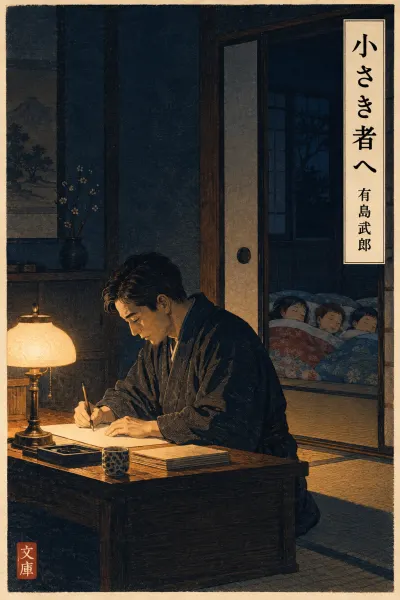
小さき者へ Sasakimono e, part 4: Flight South and a Mother's Tears
In this part
The family flees the bitter northern cold for Tōkyō, taking the sick mother and three small children. After a brief respite at a seaside villa, the mother's condition worsens, one child falls ill with a high fever, and the father collapses too. Early in the New Year the mother learns the truth about her illness and resolves not to see her children again unless she is cured. She weeps bitterly as she leaves for the hospital, and the father tells the children that those tears belong to them alone.
AI translation · independently checked
知らない間に私たちは離れられないものになってしまっていたのだ。Before we knew it, we had become inseparable.
五人の親子はどんどん押寄せて来る寒さの前に、小さく固まって身を護ろうとする雑草の株のように、互により添って暖みを分ち合おうとしていたのだ。Like a clump of weeds huddling small and tight to shield itself from a cold that kept pressing in, the five of us, parents and children, clung close together, trying to share our warmth.
然し北国の寒さは私たち五人の暖みでは間に合わない程寒かった。But the cold of the north was so fierce that the warmth of the five of us was not enough.
私は一人の病人と頑是ないお前たちとを労わりながら旅雁のように南を指して遁れなければならなくなった。Caring for one invalid and for you, who were still too small to understand anything, I had to flee south like a migrating wild goose.
それは初雪のどんどん降りしきる夜の事だった、お前たち三人を生んで育ててくれた土地を後にして旅に上ったのは。It was on a night when the first snow was falling thick and fast that we set out on our journey, leaving behind the land that had borne and raised the three of you.
忘れる事の出来ないいくつかの顔は、暗い停車場のプラットフォームから私たちに名残りを惜しんだ。From the dark station platform, a few faces I can never forget bade us a sorrowful farewell.
陰鬱な津軽海峡の海の色も後ろになった。The gloomy colour of the sea in the Tsugaru Strait, too, fell away behind us.
東京まで付いて来てくれた一人の学生は、お前たちの中の一番小さい者を、母のように終夜抱き通していてくれた。A student who came with us all the way to Tōkyō held the youngest of you in his arms all night long, like a mother.
そんな事を書けば限りがない。If I were to write of such things, there would be no end.
ともかく私たちは幸に怪我もなく、二日の物憂い旅の後に晩秋の東京に着いた。At any rate, we were fortunate enough to arrive unharmed, and after two weary days of travel we reached Tōkyō in late autumn.
今までいた処とちがって、東京には沢山の親類や兄弟がいて、私たちの為めに深い同情を寄せてくれた。Unlike the place where we had lived until then, Tōkyō was home to many of our relatives and brothers and sisters, and they offered us their deep sympathy.
それは私にどれ程の力だったろう。What strength that gave me!
お前たちの母上は程なくK海岸にささやかな貸別荘を借りて住む事になり、私たちは近所の旅館に宿を取って、そこから見舞いに通った。Before long your mother went to live in a modest rented villa at K— Beach, while the rest of us took rooms at an inn nearby and went from there to visit her.
一時は病勢が非常に衰えたように見えた。For a time her illness seemed to have lost much of its force.
お前たちと母上と私とは海岸の砂丘に行って日向ぼっこをして楽しく二三時間を過ごすまでになった。It even came to the point where you, your mother and I could go to the dunes on the shore, bask in the sun and spend two or three happy hours.
どういう積りで運命がそんな小康を私たちに与えたのかそれは分らない。With what intention fate granted us such a respite, I cannot tell.
然し彼はどんな事があっても仕遂ぐべき事を仕遂げずにはおかなかった。But fate, come what may, would not rest until it had accomplished what it meant to accomplish.
その年が暮れに迫った頃お前達の母上は仮初の風邪からぐんぐん悪い方へ向いて行った。Around the time the year was drawing to its close, your mother caught what seemed a passing cold, and from there she grew rapidly worse.
そしてお前たちの中の一人も突然原因の解らない高熱に侵された。And one of you, too, was suddenly struck by a high fever of unknown cause.
その病気の事を私は母上に知らせるのに忍びなかった。I could not bring myself to tell your mother about that illness.
病児は病児で私を暫くも手放そうとはしなかった。The sick child, for its part, would not let me go even for a moment.
お前達の母上からは私の無沙汰を責めて来た。Your mother wrote reproaching me for not keeping in touch.
私は遂に倒れた。In the end I collapsed.
病児と枕を並べて、今まで経験した事のない高熱の為めに呻き苦しまねばならなかった。Lying with my pillow beside the sick child's, I had to groan and suffer under a fever higher than any I had ever known.
私の仕事?My work?
私の仕事は私から千里も遠くに離れてしまった。My work had drifted a thousand leagues away from me.
それでも私はもう私を悔もうとはしなかった。Even so, I no longer tried to reproach myself.
お前たちの為めに最後まで戦おうとする熱意が病熱よりも高く私の胸の中で燃えているのみだった。Only the ardent will to fight to the very end for your sake burned in my breast, hotter than the fever of my illness.
正月早々悲劇の絶頂が到来した。Early in the New Year the tragedy reached its height.
お前たちの母上は自分の病気の真相を明かされねばならぬ羽目になった。Your mother came to a point where the truth about her illness had to be revealed to her.
そのむずかしい役目を勤めてくれた医師が帰って後の、お前たちの母上の顔を見た私の記憶は一生涯私を駆り立てるだろう。The memory of seeing your mother's face after the doctor who had undertaken that difficult task had gone will drive me on for the rest of my life.
真蒼な清々しい顔をして枕についたまま母上には冷たい覚悟を微笑に云わして静かに私を見た。Her face deathly pale yet serene, still lying on her pillow, your mother let a smile speak her cold resolve and looked quietly at me.
そこには死に対する Resignation と共にお前たちに対する根強い執着がまざまざと刻まれていた。Vividly engraved there, together with Resignation in the face of death, was a deep-rooted attachment to you.
それは物凄くさえあった。It was almost frightening.
私は凄惨な感じに打たれて思わず眼を伏せてしまった。Struck by a harrowing feeling, I lowered my eyes in spite of myself.
愈々H海岸の病院に入院する日が来た。At last the day came for her to enter the hospital at H— Beach.
お前たちの母上は全快しない限りは死ぬともお前たちに逢わない覚悟の臍を堅めていた。Your mother had firmly resolved that, unless she recovered completely, she would not see you again, even if it meant dying.
二度とは着ないと思われる――そして実際着なかった――晴着を着て座を立った母上は内外の母親の眼の前でさめざめと泣き崩れた。Dressed in her best kimono, which she seemed unlikely ever to wear again (and indeed she never did), your mother rose from her seat and broke down, weeping bitterly before both her own mother and mine.
女ながらに気性の勝れて強いお前たちの母上は、私と二人だけいる場合でも泣顔などは見せた事がないといってもいい位だったのに、その時の涙は拭くあとからあとから流れ落ちた。Your mother had a spirit unusually strong for a woman, and one might almost say she had never shown me a tearful face, even when we were alone together; yet the tears she shed that day kept flowing no matter how often she wiped them away.
その熱い涙はお前たちだけの尊い所有物だ。Those hot tears are a precious possession that belongs to you alone.
それは今は乾いてしまった。They have dried now.
大空をわたる雲の一片となっているか、谷河の水の一滴となっているか、太洋の泡の一つとなっているか、又は思いがけない人の涙堂に貯えられているか、それは知らない。Whether they have become a wisp of cloud crossing the wide sky, a drop of water in a mountain stream, or a single bubble of foam on the ocean, or whether they are stored in the well of tears of someone no one would expect, I do not know.
然しその熱い涙はともかくもお前たちだけの尊い所有物なのだ。But those hot tears, whatever has become of them, are a precious possession that belongs to you alone.
Vocabulary
| Word | Meaning | JLPT |
|---|---|---|
| 頑是ないがんぜない | too young to know right from wrong; innocent, helpless (of small children)Literary word used almost only of very young children. | — |
| 遁れのがれる | to flee, to escapedictionary form: 遁れるUsually written 逃れる today; 遁 is an older kanji choice. | N1 |
| 名残りを惜しんだなごりをおしむ | to be reluctant to part; to bid a sad farewelldictionary form: 名残を惜しむSet phrase for lingering sadly at a parting. | — |
| 物憂いものうい | weary, listless, dreary | — |
| 小康しょうこう | a lull, a temporary improvement (in an illness)Common in medical contexts: 小康を保つ 'to remain stable for now'. | — |
| 仕遂げしとげる | to accomplish, to carry through to the enddictionary form: 仕遂げる仕遂ぐ is the older classical form of the same verb. | — |
| 仮初かりそめ | slight, passing, trivial仮初の風邪: 'a mere cold' that seemed unimportant. | — |
| 無沙汰ぶさた | failure to keep in touch; long silencePolite form ご無沙汰しています: 'I'm sorry I haven't been in touch'. | N2 |
| 羽目はめ | an (unwelcome) situation one is forced into〜羽目になる: 'to end up having to ~'. | — |
| 覚悟かくご | resolve; readiness to face the worst | N3 |
| 臍ほぞをかためる | to make up one's mind firmlydictionary form: 臍を固める臍 (navel) appears in idioms; 覚悟の臍を固める means 'to firmly resolve'. | — |
| 晴着はれぎ | one's best clothes; formal kimono for special occasionsdictionary form: 晴れ着 | — |
| さめざめとさめざめと | (weeping) quietly and bitterlyUsed only with 泣く. | — |
| 執着しゅうちゃく | attachment, clinging, refusal to let go | N1 |
Grammar
〜ずにはおかない N1 will certainly do ~; will not stop until ~
Attached to a verb's negative stem, it expresses an unstoppable will or an inevitable outcome. Here fate is the one that inevitably carries out its purpose.
然し彼はどんな事があっても仕遂ぐべき事を仕遂げずにはおかなかった。
But fate, come what may, would not rest until it had accomplished what it meant to accomplish.
〜ねばならない/〜ねばならぬ N2 must ~; have to ~
A literary form of 〜なければならない, made from the negative stem plus ねば. ならぬ is the older form of ならない.
今まで経験した事のない高熱の為めに呻き苦しまねばならなかった。
I had to groan and suffer under a fever higher than any I had ever known.
〜に忍びない N1 cannot bear to ~; cannot bring oneself to ~
Shows that doing something would be too painful emotionally. Here the father cannot bear to tell the sick mother about their child's illness.
その病気の事を私は母上に知らせるのに忍びなかった。
I could not bring myself to tell your mother about that illness.
XはXで N2 X, for its part / in its own way
Repeating a noun as XはXで means 'X for its part' or 'X in its own way'. It shows that X has its own separate claims or circumstances, apart from whatever else is going on. Here the sick child, for its part, made its own demands and would not let the father go even for a moment.
病児は病児で私を暫くも手放そうとはしなかった。
The sick child, for its part, would not let me go even for a moment.
〜ない限り(は) N2 unless ~; as long as ~ does not happen
Sets a condition that must be met first. The mother will not see her children unless she fully recovers.
お前たちの母上は全快しない限りは死ぬともお前たちに逢わない覚悟の臍を堅めていた。
Your mother had firmly resolved that, unless she recovered completely, she would not see you again, even if it meant dying.
〜ながらに N1 though ~; for (a) ~
Attached to a noun, ながら(に) means 'despite being' or 'for one who is'. 女ながらに means 'though a woman' and introduces her unusual strength of character.
女ながらに気性の勝れて強いお前たちの母上は
Your mother, who had a spirit unusually strong for a woman,