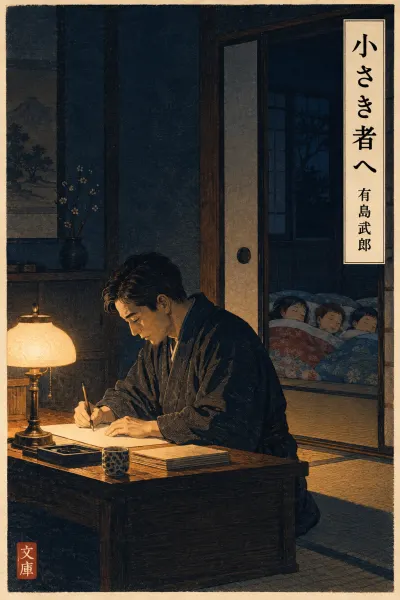
Part 1 of 7 · JLPT N2
小さき者へ Sasakimono e, part 1: A Father's Letter and a Stormy Birth
In this part
A father begins a letter to his young children, to be read when they are grown. He expects they may laugh at his old-fashioned ideas, but he hopes they will know how deeply they were loved. He mentions that they lost their mother last year, and recalls having casually written that his own happiness lay in his mother still being alive. He then recalls the blizzard-bound day seven years earlier when their mother went into a long and difficult labour.
AI translation · independently checked
お前たちが大きくなって、一人前の人間に育ち上った時、――その時までお前たちのパパは生きているかいないか、それは分らない事だが――父の書き残したものを繰拡げて見る機会があるだろうと思う。When you have grown up and become full-fledged adults (whether your papa will still be alive by then is something no one can know), I think there will come a time when you unfold and look through the writings your father left behind.
その時この小さな書き物もお前たちの眼の前に現われ出るだろう。At that time this small piece of writing, too, will surely appear before your eyes.
時はどんどん移って行く。Time moves on and on.
お前たちの父なる私がその時お前たちにどう映るか、それは想像も出来ない事だ。How I, your father, will appear to you then is something I cannot even imagine.
恐らく私が今ここで、過ぎ去ろうとする時代を嗤い憐れんでいるように、お前たちも私の古臭い心持を嗤い憐れむのかも知れない。Perhaps, just as I am here and now laughing at and pitying the age that is about to pass away, you too will laugh at and pity my stale, old-fashioned feelings.
私はお前たちの為めにそうあらんことを祈っている。For your sake, I pray that it may be so.
お前たちは遠慮なく私を踏台にして、高い遠い所に私を乗り越えて進まなければ間違っているのだ。Unless you use me freely as a stepping-stone and climb over me to go on to high and distant places, you will be in the wrong.
然しながらお前たちをどんなに深く愛したものがこの世にいるか、或はいたかという事実は、永久にお前たちに必要なものだと私は思うのだ。And yet I believe that the fact that someone in this world loves you, or once loved you, so very deeply is something you will need forever.
お前たちがこの書き物を読んで、私の思想の未熟で頑固なのを嗤う間にも、私たちの愛はお前たちを暖め、慰め、励まし、人生の可能性をお前たちの心に味覚させずにおかないと私は思っている。Even as you read this writing and laugh at how immature and stubborn my ideas are, I believe our love cannot fail to warm you, comfort you, encourage you, and let your hearts taste the possibilities of life.
だからこの書き物を私はお前たちにあてて書く。That is why I write this addressed to you.
お前たちは去年一人の、たった一人のママを永久に失ってしまった。Last year you lost your one mama, your one and only mama, forever.
お前たちは生れると間もなく、生命に一番大事な養分を奪われてしまったのだ。Soon after you were born, you were robbed of the nourishment most precious to life.
お前達の人生はそこで既に暗い。Your lives are already dark from that point on.
この間ある雑誌社が「私の母」という小さな感想をかけといって来た時、私は何んの気もなく、「自分の幸福は母が始めから一人で今も生きている事だ」と書いてのけた。The other day, when a certain magazine asked me to write a short piece of reflections called "My Mother", I wrote without a second thought, "My happiness lies in the fact that I have had just one mother from the very beginning, and that she is still alive today."
そして私の万年筆がそれを書き終えるか終えないに、私はすぐお前たちの事を思った。And the moment my fountain pen had barely finished writing it, I thought at once of you.
私の心は悪事でも働いたように痛かった。My heart ached as though I had done some wicked deed.
しかも事実は事実だ。And yet a fact is a fact.
私はその点で幸福だった。In that respect I was fortunate.
お前たちは不幸だ。You are unfortunate.
恢復の途なく不幸だ。Unfortunate beyond any hope of recovery.
不幸なものたちよ。You unfortunate ones.
暁方の三時からゆるい陣痛が起り出して不安が家中に拡がったのは今から思うと七年前の事だ。It was seven years ago, as I now reckon it, that mild labour pains began at three in the morning and unease spread through the whole house.
それは吹雪も吹雪、北海道ですら、滅多にはないひどい吹雪の日だった。It was a blizzard, and what a blizzard: a day of such fierce snowstorm as is rare even in Hokkaidō.
市街を離れた川沿いの一つ家はけし飛ぶ程揺れ動いて、窓硝子に吹きつけられた粉雪は、さらぬだに綿雲に閉じられた陽の光を二重に遮って、夜の暗さがいつまでも部屋から退かなかった。Our lone house beside the river, away from the town, shook as if it would be blown to pieces, and the powdery snow driven against the window panes doubly blocked the sunlight that was already shut in by cotton-like clouds, so that the darkness of night would not leave the room.
電燈の消えた薄暗い中で、白いものに包まれたお前たちの母上は、夢心地に呻き苦しんだ。In the dimness, with the electric light gone out, your mother, wrapped in white, moaned and suffered as if in a dream.
私は一人の学生と一人の女中とに手伝われながら、火を起したり、湯を沸かしたり、使を走らせたりした。Helped by a student and a maid, I lit fires, boiled water, and sent messengers running.
産婆が雪で真白になってころげこんで来た時は、家中のものが思わずほっと気息をついて安堵したが、昼になっても昼過ぎになっても出産の模様が見えないで、産婆や看護婦の顔に、私だけに見える気遣いの色が見え出すと、私は全く慌ててしまっていた。When the midwife came tumbling in, white all over with snow, everyone in the house breathed a sigh of relief in spite of themselves; but when noon came, and then the afternoon, with no sign of the birth, and a look of worry that only I could see began to appear on the faces of the midwife and the nurse, I lost my composure entirely.
書斎に閉じ籠って結果を待っていられなくなった。I could no longer stay shut up in my study waiting for the outcome.
私は産室に降りていって、産婦の両手をしっかり握る役目をした。I went down to the birthing room and took on the task of holding the mother's hands tightly.
陣痛が起る度毎に産婆は叱るように産婦を励まして、一分も早く産を終らせようとした。Each time the pains came, the midwife urged her on almost scoldingly, trying to bring the birth to an end even a minute sooner.
然し暫くの苦痛の後に、産婦はすぐ又深い眠りに落ちてしまった。But after a short while of pain, the mother would at once fall again into a deep sleep.
鼾さえかいて安々と何事も忘れたように見えた。She even snored, and looked as peaceful as if she had forgotten everything.
産婆も、後から駈けつけてくれた医者も、顔を見合わして吐息をつくばかりだった。The midwife, and the doctor who had hurried over after her, could only look at each other and sigh.
医師は昏睡が来る度毎に何か非常の手段を用いようかと案じているらしかった。Each time the stupor came over her, the doctor seemed to be considering whether to use some extreme measure.
Vocabulary
| Word | Meaning | JLPT |
|---|---|---|
| 一人前いちにんまえ | full-fledged, grown-up (adult)Read いちにんまえ in this sense; ひとりまえ is a rarer variant. | — |
| 嗤いわらう | to laugh at, to sneer atdictionary form: 嗤うThis kanji is used for mocking laughter, unlike 笑う. | N4 |
| 憐れんであわれむ | to pitydictionary form: 憐れむ | — |
| 踏台ふみだい | stepping-stone, footstooldictionary form: 踏み台Used figuratively for someone you climb over to advance. | — |
| 然しながらしかしながら | however, and yetFormal, written form of しかし. | N1 |
| 未熟みじゅく | immature, inexperienced | N1 |
| 書いてのけたかいてのける | to write (something) offhandedly or boldly; to dash offdictionary form: 書いてのける〜てのける means doing something with bold ease. | — |
| 恢復かいふく | recoveryOlder spelling of 回復. | N3 |
| 陣痛じんつう | labour pains | — |
| 吹雪ふぶき | snowstorm, blizzardKanji: 吹 'blow' + 雪 'snow'. | N2 |
| 産婆さんば | midwifeOld-fashioned word; the modern term is 助産師. | — |
| 安堵あんど | relief | — |
| 昏睡こんすい | stupor, coma | — |
| 案じてあんじる | to ponder, to consider anxiouslydictionary form: 案じる | N1 |
Grammar
〜ずにおかない N1 cannot fail to; will inevitably
Attached to the negative stem, it expresses that something will surely bring about a result. Here the father is confident that his love will inevitably let the children taste life's possibilities.
人生の可能性をお前たちの心に味覚させずにおかないと私は思っている
I believe it cannot fail to let your hearts taste the possibilities of life
〜か〜ないかに N1 the moment (something) was barely done
The same verb is repeated in its plain and negative forms to mean 'hardly had it happened when'. It is usually written 〜か〜ないかのうちに.
私の万年筆がそれを書き終えるか終えないに、私はすぐお前たちの事を思った
The moment my fountain pen had barely finished writing it, I thought at once of you
〜んこと(を祈る) N1 that it may be ~ (wish)
ん is the classical volitional or conjectural ending. あらんこと is literary for あること, and it expresses a hoped-for state.
私はお前たちの為めにそうあらんことを祈っている
For your sake, I pray that it may be so
さらぬだに N1 even without that; already
This is a classical expression, literally 'even if it were not so'. It shows that the sunlight was already dim before the snow blocked it further.
さらぬだに綿雲に閉じられた陽の光を二重に遮って
doubly blocking the sunlight that was already shut in by cotton-like clouds
〜でも〜たように N3 as if one had (done something)
ように after a past verb makes a comparison 'as if'. でも softens the noun to 'some sort of', so the phrase means 'as though I had done some wicked deed'.
私の心は悪事でも働いたように痛かった
My heart ached as though I had done some wicked deed
〜ばかりだ N3 do nothing but; could only
After a dictionary-form verb, ばかりだ means that this was the only thing being done. Here it stresses that the midwife and doctor were helpless.
顔を見合わして吐息をつくばかりだった
could only look at each other and sigh