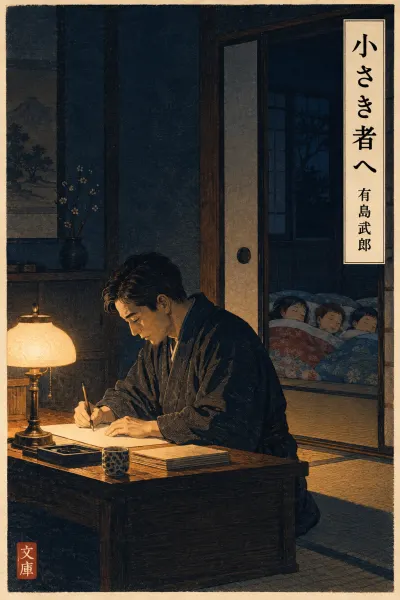
Part 2 of 7 · JLPT N2
小さき者へ Sasakimono e, part 2: A First Child Born, a Father Unsettled
In this part
After a long and dangerous labour, the mother gives birth to her first child, who is revived with a bath of wine and finally cries. The father is overwhelmed with emotion and feels his whole life has changed. He then admits that, restless and dissatisfied with his work, he came to resent his marriage and his children and treated his wife and children harshly in his frustration.
AI translation · independently checked
昼過ぎになると戸外の吹雪は段々鎮まっていって、濃い雪雲から漏れる薄日の光が、窓にたまった雪に来てそっと戯れるまでになった。As the afternoon went on, the blizzard outside slowly died down, until the faint sunlight that leaked through the heavy snow-clouds came and played softly on the snow piled against the window.
然し産室の中の人々にはますます重い不安の雲が蔽い被さった。But over the people in the birthing room a cloud of anxiety settled, heavier and heavier.
医師は医師で、産婆は産婆で、私は私で、銘々の不安に捕われてしまった。The doctor, the midwife and I were each caught in our own separate fears.
その中で何等の危害をも感ぜぬらしく見えるのは、一番恐ろしい運命の淵に臨んでいる産婦と胎児だけだった。Among us, the only ones who seemed to sense no danger at all were the very two who stood at the edge of the most fearful abyss of fate: the mother in labour and the child in her womb.
二つの生命は昏々として死の方へ眠って行った。Those two lives drifted, deeply asleep, towards death.
丁度三時と思わしい時に――産気がついてから十二時間目に――夕を催す光の中で、最後と思わしい激しい陣痛が起った。At what seemed to be exactly three o'clock, in the twelfth hour since her labour began, in a light that hinted at the coming evening, a violent contraction came that seemed as if it must be the last.
肉の眼で恐ろしい夢でも見るように、産婦はかっと瞼を開いて、あてどもなく一所を睨みながら、苦しげというより、恐ろしげに顔をゆがめた。As though seeing a terrible dream with her waking eyes, the mother flung her eyelids wide open, glared aimlessly at a single spot, and twisted her face in an expression less of pain than of terror.
そして私の上体を自分の胸の上にたくし込んで、背中を羽がいに抱きすくめた。Then she drew the upper half of my body down onto her breast and clasped me tightly, her arms locked across my back.
若し私が産婦と同じ程度にいきんでいなかったら、産婦の腕は私の胸を押しつぶすだろうと思う程だった。It was so fierce that I think, had I not been straining as hard as she was, her arms would have crushed my chest.
そこにいる人々の心は思わず総立ちになった。The hearts of everyone there leapt up as one, in spite of themselves.
医師と産婆は場所を忘れたように大きな声で産婦を励ました。The doctor and the midwife, as if they had forgotten where they were, urged her on in loud voices.
ふと産婦の握力がゆるんだのを感じて私は顔を挙げて見た。Suddenly I felt her grip loosen, and I raised my head and looked.
産婆の膝許には血の気のない嬰児が仰向けに横たえられていた。At the midwife's knees lay a newborn baby, drained of colour, on its back.
産婆は毬でもつくようにその胸をはげしく敲きながら、葡萄酒葡萄酒といっていた。The midwife was beating hard on its chest, as if bouncing a ball, and saying, "Wine, wine."
看護婦がそれを持って来た。A nurse brought it.
産婆は顔と言葉とでその酒を盥の中にあけろと命じた。With her face and her words, the midwife ordered her to empty the wine into the basin.
激しい芳芬と同時に盥の湯は血のような色に変った。With a sharp, sweet smell, the hot water in the basin turned the colour of blood.
嬰児はその中に浸された。The baby was dipped into it.
暫くしてかすかな産声が気息もつけない緊張の沈黙を破って細く響いた。After a while, a faint first cry broke through the tense silence, in which no one could even breathe, and rang out thinly.
大きな天と地との間に一人の母と一人の子とがその刹那に忽如として現われ出たのだ。Between the vast heaven and earth, in that instant, a mother and a child had suddenly come into being.
その時新たな母は私を見て弱々しくほほえんだ。At that moment the new mother looked at me and smiled weakly.
私はそれを見ると何んという事なしに涙が眼がしらに滲み出て来た。When I saw it, for no reason I could name, tears welled up at the corners of my eyes.
それを私はお前たちに何んといっていい現わすべきかを知らない。I do not know how I ought to put this into words for you.
私の生命全体が涙を私の眼から搾り出したとでもいえばいいのか知らん。Perhaps I should say that my whole life wrung the tears from my eyes.
その時から生活の諸相が総て眼の前で変ってしまった。From that moment every aspect of life changed before my eyes.
お前たちの中最初にこの世の光を見たものは、このようにして世の光を見た。This is how the first of you to see the light of this world came to see it.
二番目も三番目も、生れように難易の差こそあれ、父と母とに与えた不思議な印象に変りはない。With the second and the third, though the births were easier or harder, the wondrous impression they made on your father and mother was no different.
こうして若い夫婦はつぎつぎにお前たち三人の親となった。And so, one after another, the young couple became the parents of the three of you.
私はその頃心の中に色々な問題をあり余る程持っていた。In those days I carried all sorts of problems in my heart, more than enough of them.
そして始終齷齪しながら何一つ自分を「満足」に近づけるような仕事をしていなかった。And though I was forever toiling and fretting, I was doing no work at all that brought me any closer to "satisfaction."
何事も独りで噛みしめてみる私の性質として、表面には十人並みな生活を生活していながら、私の心はややともすると突き上げて来る不安にいらいらさせられた。Being the kind of person who chews over everything alone, I lived an ordinary life on the surface, yet my heart was all too often fretted by an anxiety that kept surging up inside me.
ある時は結婚を悔いた。At times I regretted my marriage.
ある時はお前たちの誕生を悪んだ。At times I resented your births.
何故自分の生活の旗色をもっと鮮明にしない中に結婚なぞをしたか。Why had I married before I had made the colours of my own life clearer?
妻のある為めに後ろに引きずって行かれねばならぬ重みの幾つかを、何故好んで腰につけたのか。Why had I chosen to fasten to my waist all those weights I must drag behind me because I had a wife?
何故二人の肉慾の結果を天からの賜物のように思わねばならぬのか。Why must I regard the result of two people's carnal desire as a gift from heaven?
家庭の建立に費す労力と精力とを自分は他に用うべきではなかったのか。Should I not have spent elsewhere the labour and energy that go into building a home?
私は自分の心の乱れからお前たちの母上を屡々泣かせたり淋しがらせたりした。Out of the turmoil in my heart I often made your mother weep and feel lonely.
またお前たちを没義道に取りあつかった。And I treated you cruelly.
お前達が少し執念く泣いたりいがんだりする声を聞くと、私は何か残虐な事をしないではいられなかった。When I heard you crying or whining a little too stubbornly, I could not keep myself from doing something cruel.
原稿紙にでも向っていた時に、お前たちの母上が、小さな家事上の相談を持って来たり、お前たちが泣き騒いだりしたりすると、私は思わず机をたたいて立上ったりした。When I was sitting at my manuscript paper and your mother came to consult me about some small household matter, or you started crying and making a fuss, I would find myself banging the desk and jumping to my feet.
そして後ではたまらない淋しさに襲われるのを知りぬいていながら、激しい言葉を遣ったり、厳しい折檻をお前たちに加えたりした。And even though I knew full well that afterwards I would be seized by an unbearable loneliness, I would use harsh words and punish you severely.
Vocabulary
| Word | Meaning | JLPT |
|---|---|---|
| 産室さんしつ | birthing roomBirths then usually took place at home, in a room set aside for them. | — |
| 産婆さんば | midwifeOld-fashioned word; today 助産師 (じょさんし) is used. | — |
| 産婦さんぷ | woman in labour産 (birth) + 婦 (woman). | — |
| 陣痛じんつう | labour pains, contractions | — |
| 嬰児えいじ | newborn baby, infantLiterary; everyday Japanese uses 赤ちゃん or 赤ん坊. | — |
| 盥たらい | washbasin, tub | — |
| 産声うぶごえ | a newborn's first cryAlso used figuratively: 産声を上げる means 'to be born, to come into existence'. | — |
| 刹那せつな | instant, momentA Buddhist term for the shortest unit of time. | — |
| 齷齪あくせく | toiling and fretting, busy without restUsually written in hiragana today. | — |
| 悔いたくいる | to regretdictionary form: 悔いるMore literary than 後悔する. | — |
| 悪んだにくむ | to hate, to resentdictionary form: 憎むNormally written 憎む; here the older spelling 悪む is used. | N2 |
| 没義道もぎどう | heartless, cruelOld-fashioned; mostly used as 没義道に (cruelly). | — |
| 執念くしゅうねい | persistently, stubbornlydictionary form: 執念いArchaic; compare modern しつこい. | — |
| 折檻せっかん | harsh punishment, beatingUsually physical punishment of a child. | — |
Grammar
〜までになる N2 to reach the point where…
Attached to a plain verb, it shows that a gradual change has gone as far as a certain state. Here the storm eases until the sunlight can play on the window.
窓にたまった雪に来てそっと戯れるまでになった
until it came and played softly on the snow piled against the window
〜こそあれ N1 although there is…, still…
A literary concessive: X こそあれ admits that X does exist, then says the main point is unaffected. Here the births differed in difficulty, but the impression they left did not.
生れように難易の差こそあれ、父と母とに与えた不思議な印象に変りはない
though the births were easier or harder, the wondrous impression they made on your father and mother was no different
〜ねばならぬ N2 must, have to
This is the literary form of 〜なければならない. ぬ is the old negative (= ない). In this sentence it attaches to the passive 引きずって行かれ.
後ろに引きずって行かれねばならぬ重みの幾つか
all those weights I must drag behind me
〜ないではいられない N2 cannot help doing…
Literally 'cannot stay without doing', so the speaker is driven to do something despite himself. Here the father confesses an urge he could not hold back.
私は何か残虐な事をしないではいられなかった
I could not keep myself from doing something cruel
〜ながら (concessive) N2 although, even though
With a stative verb such as 知っている, ながら means 'despite', not 'while doing'. 知りぬく adds the sense of 'knowing thoroughly'.
たまらない淋しさに襲われるのを知りぬいていながら
even though I knew full well that I would be seized by an unbearable loneliness
〜ぬ (classical negative) N1 not (= ない)
ぬ is the old negative ending. Here it attaches to 感ずる (an older form of 感じる), giving 感ぜぬ = 感じない. It also appears in ねばならぬ.
何等の危害をも感ぜぬらしく見える
seemed to sense no danger at all