Advanced · JLPT N1
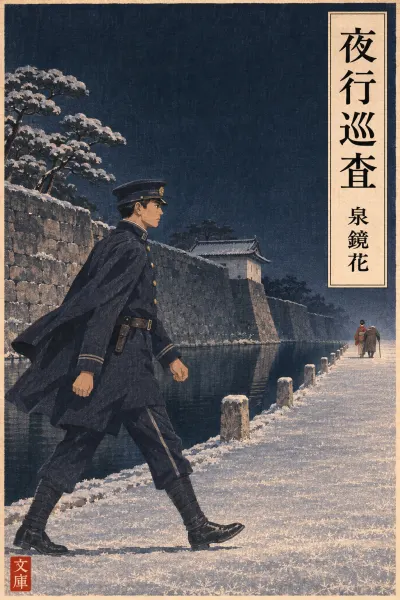
夜行巡査Yakōjunsa — The Constable on His Night Round
- JLPT N1
- 10,749 characters
- 8 parts
- about 90 minutes
Izumi Kyōka's early story 夜行巡査 is usually grouped with his 観念小説 ('idea fiction'), works built around a stark moral idea. It is set on a frosty midnight beside the moat in Kōjimachi, Tokyo, near the British Legation. Constable Hatta Yoshinobu walks his round with a perfectly regular stride and an unbending devotion to the rules. On the same moat-side road, a young woman named Okō is leading her drunken uncle home from a wedding. The uncle has his own reasons for standing between her and the man she loves. The story asks what duty is worth when it leaves no room for human feeling, and the narrator states his own view openly. The tone is cold and tense, and it grows more bitter as it goes on. For learners the main challenge is the contrast between two kinds of language. The narration is dense classical literary Japanese with kanbun-style phrasing. The dialogue, by contrast, is lively Meiji Tokyo speech, from a workman's rough Edo talk to an old rickshaw man's humble politeness. It is short but demanding, and well suited to a reader stepping up to authentic Meiji prose.
Contents
Before you read
- Learn the classical endings before you start, because the narration depends on them. These include the negative 〜じ, the verb-joining 〜で (not doing), the past negative 〜ざりき, 〜たり, 〜べき and 〜べからざる (must not, cannot be). Comparisons with 〜のごとし and 〜がごとく also appear often in the descriptive passages.
- Expect a sharp change in register whenever a character speaks. The young workman uses rough Edo べらんめえ speech, such as 〜じゃあるめえし ('it's not as if…'), with contracted vowels like ねえ for ない. The old rickshaw man, by contrast, is humbly over-polite.
- Watch the uncle's tone in Parts 4–6. His praise of Hatta is ironic, and in Part 6 he calls him by a mocking name (rendered 'Mr Eight Yen'). His long, cruel speeches make up most of the dialogue in these parts.
- A small set of words recurs throughout, so learn them first: 巡査 (constable), 車夫 (rickshaw man), 堀 (moat), 提灯 (lantern), 霜 (frost), 規則 (rules), 職務 (duty) and 伯父 (uncle). Each part also uses 〜つつ ('while doing') for Hatta's steady walking.
- The narrator makes moral comments directly, most strongly in the final part. Read those closing lines as the author's argument rather than as plot.
Words to know
The most useful words from the notes across the story.
| Word | Meaning | JLPT |
|---|---|---|
| 因業いんごう | heartless; cruel and stubbornOriginally a Buddhist word for karma; colloquially used for a hard-hearted person. | — |
| 威厳いげん | dignity; commanding presence | — |
| 後生ごしょう | for pity's sake, I beg youLiterally 'the next life'; 後生だから is a desperate plea. | — |
| 頓着とんじゃく | concern, heedUsually used with a negative: 頓着しない means 'not to care at all'. Also read とんちゃく. | — |
| 職掌しょくしょう | official duties; one's postFormal; the modern everyday word is 職務. | — |
| 規則きそく | rule, regulation | N4 |
| 霜しも | frost | N3 |
| 覚悟かくご | resignation; readiness for the worst覚悟しろ: 'Prepare yourself / Resign yourself!' | N3 |
| 断念ろあきらめる | to give up, resign oneselfdictionary form: 諦めるThe kanji 断念 (だんねん, 'abandoning hope') is used with the reading あきらめ; ろ is the plain imperative ending. | N3 |
| 巡査じゅんさ | police constableThe workman calls them 巡的, a slangy word, and the old man uses the polite おまわりさん. | N2 |
| 心得てるこころえる | to understand fully, to be well aware ofdictionary form: 心得る心得てる is the casual contraction of 心得ている. | N2 |
| 囁くささやく | to whisperHere 囁く声 means 'a whispering voice', i.e. even a whisper. | N2 |
| 拝みおがむ | to put one's hands together in supplication; to begdictionary form: 拝むHere a silent gesture of apology and pleading towards Hatta. | N2 |
| 咎めたとがめる | to reprimand, to take someone to taskdictionary form: 咎める咎め立て means needless fault-finding. | N1 |
| 顧みてかえりみる | to look back (over one's shoulder)dictionary form: 顧みるAlso means 'to reflect on' (one's past). Here it is literal. | N1 |
Plot summary
Show the full summary (contains spoilers)
On a freezing night by the Kōjimachi moat, Constable Hatta Yoshinobu scolds an old rickshaw man for his bare legs. A young workman curses the officer on the old man's behalf. Hatta then drives a beggar mother and her baby from a sheltering gateway, saying the rules allow no exceptions. Meanwhile Okō leads her drunken uncle home. The uncle taunts her: he refused Hatta's proposal, and he raised her to suffer thwarted love because her mother, whom he loved, married his brother. Hatta, patrolling behind them, keeps his fixed pace though the words pain him. When the uncle swears Okō will die with him, she breaks free. He lunges after her, slips on the frost and falls into the icy moat. Hatta despises the old man and cannot swim, yet out of duty he shakes off Okō and leaps in, giving up his life and his love. The narrator asks why society praised his 'benevolence' but ignored his cruelty.
About the author
Izumi Kyōka was born in Kanazawa. He went to Tokyo and became a disciple of the novelist Ozaki Kōyō, whom he revered throughout his life. He went on to develop a highly individual style that is ornate, sensuous and deeply rooted in Edo-period storytelling and language. His fiction often features beautiful, otherworldly women and the supernatural, as in 高野聖 (The Holy Man of Mount Kōya). He also wrote plays, including 夜叉ヶ池. The Izumi Kyōka Literary Prize is named after him.