Advanced · JLPT N1
秘密Himitsu — A Taste for Secrets
- JLPT N1
- 14,501 characters
- 11 parts
- about 121 minutes
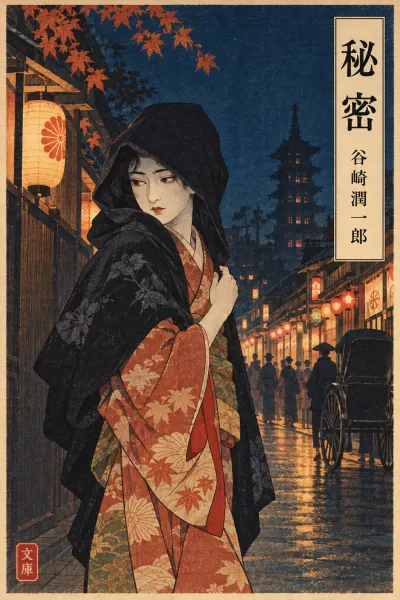
秘密 is an early short story by Tanizaki Jun'ichirō, narrated in the first person by a jaded young man in Tōkyō who has grown bored with ordinary pleasures. He hides away in a temple in a run-down corner of Asakusa, fills his room with books on magic and crime, and begins slipping out at night in disguise, eventually dressed as a woman. In a cinema he finds himself seated beside T, a woman he had an affair with on a voyage to Shanghai and then deserted. What follows is a game of secrecy built around a blindfold and a deliberately winding rickshaw ride to a house he is not allowed to locate. The tone is languid, sensuous and self-absorbed, with lush descriptions of silk, cosmetics, incense and the lamplit streets of the shitamachi. For learners the story is demanding. It is measured at N1 and uses long, ornate sentences, literary forms such as 〜の如く and 〜つつ, katakana loanwords and English phrases, and a dense web of real Tōkyō place names. The reward is a vivid picture of early-twentieth-century Asakusa and a tightly built story about the pleasure of secrets.
Contents
- In Search of a Hidden Corner
- A Hidden Lodging in Forgotten Streets
- A Room of Incense and Strange Books
- A Night Walk in Women's Clothes
- Nightly Masquerades in Asakusa
- A Former Lover in the Darkened Theatre
- A Note Slipped Into a Sleeve
- Blindfolded Ride Through the Rain
- Nightly Visits to a Hidden House
- The Street with the Seal-Maker's Sign
- The Hidden House Opposite the Shrine
Before you read
- Learn the common place-name suffixes before you start: 町 (ちょう/まち, neighbourhood), 橋 (はし/ばし, bridge), 堀 (ほり/ぼり, canal), 座 (ざ, theatre) and 区 (く, ward). Parts 8 and 11 trace the rickshaw route as long chains of street and bridge names. You do not need to memorise them; just recognise each one as a place and follow the direction of travel.
- The narration relies on literary grammar that recurs throughout: 〜の如く/〜如く ('like, as if'), 〜つつ ('while'), 〜に違いない ('must surely be'), 〜なければなるまい ('will have to'), 〜に随い ('as … , in accordance with'), 〜た揚句 ('after all that, in the end') and 〜ば〜ほど ('the more … the more'). Watch for 〜ながら used concessively ('although') as well as in its everyday sense.
- The notes exchanged in Part 7 are written in an archaic epistolary style, and T's reply is in sōrōbun, the classical letter style marked by 候 (そうろう). Read these passages for the gist: who wants to meet whom, and on what condition. Do not try to parse every form.
- Notice how speech marks character. T speaks polite feminine Tōkyō speech, while the rickshaw man in Part 8 uses brusque shitamachi speech. The narrator's own voice is formal plain style (〜である). Comparing these registers helps you track who is speaking.
- Expect lists built with 〜だの〜だの. In Part 3, for example, this pattern catalogues the narrator's books, paintings and objects. The text also includes katakana loanwords and English phrases kept as they are, so read the English directly and treat the katakana as ordinary vocabulary.
Words to know
The most useful words from the notes across the story.
| Word | Meaning | JLPT |
|---|---|---|
| 見当けんとう | rough idea, estimate見当がつく / 見当すら判らない: have (not even) a rough idea. | N3 |
| 我が儘わがまま | selfishness, wilfulnessUsually written in kana today. | N3 |
| 欺きあざむく | to deceive, to fooldictionary form: 欺くWritten, formal word; the everyday equivalent is だます. | N1 |
| 嫉妬しっと | jealousy | N1 |
| 界隈かいわい | neighbourhood, vicinityFollows a place name: 〜の界隈 means 'around ~'. | — |
| お白粉おしろい | white face powderdictionary form: 白粉Traditional white make-up; almost always used with the polite prefix お. | — |
| 窺ってうかがう | to watch closely, to observe secretlydictionary form: 窺うDifferent kanji from 伺う (to visit / to ask, humble), though both are read うかがう. | — |
| 往来おうらい | road, street; coming and goingHere it means the streets the rickshaw travels along. | — |
| 化粧けしょう | make-up化粧をする = to put on make-up; 厚化粧 = heavy make-up. | N3 |
| 却ってかえって | on the contrary, ratherMarks a result opposite to what one might expect. | N2 |
| 格別かくべつ | exceptional, quite specialStronger and more literary than 特別. | N2 |
| 羨ましくうらやましい | enviable; enviousdictionary form: 羨ましい羨ましそうに (s. 22) = with an envious look. | N2 |
| 素人しろうと | an ordinary, respectable woman (as opposed to a professional entertainer)Usually 'amateur'; here contrasted with 商売人, a woman of the pleasure trade. | N2 |
| 溢れてあふれる | to overflowdictionary form: 溢れる | N2 |
| 襖ふすま | sliding paper door between rooms | N2 |
Plot summary
Show the full summary (contains spoilers)
Tired of society, the narrator rents a room in a Shingon temple in Matsubachō, Asakusa, and roams the streets at night in disguise, finally dressed as a woman. In a cinema he recognises T, a woman he had an affair with on a voyage to Shanghai and then deserted. He passes her a note. She replies that she knew him from the start and will meet him only if a rickshaw brings him to her house blindfolded. For a month or two he visits her this way. When she briefly uncovers his eyes, he glimpses a seal-maker's signboard. Retracing the route by daylight, he finds only a shabby, ordinary street and is disappointed. Curiosity drives him to try again, and he finds her house opposite the Dōryō Gongen shrine. She gazes down at him, pale as a corpse, her secret exposed. She turns out to be Yoshino, a wealthy widow. He abandons her, moves to Tabata, and craves stronger, bloodier pleasures.
About the author
Tanizaki Jun'ichirō was born in Nihonbashi, Tōkyō, and became one of the major novelists of modern Japanese literature. His early stories, such as 刺青 (The Tattooer), are known for their aestheticism and their fascination with beauty, obsession and transgression, qualities that are also on display in 秘密. After the Great Kantō Earthquake he moved to the Kansai region, and his later writing turned increasingly toward traditional Japanese culture. His best-known works include 痴人の愛 (Naomi), 蓼喰ふ蟲 (Some Prefer Nettles), 細雪 (The Makioka Sisters) and the essay 陰翳礼讃 (In Praise of Shadows). He also produced modern Japanese translations of The Tale of Genji.