Upper intermediate · JLPT N2
藪の中Yabunonaka — Deep in the Thicket
- JLPT N2
- 8,353 characters
- 8 parts
- about 70 minutes
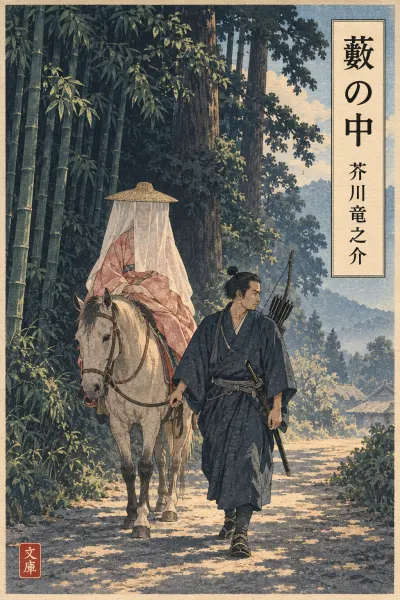
Akutagawa's 藪の中 is a short crime story with no narrator, set in an earlier age of the capital. A samurai has been found dead in a remote thicket off the Yamashina road, and seven people give accounts of what happened: a woodcutter, a travelling monk, a constable, the victim's mother-in-law, the bandit Tajōmaru, the victim's wife Masago, and the dead man himself, speaking through a medium. Each account is presented as a bare testimony, with only brief notes in parentheses in place of narration, so the reader has to act as the magistrate. The tone is cool and clinical in the early statements and grows more intense and personal as the main figures speak. The story is a basis, together with Akutagawa's 羅生門, for Kurosawa's film Rashomon, and its title has become a Japanese expression for a matter whose truth cannot be known. For learners it is demanding but well structured. The eight parts are short and self-contained. Each speaker has a distinct voice, from humble keigo to swaggering plain-polite speech to bitter, literary plain form, which makes the text a practical lesson in how register reveals character.
Contents
- The Woodcutter Finds a Body (検非違使に問われたる木樵りの物語)
- The Monk Recalls the Traveling Couple (検非違使に問われたる旅法師の物語)
- The Constable Identifies the Bandit (検非違使に問われたる放免の物語)
- A Mother Pleads for Her Daughter (検非違使に問われたる媼の物語)
- The Bandit Confesses to Murder (多襄丸の白状)
- The Duel Fought for Masago (多襄丸の白状(つづき))
- The Wife's Confession at Kiyomizu (清水寺に来れる女の懺悔)
- The Dead Husband's Testimony (巫女の口を借りたる死霊の物語)
Before you read
- Read each part as a separate witness statement and note who is speaking and to whom. The first four witnesses address the magistrate (検非違使) in humble keigo, so learn でございます, 居ります, 参ります and 申します first. These forms recur on almost every line.
- Watch how speech style changes between speakers. Tajōmaru uses plain-polite です/ます with a defiant edge. Masago's polite speech is broken and emotional. The dead man uses blunt おれ narration with archaic, literary Buddhist vocabulary. The register tells you as much about each person as the content does.
- Expect expressions of certainty and concession, because every witness is arguing a case: 〜に違いない/違いございません, 〜筈はない, たとい〜ても and 〜とは申すものの all recur. Notice who claims certainty and about what. The contradictions between testimonies are the point of the story.
- Learn the key physical clues early, since each witness mentions them: 縄 (rope), 櫛 (comb), 太刀 (long sword), 弓矢 (bow and arrows), 小刀 (small dagger), 馬 (horse) and 杉 (cedar). Tracking these objects across the eight parts lets you compare the accounts directly.
- Part 8 is the hardest section. It is in literary plain form with constructions like 〜が早いか ('no sooner had…'), 〜たまま and 〜ぎり, plus Buddhist and classical vocabulary. Read it slowly and lean on the notes. The short parenthetical stage directions in other parts are terse but follow simple patterns.
Words to know
The most useful words from the notes across the story.
| Word | Meaning | JLPT |
|---|---|---|
| 死骸しがい | corpse, dead bodyFormal and blunt word. 遺体 is the more respectful modern term. | — |
| 水干すいかん | hunting robe, a simple robe worn by lower-ranking menClassical clothing of the Heian period. 縹 (はなだ) is a light indigo blue. | — |
| 小刀さすが | small dagger (刺刀), a short blade worn at the waist or kept in the robeOld reading. In modern Japanese 小刀 is read こがたな (penknife). | — |
| 咄嗟とっさ | an instant, split secondCommon as とっさに = on the spur of the moment. | N1 |
| 月毛つきげ | pale dun / cream-coloured (of a horse's coat)Literally 'moon hair'; a traditional term for horse colouring. | — |
| 携えてたずさえる | to carry (with one), to have in handdictionary form: 携えるWritten, formal verb; compare 携帯 (mobile phone, 'carried item'). | — |
| 盗人ぬすびと | thief, robberOlder form of 泥棒. Also read ぬすっと. | — |
| 刹那せつな | instant, momentBuddhist word for the smallest unit of time. 〜した刹那 = the instant that… | — |
| 手ごめてごめ | rape; taking by forcedictionary form: 手籠めOld-fashioned word; 手ごめにする / 手ごめに遇う = to violate / be violated. | — |
| 身悶えみもだえ | writhing, squirmingLiterally 'body agonising'. | — |
| 町ちょう | chō, an old unit of distance (about 109 m)Read ちょう as a unit, not まち. 四五町 is roughly 400–500 m. | N5 |
| 佩いてはく | to wear at the waist; to gird on (here, a sword)dictionary form: 佩くUsed only for swords; different kanji from 履く (shoes). | N5 |
| 参りましたまいる | to go (humble)dictionary form: 参るHumble form of 行く/来る. The woodcutter uses it to show deference to the magistrate. | N4 |
| 片附けてかたづける | to deal with, to dispose of (here: to tie up the husband)dictionary form: 片付けるOlder spelling 片附ける. Usually means 'to tidy up'. Here it is a euphemism for getting someone out of the way. | N4 |
| 人気ひとけ | sign of people, human presenceRead ひとけ here, not にんき ('popularity'). It is usually found in 人気のない, 'deserted'. | N3 |
Plot summary
Show the full summary (contains spoilers)
A woodcutter finds a samurai stabbed to death in a thicket. Only a rope and a comb lie nearby. A monk saw the man the day before, travelling with his veiled wife on horseback. A constable has captured the bandit Tajōmaru carrying the dead man's bow and riding his horse. The man's mother-in-law identifies him as Takehiro and begs the authorities to find her daughter Masago. Tajōmaru confesses: he tied Takehiro up, assaulted Masago, and then killed Takehiro in a fair sword fight at her urging. Masago testifies that her husband's contempt drove her to stab him before her own suicide attempts failed. Through a medium, Takehiro claims that Masago asked the bandit to kill him, then fled. He says he killed himself, and that someone unseen drew the blade from his chest. The truth is left unresolved.
About the author
Akutagawa Ryūnosuke (1892–1927) was one of the most important writers of modern Japanese short fiction. Born in Tokyo, he studied English literature at Tokyo Imperial University, and his early story 鼻 (The Nose) won praise from Natsume Sōseki. Many of his works retell older Japanese and Chinese tales with modern psychological insight, including 羅生門 (Rashōmon) and 藪の中 (In a Grove), which later inspired Kurosawa Akira's film Rashomon. He died by suicide at the age of 35. The Akutagawa Prize was named in his honour by his friend Kikuchi Kan.