Part 1 of 7 · JLPT N3
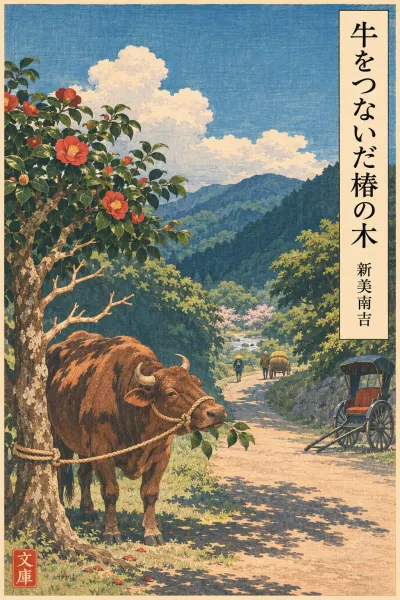
牛をつないだ椿の木 Ushi o Tsunaida Tsubaki no Ki, part 1: A Young Camellia Stripped Bare
In this part
Risuke the ox-cart driver and Kaizō the rickshaw puller stop on a mountain road. Risuke ties his ox to a young camellia, and the two go to drink from a cold spring some way off the road. When they return, the ox has eaten all the camellia's leaves. The old landowner from town is standing by the tree with his bicycle, and he scolds Risuke furiously until Kaizō apologises for him.
AI translation · independently checked
一1
山の中の道のかたわらに、椿の若木がありました。Beside a road in the mountains there stood a young camellia tree.
牛曳きの利助さんは、それに牛をつなぎました。Risuke the ox-cart driver tied his ox to it.
人力曳きの海蔵さんも、椿の根本へ人力車をおきました。Kaizō the rickshaw puller also set his rickshaw down at the foot of the camellia.
人力車は牛ではないから、つないでおかなくってもよかったのです。A rickshaw is not an ox, so there was no need to tie it up.
そこで、利助さんと海蔵さんは、水をのみに山の中にはいってゆきました。Then Risuke and Kaizō went off into the hills to get a drink of water.
道から一町ばかり山にわけいったところに、清くてつめたい清水がいつも湧いていたのであります。A hundred yards or so into the hills from the road, a clear, cold spring was always bubbling up.
二人はかわりばんこに、泉のふちの、しだやぜんまいの上に両手をつき、腹ばいになり、つめたい水の匂いをかぎながら、鹿のように水をのみました。Taking turns, the two men put both hands down on the ferns and fiddleheads at the edge of the spring, lay flat on their bellies, and, breathing in the smell of the cold water, drank like deer.
はらの中が、ごぼごぼいうほどのみました。They drank until their insides gurgled.
山の中では、もう春蝉が鳴いていました。Up in the hills the spring cicadas were already singing.
「ああ、あれがもう鳴き出したな。あれをきくと暑くなるて。」"Ah, those things have started up already. Once you hear them, you know it's going to get hot."
と、海蔵さんが、まんじゅう笠をかむりながらいいました。said Kaizō, putting on his domed bamboo hat.
「これからまたこの清水を、ゆききのたンびに飲ませてもらうことだて。」"From now on I'll be stopping for a drink at this spring again every time I pass this way."
と、利助さんは、水をのんで汗が出たので、手拭いでふきふきいいました。said Risuke, mopping himself with his towel, for drinking the water had made him sweat.
「もうちと、道に近いとええがのオ。」"If only it were a bit closer to the road."
と海蔵さんがいいました。said Kaizō.
「まったくだて。」"Isn't that the truth."
と、利助さんが答えました。Risuke answered.
ここの水をのんだあとでは、誰でもそんなことを挨拶のようにいいあうのがつねでした。After drinking the water here, everyone used to say something like that to one another, almost as a kind of greeting.
二人が椿のところへもどって来ると、そこに自転車をとめて、一人の男の人が立っていました。When the two came back to the camellia, they found a man standing there with a bicycle stopped beside him.
その頃は自転車が日本にはいって来たばかりのじぶんで、自転車を持っている人は、田舎では旦那衆にきまっていました。In those days bicycles had only just come into Japan, and in the countryside anyone who owned a bicycle was sure to be one of the well-to-do gentlemen.
「誰だろう。」"Who can that be?"
と、利助さんが、おどおどしていいました。said Risuke nervously.
「区長さんかも知れん。」"Might be the district head."
と、海蔵さんがいいました。said Kaizō.
そばに来てみると、それはこの附近の土地を持っている、町の年とった地主であることがわかりました。When they came closer, they saw that it was the old landowner from town who owned the land around there.
そして、も一つわかったことは、地主がかんかんに怒っていることでした。And the other thing they saw was that the landowner was in a towering rage.
「やいやい、この牛は誰の牛だ。」"Hey, you there! Whose ox is this?"
と、地主は二人をみると、どなりつけました。the landowner bellowed as soon as he saw the two of them.
その牛は利助さんの牛でありました。The ox was Risuke's.
「わしの牛だがのイ。」"It's mine, sir."
「てめえの牛? これを見よ。椿の葉をみんな喰ってすっかり坊主にしてしまったに。」"Yours? Then look at this! It's eaten every last leaf off the camellia and stripped it bare!"
二人が、牛をつないだ椿の木を見ると、それは自転車をもった地主がいったとおりでありました。When the two looked at the camellia tree where the ox had been tied, it was just as the landowner with the bicycle had said.
若い椿の、柔らかい葉はすっかりむしりとられて、みすぼらしい杖のようなものが立っていただけでした。Every soft leaf of the young camellia had been torn off, and all that was left standing was something like a shabby walking stick.
利助さんは、とんだことになったと思って、顔をまっかにしながら、あわてて木から綱をときました。Risuke, thinking what a dreadful thing had happened, turned bright red and hurriedly untied the rope from the tree.
そして申しわけに、牛の首ったまを、手綱でぴしりと打ちました。Then, by way of apology, he gave the ox a sharp crack on the scruff of its neck with the reins.
しかし、そんなことぐらいでは、地主はゆるしてくれませんでした。But a little thing like that was not going to make the landowner forgive him.
地主は大人の利助さんを、まるで子供を叱るように、さんざん叱りとばしました。The landowner gave Risuke, a grown man, a thorough telling-off, just as if he were scolding a child.
そして自転車のサドルをパンパン叩きながら、こういいました。And slapping the bicycle saddle again and again, he said:
「さあ、何でもかんでも、もとのように葉をつけてしめせ。」"Now then, whatever it takes, you put the leaves back the way they were and show me!"
これは無理なことでありました。That was an impossible demand.
そこで人力曳きの海蔵さんも、まんじゅう笠をぬいで、利助さんのためにあやまってやりました。So Kaizō the rickshaw puller also took off his domed hat and apologised on Risuke's behalf.
「まあまあ、こんどだけはかにしてやっとくんやす。利助さも、まさか牛が椿を喰ってしまうとは知らずにつないだことだで。」"Now, now, please forgive him just this once. Risuke never dreamed the ox would eat the camellia when he tied it there."
そこでようやく地主は、はらのむしがおさまりました。At last the landowner's temper cooled.
けれど、あまりどなりちらしたので、体がふるえるとみえて、二、三べん自転車に乗りそこね、それからうまくのって、行ってしまいました。But he had shouted so much that he seemed to be trembling all over; he failed two or three times to get onto his bicycle, then at last managed it and rode away.
Vocabulary
| Word | Meaning | JLPT |
|---|---|---|
| かたわらかたわら | side; besidedictionary form: 傍らWritten-style word; 道のかたわら = by the roadside. | N1 |
| 根本ねもと | foot (of a tree); baseAlso read こんぽん meaning 'root, basis'; ねもと is the physical base. | N1 |
| 湧いてわく | to well up; to gush forth (water)dictionary form: 湧くAlso used for feelings: 勇気が湧く. | N2 |
| かわりばんこかわりばんこ | taking turns; by turnsColloquial; same as 交代で. | — |
| 腹ばいはらばい | lying flat on one's stomachdictionary form: 腹這い腹ばいになる = to lie face down. | — |
| 旦那衆だんなしゅう | the well-to-do gentlemen; the moneyed class衆 marks a group of people of a certain kind. | — |
| 地主じぬし | landowner; landlordA key figure in the story. | N1 |
| かんかんかんかん | (being) furiousUsually かんかんに怒る: to be livid. | — |
| 坊主ぼうず | bare, stripped (like a shaven head)Literally 'Buddhist monk'; 坊主にする = to strip something bare, from the monk's shaved head. | — |
| みすぼらしいみすぼらしい | shabby; wretched-looking | N1 |
| 申しわけもうしわけ | apology; excusedictionary form: 申し訳申しわけに = by way of apology; familiar from 申し訳ありません. | N3 |
| 叱りとばしましたしかりとばす | to scold severely; to tell offdictionary form: 叱り飛ばす〜とばす adds force to a verb of speaking. | — |
| かにしてかんにんする | to forgive; to pardondictionary form: 堪忍するDialect contraction of 堪忍して; やっとくんやす is a dialect request: 'please do (it) for him'. | — |
| はらのむしはらのむし | one's temper; angerdictionary form: 腹の虫腹の虫がおさまる = one's anger subsides; literally 'the bug in the belly settles'. | — |
Grammar
〜ほど N4 to the extent that; so much that
ほど after a clause shows the degree of an action. Here they drank so much that their bellies gurgled.
はらの中が、ごぼごぼいうほどのみました。
They drank until their insides gurgled.
〜たばかり N4 have just done
Past tense plus ばかり means something has only just happened. Here it tells us bicycles had only recently arrived in Japan.
自転車が日本にはいって来たばかりのじぶんで
it was a time when bicycles had only just come into Japan
〜かも知れん N4 might be; perhaps
This is かもしれない, with the colloquial/dialect negative ん replacing ない. It expresses a guess.
「区長さんかも知れん。」
"Might be the district head."
〜とおり N3 just as; exactly as
Verb (often past) + とおり means 'in the same way as'. The tree looked exactly as the landowner had described.
それは自転車をもった地主がいったとおりでありました。
it was just as the landowner with the bicycle had said.
〜とみえて N1 apparently; it seems that … (and so)
とみえる means 'it appears that', an inference drawn from outward signs. It is a literary or formal pattern. In the て-form it links to what follows as a reason. Here the narrator infers he was shaking from the way he behaved.
体がふるえるとみえて、二、三べん自転車に乗りそこね
he seemed to be trembling, and failed two or three times to get onto his bicycle
〜そこねる N2 to fail to do; to miss doing
Attached to the verb stem, そこねる (also そこなう) means the attempt went wrong. 乗りそこね = failed to get on.
二、三べん自転車に乗りそこね
he failed two or three times to get onto his bicycle