Part 4 of 7 · JLPT N3
牛をつないだ椿の木 Ushi o Tsunaida Tsubaki no Ki, part 4: A Donation Box No One Fills
In this part
Kaizō hangs a donation box on the camellia, asking travellers to help pay for a well, then hides on the cliff to watch. An old woman cannot read the sign, and an old man reads it, is impressed, smokes his pipe and leaves without giving anything, so Kaizō decides to do the work alone. The next day at the village teahouse he puts back the sweet he has picked up, and his friend Gen asks him what is wrong.
AI translation · independently checked
三Three
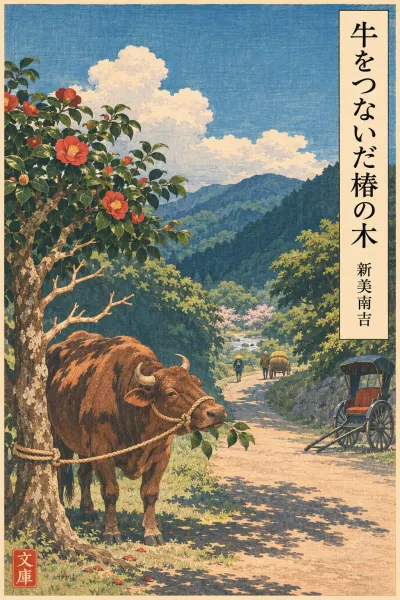
旅の人や、町へゆく人は、しんたのむねの下の椿の木に、賽銭箱のようなものが吊るされてあるのを見ました。Travellers, and people on their way to town, saw that something like an offering box had been hung on the camellia tree below Shinta no Mune.
それには札がついていて、こう書いてありました。A tag was attached to it, and this is what it said.
「ここに井戸を掘って旅の人にのんでもらおうと思います。志のある方は一銭でも五厘でも喜捨して下さい。」"I mean to dig a well here so that travellers may drink from it. Anyone who is willing, please give, even if it is only one sen or five rin."
これは海蔵さんのしわざでありました。This was Kaizō's doing.
それがしょうこに、それから五、六日のち、海蔵さんは、椿の木に向かいあった崖の上にはらばいになって、えにしだの下から首ったまだけ出し、人々の喜捨のしようを見ていました。As proof of it, five or six days later Kaizō lay on his belly on top of the cliff facing the camellia tree, with only his head poking out from under the broom bushes, watching how people went about giving.
やがて半田の町の方からお婆さんがひとり、乳母車を押してきました。Before long an old woman came along from the direction of the town of Handa, pushing a baby carriage.
花を売って帰るところでしょう。No doubt she was on her way home after selling flowers.
お婆さんは箱に目をとめて、しばらく札をながめていました。The old woman noticed the box and gazed at the sign for a while.
しかし、お婆さんは字を読んだのではなかったのです。But she had not been reading the words at all.
なぜなら、こんなひとりごとをいいました。For this is what she muttered to herself:
「地蔵さんも何もないのに、なんでこんなとこに賽銭箱があるのじゃろ。」そしてお婆さんは行ってしまいました。"There's no Jizō statue here or anything, so why would there be an offering box in a spot like this?" And off she went.
海蔵さんは、右手にのせていたあごを、左手にのせかえました。Kaizō shifted his chin from his right hand to his left.
こんどは村の方から、しりはしょりした、がにまたのお爺さんがやって来ました。This time a bow-legged old man, with the hem of his kimono tucked up into his sash, came along from the direction of the village.
「庄平さんのじいさんだ。あの爺さんは昔の人間でも、字が読めるはずだ。」と、海蔵さんはつぶやきました。"That's old Shōhei. He may be a man of the old days, but that old man ought to be able to read," Kaizō murmured.
お爺さんは箱に眼をとめました。The old man noticed the box.
そして「なになに。」といいながら、腰をのばして札を読みはじめました。Then, saying "Well now, what's this?", he straightened his back and began to read the sign.
読んでしまうと、「なアるほど、ふふウん、なアるほど。」と、ひどく感心しました。When he had finished reading, he was greatly impressed: "I see, I see. Hmm, well, I see."
そして、懐の中をさぐりだしたので、これは喜捨してくれるなと思っていると、とり出したのは古くさい莨入れでした。Then he began feeling about inside the front of his kimono, and just as Kaizō was thinking, "Here comes a donation," what he pulled out was a shabby old tobacco pouch.
お爺さんは椿の根元でいっぷくすって行ってしまいました。The old man had a smoke at the foot of the camellia and then went on his way.
海蔵さんは起きあがって、椿の木の方へすべりおりました。Kaizō got up and slid down toward the camellia tree.
箱を手にとって、ふってみました。He picked up the box and gave it a shake.
何の手ごたえもないのでした。Nothing moved inside it at all.
がっかりして海蔵さんは、ふうッと、といきをもらしました。Disappointed, Kaizō let out a long sigh.
「けっきょく、ひとは頼りにならんとわかった。いよいよこうなったら、おれひとりの力でやりとげるのだ。」"So in the end I've learned you can't count on other people. Well, if that's how it is, I'll see this through on my own strength."
といいながら、海蔵さんは、しんたのむねをのぼって行きました。Saying this, Kaizō climbed up Shinta no Mune.
四Four
次の日、大野の町へ客を送ってきた海蔵さんが、村の茶店にはいっていきました。The next day, having taken a passenger to the town of Ōno, Kaizō went into the village teahouse.
そこは、村の人力曳きたちが一仕事して来ると、次のお客を待ちながら、憩んでいる場所になっていたのでした。That was where the village rickshaw pullers rested after finishing a job, while they waited for their next passenger.
その日も、海蔵さんよりさきに三人の人力曳きが、茶店の中に憩んでいました。That day too, three rickshaw pullers had got there before Kaizō and were resting inside the teahouse.
店にはいって来た海蔵さんは、いつものように、駄菓子箱のならんだ台のうしろに仰向けに寝ころがってうっかり油菓子をひとつ摘んでしまいました。When Kaizō came into the shop, he lay down on his back behind the stand where the boxes of cheap sweets were lined up, as he always did, and without thinking he picked up a fried cake.
人力曳きたちは、お客を待っているあいだ、することがないので、つい、駄菓子箱のふたをあけて、油菓子や、げんこつや、ぺこしゃんという飴や、やきするめや餡つぼなどをつまむのが癖になっていました。While they waited for passengers, the rickshaw pullers had nothing to do, so they had got into the habit of opening the lids of the sweet boxes and nibbling on fried cakes, knobbly genkotsu "fist" sweets, the boiled candy called pekoshan, grilled dried squid, bean-paste sweets and the like.
海蔵さんもまたそうでした。Kaizō was no different.
しかし海蔵さんは、今、つまんだ油菓子をまたもとの箱に入れてしまいました。But this time Kaizō put the fried cake he had just picked up back into its box.
見ていた仲間の源さんが、His friend Gen, who had been watching, said,
「どうしただや、海蔵さ。あの油菓子は鼠の小便でもかかっておるだかや。」"What's the matter, Kaizō? Has a mouse gone and peed on that fried cake or something?"
といいました。he said.
海蔵さんは顔をあかくしながら、Turning red, Kaizō
「ううん、そういうわけじゃねえけれど、きょうはあまり喰べたくないだがや。」"No, it's not that, but I don't much feel like eating today,"
と、答えました。answered.
「へへエ。いっこう顔色も悪くないようだが、それでどこか悪いだかや。」"Huh. You don't look the least bit pale, so is something wrong with you somewhere?"
Vocabulary
| Word | Meaning | JLPT |
|---|---|---|
| 賽銭箱さいせんばこ | offering box (at a shrine or temple)賽銭 is the money tossed in as an offering when praying. | — |
| 志こころざし | goodwill, a wish to helpUsually 'ambition, aim'; in 志のある方 it means people willing to give. | N1 |
| 喜捨きしゃ | charitable donation, giving almsLiterally 'gladly give away'; a formal, Buddhist-flavoured word. | — |
| しわざしわざ | someone's doing, the work ofdictionary form: 仕業Often used for mischief, here used playfully. | — |
| はらばいはらばい | lying flat on one's bellydictionary form: 腹這いはらばいになる = to lie face down. | — |
| ひとりごとひとりごと | talking to oneself, a mutterdictionary form: 独り言 | N2 |
| 地蔵じぞう | Jizō, a Buddhist guardian figureStone Jizō statues stand by roadsides as protectors of travellers and children, often with an offering box beside them. | — |
| 感心かんしん | being impressed, admiring感心する: to be impressed by something worthy. | N3 |
| 懐ふところ | the fold at the front of a kimono, used as a pocket | — |
| 手ごたえてごたえ | a feel of something in one's hand, a responsedictionary form: 手応えHere: no weight or rattle of coins. Also used for 'a sense of results'. | — |
| といきといき | a sighdictionary form: 吐息といきをもらす = to let out a sigh. | — |
| 頼りたより | reliance, something to depend on頼りにならない = can't be relied on; ならん is a casual, dialect-like negative. | — |
| やりとげるやりとげる | to carry through to the end, accomplishdictionary form: やり遂げる | N1 |
| 癖くせ | habit (often a bad one) | N3 |
Grammar
〜てある N4 has been done (resulting state)
With a transitive verb, 〜てある describes a state that someone has deliberately brought about. 吊るされてある combines the passive with てある, an old-fashioned way of saying the box has been left hanging there.
賽銭箱のようなものが吊るされてあるのを見ました
saw something like an offering box that had been hung there
〜てもらおうと思う N4 intend to have someone do something
〜てもらう means to receive the benefit of someone's action; the volitional form plus と思う turns it into an intention. Kaizō plans to have travellers drink from the well.
旅の人にのんでもらおうと思います
I mean to have travellers drink from it
〜はずだ N4 should, ought to (expectation)
はずだ expresses a confident expectation based on what the speaker knows. Kaizō expects the old man to be able to read, even though he is from an older generation.
あの爺さんは昔の人間でも、字が読めるはずだ。
He may be from the old days, but he ought to be able to read.
〜と思っていると N3 just as one was thinking ..., (something unexpected happened)
〜ていると followed by a new event shows that while one state continued, something else happened. Here it sets up a disappointing surprise: the old man takes out a tobacco pouch, not money.
これは喜捨してくれるなと思っていると、とり出したのは古くさい莨入れでした
just as he was thinking, "Here comes a donation," what came out was a shabby old tobacco pouch
〜のが癖になる N3 to get into the habit of doing
The の nominalises the verb phrase, and 癖になっていました says this had become a habit. The long list of sweets sits inside the nominalised phrase.
やきするめや餡つぼなどをつまむのが癖になっていました
they had got into the habit of nibbling on grilled dried squid, bean-paste sweets and the like
dialect だや / だかや / だがや N1 regional sentence endings (question / assertion)
In this rural dialect だや and だかや mark questions (like standard のか / のかい), while だがや adds emphasis to a statement (like standard んだよ). おる replaces いる, and さ after a name is a shortened さん.
どうしただや、海蔵さ。
What's the matter, Kaizō?