Part 2 of 7 · JLPT N3
牛をつないだ椿の木 Ushi o Tsunaida Tsubaki no Ki, part 2: Kaizō Asks the Price of a Well
In this part
Walking back toward the village, Kaizō feels for Risuke, who has been scolded, and the two wish the spring were closer to the road. At the rickshaw pullers' hangout Kaizō asks Idoshin the well digger what a well costs, learns that thirty yen would do, and keeps his reasons to himself. That evening he tells his old mother about the camellia, and she lists all the travellers who pass that hot stretch of road and would be glad of a well.
AI translation · independently checked
利助さんと海蔵さんは、村の方へ歩きだしました。Risuke and Kaizō set off walking toward the village.
けれどもう話をしませんでした。But they did not talk any more.
大人が大人に叱りとばされるというのは、情けないことだろうと、人力曳きの海蔵さんは、利助さんの気持ちをくんでやりました。It must be a wretched thing for a grown man to be roundly scolded by another grown man, thought Kaizō the rickshaw puller, and he felt for Risuke.
「もうちっと、あの清水が道に近いとええだがのオ。」"If only that spring were a bit closer to the road, eh?"
と、とうとう海蔵さんが言いました。Kaizō said at last.
「まったくだて。」"You're right there."
と、利助さんが答えました。Risuke answered.
二II
海蔵さんが人力曳きのたまり場へ来ると、井戸掘りの新五郎さんがいました。When Kaizō came to the place where the rickshaw pullers gathered, Shingorō the well digger was there.
人力曳きのたまり場といっても、村の街道にそった駄菓子屋のことでありました。It was called the rickshaw pullers' hangout, but it was really just a little sweetshop along the village highway.
そこで井戸掘りの新五郎さんは、油菓子をかじりながら、つまらぬ話を大きな声でしていました。There Shingorō the well digger was munching on a fried sweet and chattering about nothing much in a loud voice.
井戸の底から、外にいる人にむかって話をするために、井戸新さんの声が大きくなってしまったのであります。Idoshin's voice had grown loud from talking up from the bottom of wells to the people outside.
「井戸ってもなア、いったいいくらくらいで掘れるもんかイ、井戸新さ。」"Say, Idoshin, about how much does it cost to dig a well, anyway?"
と、海蔵さんは、じぶんも駄菓子箱から油菓子を一本つまみだしながらききました。Kaizō asked, picking out a fried sweet from the sweet box for himself as well.
井戸新さんは、人足がいくらいくら、井戸囲いの土管がいくらいくら、土管のつぎめを埋めるセメントがいくらと、こまかく説明して、Idoshin explained it all in detail: so much for the labourers, so much for the clay pipes that line the well, so much for the cement to fill the joints between the pipes,
「先ず、ふつうの井戸なら、三十円もあればできるな。」"So for an ordinary well, thirty yen ought to do it, I'd say."
と、いいました。he said.
「ほオ、三十円な。」"Well now, thirty yen, is it?"
と、海蔵さんは、眼をまるくしました。Kaizō's eyes went round.
それからしばらく、油菓子をぼりぼりかじっていましたが、Then for a while he crunched away on his fried sweet,
「しんたのむねを下りたところに掘ったら、水が出るだろうかなア。」"If a man dug at the spot just down from Shinta no Mune, d'you reckon he'd strike water?"
と、ききました。he asked.
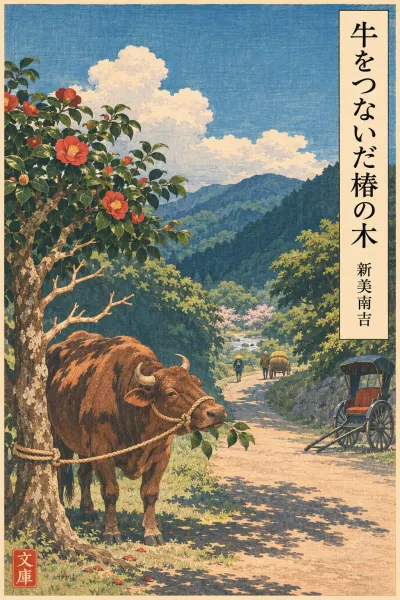
それは、利助さんが牛をつないだ椿の木のあたりのことでありました。He meant the spot near the camellia tree where Risuke had tied his ox.
「うん、あそこなら、出ようて、前の山で清水が湧くくらいだから、あの下なら水は出ようが、あんなところへ井戸を掘って何にするや。」"Sure, you'd get water there. Seeing as a spring wells up on the hill in front, you'd strike water below it all right. But what would you want to dig a well in a place like that for?"
と、井戸新さんがききました。Idoshin asked.
「うん、ちっとわけがあるだて。」"Well, I've got my reasons."
と、答えたきり、海蔵さんはそのわけをいいませんでした。That was all Kaizō answered, and he did not say what his reasons were.
海蔵さんは、からの人力車をひきながら家に帰ってゆくとき、As Kaizō pulled his empty rickshaw home,
「三十円な。……三十円か。」"Thirty yen, eh… thirty yen."
と、何度もつぶやいたのでありました。he murmured to himself again and again.
海蔵さんは藪をうしろにした小さい藁屋に、年とったお母さんと二人きりで住んでいました。Kaizō lived alone with his aged mother in a small thatched cottage with a bamboo thicket behind it.
二人は百姓仕事をし、暇なときには海蔵さんが、人力車を曳きに出ていたのであります。The two of them worked the fields, and whenever he had time to spare, Kaizō went out to pull his rickshaw.
夕飯のときに二人は、その日にあったことを話しあうのが、たのしみでありました。At supper, the two of them loved to tell each other what had happened that day.
年とったお母さんは隣の鶏が今日はじめて卵をうんだが、それはおかしいくらい小さかったこと、背戸の柊の木に蜂が巣をかけるつもりか、昨日も今日も様子を見に来たが、あんなところに蜂の巣をかけられては、味噌部屋へ味噌をとりにゆくときにあぶなくてしようがないということを話しました。His old mother told how the neighbours' hen had laid her very first egg today, but it was so small it was comical; and how a bee had come yesterday and again today to look over the holly tree by the back door, perhaps meaning to build a nest there, and if it built a nest in a place like that, it would be terribly dangerous every time she went to the miso shed to fetch miso.
海蔵さんは、水をのみにいっている間に利助さんの牛が椿の葉を喰ってしまったことを話して、Kaizō told her how, while he and Risuke had gone off to drink water, Risuke's ox had eaten the leaves of the camellia,
「あそこの道ばたに井戸があったら、いいだろにのオ。」と、いいました。"Wouldn't it be good if there were a well by the road there?" he said.
「そりゃ、道ばたにあったら、みんながたすかる。」"Why, if there were one by the road, it would help everybody."
と、いって、お母さんは、あの道の暑い日盛りに通る人々をかぞえあげました。his mother said, and she counted off all the people who passed along that road in the heat of the day.
大野の町から車をひいて来る油売り、半田の町から大野の町へ通る飛脚屋、村から半田の町へでかけてゆく羅宇屋の富さん、そのほか沢山の荷馬車曳き、牛車曳き、人力曳き、遍路さん、乞食、学校生徒などをかぞえあげました。The oil seller pulling his cart from the town of Ōno, the courier going from the town of Handa to the town of Ōno, Tomi the pipe-stem mender setting off from the village to the town of Handa, and besides them all the many packhorse drivers, ox-cart drivers, rickshaw pullers, pilgrims, beggars and schoolchildren — she counted them all off.
これらの人ののどがちょうどしんたのむねあたりで乾かぬわけにはいきません。Every one of these people was bound to grow thirsty right around Shinta no Mune.
Vocabulary
| Word | Meaning | JLPT |
|---|---|---|
| 叱りとばされるしかりとばす | to scold harshly, to give someone a dressing-downdictionary form: 叱り飛ばすHere in the passive: to be scolded harshly. 〜飛ばす adds the sense of doing something forcefully. | — |
| 情けないなさけない | miserable, shameful, pitifulOften used for humiliating or pathetic situations. | — |
| 清水しみず | spring water, a clear springRead しみず for a natural spring; せいすい means simply 'clean water'. | — |
| たまり場たまりば | hangout, gathering placedictionary form: 溜まり場From 溜まる 'to collect, pile up'. | — |
| 駄菓子屋だがしや | shop selling cheap sweets駄菓子 are cheap, everyday sweets, as opposed to fine confectionery. | — |
| 街道かいどう | highway, main road between towns | N1 |
| 人足にんそく | labourer, hired workmanOld-fashioned word for manual labourers. | — |
| 土管どかん | clay pipe, earthenware pipe | — |
| つぶやいたつぶやく | to murmur, to mutter to oneselfdictionary form: 呟く | N1 |
| 藁屋わらや | thatched cottage藁 is straw; a humble house with a straw-thatched roof. | — |
| 百姓仕事ひゃくしょうしごと | farm work百姓 'farmer, peasant' is old-fashioned and can sound rude today; 農家 is the neutral word. | — |
| 背戸せど | back door; area behind the houseOld or rural word. | — |
| 日盛りひざかり | the hottest part of the day | — |
| 羅宇屋らうや | repairer of tobacco-pipe stemsA 羅宇 is the bamboo stem of a traditional Japanese pipe (kiseru); the 羅宇屋 travelled around replacing them. | — |
Grammar
〜といっても N3 although it is called ~; even so
Sets up an expectation from a name or label and then corrects it. The 'rickshaw pullers' hangout' sounds grand, but it is really just a sweetshop.
人力曳きのたまり場といっても、村の街道にそった駄菓子屋のことでありました。
It was called the rickshaw pullers' hangout, but it was really just a little sweetshop along the village highway.
〜ながら N4 while doing ~
Attached to the verb stem, it shows that two actions happen at the same time, with the main action at the end. Kaizō pulls the rickshaw and goes home at once.
からの人力車をひきながら家に帰ってゆくとき
as he pulled his empty rickshaw home
〜たきり N2 did ~ and nothing more
After a past-tense verb, きり means that the action happened and then nothing followed. Kaizō gave that one answer and said nothing further.
答えたきり、海蔵さんはそのわけをいいませんでした。
That was all Kaizō answered, and he did not say what his reasons were.
〜ては〜てしようがない N3 if ~ happens, it would be unbearably ~
〜ては gives a condition with an unwelcome result, and 〜てしようがない (= しょうがない) means 'extremely, beyond help'. Here the passive かけられては also shows that the mother would be troubled by the bee's action.
あんなところに蜂の巣をかけられては、味噌部屋へ味噌をとりにゆくときにあぶなくてしようがない
if a bee built a nest in a place like that, it would be terribly dangerous every time she went to the miso shed to fetch miso
〜ないわけにはいかない N3 cannot help but ~; is bound to ~
A double negative meaning something is unavoidable. 乾かぬ is the literary form of 乾かない, so the travellers' throats are bound to grow dry.
これらの人ののどがちょうどしんたのむねあたりで乾かぬわけにはいきません。
Every one of these people was bound to grow thirsty right around Shinta no Mune.