Part 7 of 7 · JLPT N3
牛をつないだ椿の木 Ushi o Tsunaida Tsubaki no Ki, part 7: Kaizō's Well and His Last Journey
In this part
Kaizō is glad that the greedy old landowner has had a change of heart before dying. In late spring, Kaizō leaves the village as a soldier for the war with Russia, stops to drink from his newly finished well beside the camellia tree, and departs full of quiet joy. He never returns, but the well he left behind still refreshes tired travellers today.
AI translation · independently checked
海蔵さんは、思いがけない言葉をきいて、返事のしようもありませんでした。Hearing such unexpected words, Kaizō could find nothing to say in reply.
だが、死ぬまえに、この一人の慾ばりの老人が、よい心になったのは、海蔵さんにもうれしいことでありました。Still, Kaizō, too, was glad that this greedy old man had come to have a good heart before he died.
六Six
しんたのむねから打ちあげられて、少しくもった空で花火がはじけたのは、春も末に近いころの昼でした。It was midday, near the end of spring, when fireworks sent up from Shinta no Mune burst in the slightly cloudy sky.
村の方から行列が、しんたのむねを下りて来ました。A procession came from the direction of the village, down the slope from Shinta no Mune.
行列の先頭には黒い服、黒と黄の帽子をかむった兵士が一人いました。At the head of the procession walked a single soldier in a black uniform and a black and yellow cap.
それが海蔵さんでありました。That soldier was Kaizō.
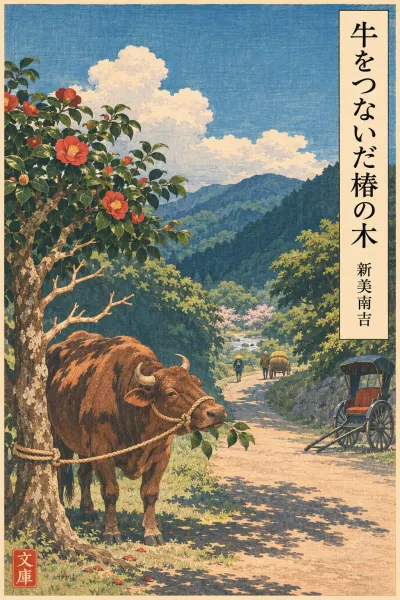
しんたのむねを下りたところに、かたがわには椿の木がありました。At the foot of Shinta no Mune, on one side of the road, stood the camellia tree.
今花は散って、浅緑の柔らかい若葉になっていました。Its flowers had fallen by now, and it was covered in soft young leaves of pale green.
もういっぽうには、崖をすこしえぐりとって、そこに新しい井戸ができていました。On the other side, the cliff had been cut back a little, and a new well had been made there.
そこまで来ると、行列がとまってしまいました。When it reached that spot, the procession came to a halt.
先頭の海蔵さんがとまったからです。That was because Kaizō, at its head, had stopped.
学校かえりの小さい子供が二人、井戸から水を汲んで、のどをならしながら、美しい水をのんでいました。Two little children on their way home from school had drawn water from the well and were drinking the lovely water, gulping it down noisily.
海蔵さんは、それをにこにこしながら見ていました。Kaizō stood watching them with a broad smile.
「おれも、いっぱいのんで行こうか。」"Think I'll have a drink before I go, too."
子供たちがすむと、海蔵さんはそういって、井戸のところへ行きました。When the children had finished, Kaizō said this and went over to the well.
中をのぞくと、新しい井戸に、新しい清水がゆたかに湧いていました。When he looked in, fresh clear water was welling up plentifully in the new well.
ちょうど、そのように、海蔵さんの心の中にも、よろこびが湧いていました。In just the same way, joy was welling up in Kaizō's heart.
海蔵さんは、汲んでうまそうにのみました。Kaizō drew some water and drank it with relish.
「わしはもう、思いのこすことはないがや。こんな小さな仕事だが、人のためになることを残すことができたからのオ。」"There's nothing left for me to regret now. It's only a small job, but I've managed to leave behind something that'll do people good."
と、海蔵さんは誰でも、とっつかまえていいたい気持ちでした。That was how Kaizō felt; he wanted to grab hold of anyone at all and tell them so.
しかし、そんなことはいわないで、ただにこにこしながら、町の方へ坂をのぼって行きました。But he said nothing of the kind, and simply went on up the slope toward the town, smiling all the while.
日本とロシヤが、海の向こうでたたかいをはじめていました。Japan and Russia had begun a war across the sea.
海蔵さんは海をわたって、そのたたかいの中にはいって行くのでありました。Kaizō was to cross the sea and go into the midst of that war.
七Seven
ついに海蔵さんは、帰って来ませんでした。In the end, Kaizō never came back.
勇ましく日露戦争の花と散ったのです。He fell bravely in the Russo-Japanese War, scattered like a blossom.
しかし、海蔵さんのしのこした仕事は、いまでも生きています。But the work Kaizō left behind lives on even today.
椿の木かげに清水はいまもこんこんと湧き、道につかれた人々は、のどをうるおして元気をとりもどし、また道をすすんで行くのであります。In the shade of the camellia the clear spring water still wells up without end, and people weary from the road wet their throats, get their strength back, and go on their way once more.
Vocabulary
| Word | Meaning | JLPT |
|---|---|---|
| 思いがけないおもいがけない | unexpected, surprisingLiterally 'not something one had thought of'. | N2 |
| 慾ばりよくばり | greedy; a greedy persondictionary form: 欲張り慾 is an older form of the kanji 欲. | N2 |
| 先頭せんとう | the head, the front (of a line or procession) | N2 |
| 兵士へいし | soldier | N1 |
| 若葉わかば | young leaves, fresh spring foliage | — |
| えぐりとってえぐりとる | to gouge out, to hollow outdictionary form: えぐり取るHere the cliff face was cut back to make room for the well. | — |
| 汲んでくむ | to draw (water), to scoop updictionary form: 汲む | N2 |
| 清水しみず | clear spring waterRead しみず for spring water; also a common place and family name. | — |
| 湧いてわく | to well up, to gush outdictionary form: 湧くUsed for both water and feelings, as the story does in the next sentence. | N2 |
| 思いのこすおもいのこす | to leave with regrets, to have something left undonedictionary form: 思い残すAlmost always negative: 思い残すことはない 'I have no regrets'. | — |
| がやがや | sentence-final emphasis, 'you know'Regional dialect of the Chita/Owari area; のオ in the same speech is also dialectal. | — |
| とっつかまえてとっつかまえる | to grab hold of, to collar (someone)dictionary form: とっ捕まえるColloquial, stronger form of 捕まえる. | — |
| 花と散ったはなとちる | to die gallantly in battledictionary form: 花と散るLiterally 'to scatter like blossoms'; a set expression for a soldier's death. | — |
| こんこんとこんこんと | (of water) welling up endlessly | — |
Grammar
〜ようもない N2 there is no way to ~
The verb stem plus よう ('way of doing') with もない means there was no possible way to do it. しようもない here means Kaizō was at a loss for any reply.
返事のしようもありませんでした
he could find nothing to say in reply
〜からです N4 it is because ~
A sentence ending in からです gives the reason for what was said just before. Here it explains why the procession stopped.
先頭の海蔵さんがとまったからです。
That was because Kaizō, at its head, had stopped.
〜ながら N4 while ~ing
Attached to the verb stem, ながら shows two actions happening at once by the same person. Kaizō smiles as he watches.
海蔵さんは、それをにこにこしながら見ていました。
Kaizō stood watching them with a broad smile.
〜てしまう N4 to end up ~ / ~ completely
Here てしまう stresses that the procession came to a full, somewhat unexpected stop.
行列がとまってしまいました。
the procession came to a halt.
〜ないで N4 without ~ing
The negative form plus で describes doing the next action without doing the first. Kaizō went on without saying anything.
そんなことはいわないで、ただにこにこしながら、町の方へ坂をのぼって行きました。
he said nothing of the kind, and simply went on up the slope toward the town, smiling all the while.
〜のであります N3 explanatory 'it is that ~' (formal)
This is an old-fashioned formal version of のです, used by the narrator to explain a situation with weight and emphasis.
そのたたかいの中にはいって行くのでありました。
he was to go into the midst of that war.