Intermediate · JLPT N3
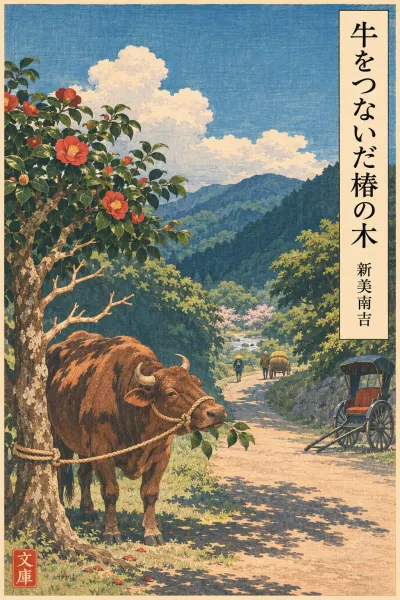
牛をつないだ椿の木Ushi o Tsunaida Tsubaki no Ki — The Camellia by the Mountain Road
- JLPT N3
- 8,971 characters
- 7 parts
- about 75 minutes
- 1 easier version
This is a quiet country tale about one man's small, stubborn kindness. On a hot mountain road, Kaizō, a rickshaw puller, and Risuke, an ox-cart driver, leave the road to drink at a distant spring. While they are gone, Risuke's ox strips the leaves from a young camellia, and the old landowner who owns the tree scolds Risuke furiously. Out of that small incident Kaizō forms a plan: a well by the roadside, so that tired travellers need not walk so far for water. The story follows the plan through refusals, setbacks and quiet sacrifice, and the people Kaizō must win over along the way. The setting is a village near Handa and Ōno, in the years when bicycles were new in Japan and war with Russia was coming. The narrator speaks gently, in polite です/ます endings with an old-fashioned であります flavour, as if telling the story to children, so the narration is easy to follow. The dialogue is harder. The villagers speak a rural dialect, and the landowner's speech shifts from coarse to elderly and formal. The plot is simple, but the moral turns, especially near the end, reward careful reading.
Contents
Easier versions
This story is also retold in simpler Japanese. Reading an easier version first makes the original much more approachable.
Before you read
- Separate the two voices. The narration uses polite です/ます forms, sometimes with であります, and is fairly standard. The dialogue is in rural dialect: sentence endings like だて, だで, だがや and a drawn-out のオ, and -さ used in place of -さん after names. When a line feels odd, check whether the ending is dialect before looking up the main verb.
- Learn the title words first: 牛 (ox), 椿 (camellia) and 井戸 (well), which also appears in the well digger's nickname 井戸新 (Idoshin). The story keeps returning to these three things, and the title itself, 牛をつないだ椿の木, is a relative clause meaning 'the camellia tree the ox was tied to'.
- Watch for the recurring grammar points in the notes. Some describe how things look or are guessed at: 〜とみえて ('it seems that…'), 〜かも知れん (dialect for かもしれない), 〜とおり ('just as…'). Others describe timing and outcome: 〜たばかり ('had only just…'), 〜たきり ('…and then never again'), 〜そこねる ('to fail to…'). Several of these carry the story's key moments.
- The constructions 〜ては〜てしようがない ('if…, it would be unbearable/hopeless') and 〜といっても ('even though one says…') often come up when characters argue about money and duty. Pay attention to them in the exchanges with Risuke and the landowner.
- Keep the cast list handy. Many minor villagers appear only once, among them Tomi, Nizaemon, Shōhei's father, and Gen and Yoshi at the teahouse. Kaizō, his mother, Risuke, Idoshin and the landowner are the ones to follow closely.
Words to know
The most useful words from the notes across the story.
| Word | Meaning | JLPT |
|---|---|---|
| 地主じぬし | landowner; landlordA key figure in the story. | N1 |
| 感心かんしん | being impressed, admiring感心する: to be impressed by something worthy. | N3 |
| 湧いてわく | to well up; to gush forth (water)dictionary form: 湧くAlso used for feelings: 勇気が湧く. | N2 |
| しゃっくりしゃっくり | hiccup(s) | N2 |
| 腹ばいはらばい | lying flat on one's stomachdictionary form: 腹這い腹ばいになる = to lie face down. | — |
| 叱りとばしましたしかりとばす | to scold severely; to tell offdictionary form: 叱り飛ばす〜とばす adds force to a verb of speaking. | — |
| 清水しみず | spring water, a clear springRead しみず for a natural spring; せいすい means simply 'clean water'. | — |
| 習慣しゅうかん | habit, custom | N4 |
| 承知しょうち | consent, agreement承知する can mean 'to agree to' or 'to know'. Here it means giving permission. | N4 |
| 申しわけもうしわけ | apology; excusedictionary form: 申し訳申しわけに = by way of apology; familiar from 申し訳ありません. | N3 |
| 癖くせ | habit (often a bad one) | N3 |
| がまんがまん | holding back, enduringdictionary form: 我慢がまんする = to put up with, to resist temptation. | N3 |
| 決心けっしん | resolve, determination | N3 |
| お見舞いみまい | visit to a sick persondictionary form: 見舞いお見舞いに行く/来る = to visit someone who is ill. | N3 |
| ひとしいひとしい | equal to, no different fromdictionary form: 等しいAにひとしいB = a B as bad as A. 鬼にもひとしい心 means a heart no better than a demon's. | N3 |
Plot summary
Show the full summary (contains spoilers)
Risuke's ox eats the leaves of a camellia while he and Kaizō drink at a spring far from the road, and the old landowner scolds Risuke until Kaizō apologises for him. Kaizō quietly learns from Idoshin, the well digger, that a well would cost about thirty yen. His mother agrees a roadside well would help everyone. Kaizō asks the newly rich Risuke to pay for it, but Risuke refuses, and Kaizō resolves to build it himself. A donation box he hangs on the camellia brings in nothing, so he decides to do the work alone. He gives up sweets at the teahouse, pretending to have a toothache, and saves the money. Two years later he has nearly enough, but the landowner in Handa refuses permission. When the landowner is dying, his son promises permission after his father's death, and Kaizō is glad. His mother scolds him for wishing for a man's death. Ashamed, Kaizō goes back, apologises, and begs the old man not to die. Moved, the landowner grants permission and offers to pay. In late spring Kaizō leaves as a soldier for the war with Russia. He drinks from the finished well by the camellia and never returns, but the well still refreshes travellers today.
About the author
Niimi Nankichi was a Japanese writer of children's stories, poems and songs from Handa in Aichi Prefecture. The countryside of that area is widely thought to lie behind the village and hills of Gongitsune. He began writing as a young man. Gongitsune appeared in the children's magazine Akai Tori (The Red Bird), edited by Suzuki Miekichi. Niimi later worked as a teacher at a girls' school while continuing to write. His health was poor, and he died of tuberculosis while still in his twenties. Many of his works were published and became widely known only after his death. Besides Gongitsune, he is especially remembered for Tebukuro wo Kai ni (Buying Mittens).