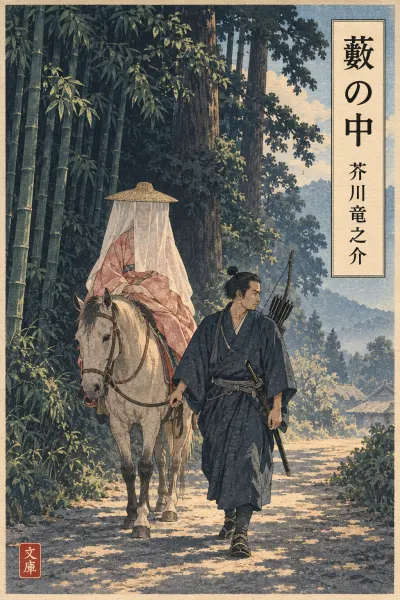
Part 7 of 8 · JLPT N2
藪の中(清水寺に来れる女の懺悔) Yabunonaka, part 7: The Wife's Confession at Kiyomizu
In this part
Masago says that after the bandit assaulted her and left, she saw only cold contempt and hatred in her bound husband's eyes. Overcome with shame, she resolved that they both must die, and she stabbed him with a small dagger when he silently mouthed 'Kill me.' She then tried several times to kill herself but failed, and she breaks down sobbing as she asks what she is to do now.
AI translation · independently checked
――その紺の水干を着た男は、わたしを手ごめにしてしまうと、縛られた夫を眺めながら、嘲るように笑いました。—That man in the dark-blue suikan, once he had taken me by force, looked over at my bound husband and laughed as if in mockery.
夫はどんなに無念だったでしょう。How bitter my husband must have felt!
が、いくら身悶えをしても、体中にかかった縄目は、一層ひしひしと食い入るだけです。But however much he writhed, the ropes wound about his whole body only bit into him all the more tightly.
わたしは思わず夫の側へ、転ぶように走り寄りました。Without thinking, I ran to my husband's side, almost stumbling as I went.
いえ、走り寄ろうとしたのです。No, I tried to run to him.
しかし男は咄嗟の間に、わたしをそこへ蹴倒しました。But in an instant the man kicked me to the ground where I stood.
ちょうどその途端です。It was at that very moment.
わたしは夫の眼の中に、何とも云いようのない輝きが、宿っているのを覚りました。I realised that in my husband's eyes there dwelt a light I cannot put into words.
何とも云いようのない、――わたしはあの眼を思い出すと、今でも身震いが出ずにはいられません。A light I cannot put into words—even now, when I remember those eyes, I cannot help shuddering.
口さえ一言も利けない夫は、その刹那の眼の中に、一切の心を伝えたのです。My husband, who could not utter a single word, conveyed his whole heart in his eyes in that instant.
しかしそこに閃いていたのは、怒りでもなければ悲しみでもない、――ただわたしを蔑んだ、冷たい光だったではありませんか?And yet what flashed there was neither anger nor grief—was it not simply a cold light of contempt for me?
わたしは男に蹴られたよりも、その眼の色に打たれたように、我知らず何か叫んだぎり、とうとう気を失ってしまいました。Struck more by the look in those eyes than by the man's kick, I cried out something without knowing it, and then at last I fainted.
その内にやっと気がついて見ると、あの紺の水干の男は、もうどこかへ行っていました。When I finally came to, the man in the dark-blue suikan had already gone off somewhere.
跡にはただ杉の根がたに、夫が縛られているだけです。All that remained was my husband, tied at the foot of the cedar.
わたしは竹の落葉の上に、やっと体を起したなり、夫の顔を見守りました。Having barely raised myself up from the fallen bamboo leaves, I stayed there watching my husband's face.
が、夫の眼の色は、少しもさっきと変りません。But the look in his eyes had not changed in the least from before.
やはり冷たい蔑みの底に、憎しみの色を見せているのです。Still, beneath the cold contempt, there showed a glint of hatred.
恥しさ、悲しさ、腹立たしさ、――その時のわたしの心の中は、何と云えば好いかわかりません。Shame, sorrow, anger—I do not know how to describe what was in my heart at that moment.
わたしはよろよろ立ち上りながら、夫の側へ近寄りました。Staggering to my feet, I went up close to my husband.
「あなた。もうこうなった上は、あなたと御一しょには居られません。わたしは一思いに死ぬ覚悟です。しかし、――しかしあなたもお死になすって下さい。あなたはわたしの恥を御覧になりました。わたしはこのままあなた一人、お残し申す訳には参りません。」"My husband. Now that things have come to this, I can no longer stay with you. I am resolved to die at once. But—but you, too, must please die. You have seen my shame. I cannot leave you behind alone like this."
わたしは一生懸命に、これだけの事を云いました。I said this much with all the strength I had.
それでも夫は忌わしそうに、わたしを見つめているばかりなのです。Even so, my husband only kept staring at me as if I were something loathsome.
わたしは裂けそうな胸を抑えながら、夫の太刀を探しました。Pressing my hand to my breast, which felt as if it would burst, I searched for my husband's sword.
が、あの盗人に奪われたのでしょう、太刀は勿論弓矢さえも、藪の中には見当りません。But that robber must have taken it, for not only the sword but even the bow and arrows were nowhere to be found in the thicket.
しかし幸い小刀だけは、わたしの足もとに落ちているのです。Fortunately, though, the small dagger alone lay at my feet.
わたしはその小刀を振り上げると、もう一度夫にこう云いました。I raised the dagger high and spoke to my husband once more.
「ではお命を頂かせて下さい。わたしもすぐにお供します。」"Then please let me take your life. I will follow you at once."
夫はこの言葉を聞いた時、やっと唇を動かしました。When my husband heard these words, at last his lips moved.
勿論口には笹の落葉が、一ぱいにつまっていますから、声は少しも聞えません。Of course, his mouth was stuffed full of fallen bamboo leaves, so no sound could be heard at all.
が、わたしはそれを見ると、たちまちその言葉を覚りました。But when I saw it, I understood his words at once.
夫はわたしを蔑んだまま、「殺せ。」と一言云ったのです。Still despising me, my husband said just one word: "Kill."
わたしはほとんど、夢うつつの内に、夫の縹の水干の胸へ、ずぶりと小刀を刺し通しました。Almost as if in a dream, I thrust the dagger deep through the breast of his pale-blue suikan.
わたしはまたこの時も、気を失ってしまったのでしょう。I suppose I fainted again at that moment as well.
やっとあたりを見まわした時には、夫はもう縛られたまま、とうに息が絶えていました。When at last I looked around me, my husband, still bound, had long since stopped breathing.
その蒼ざめた顔の上には、竹に交った杉むらの空から、西日が一すじ落ちているのです。Upon his deathly pale face fell a single ray of the setting sun, from the sky above the cedars mingled with the bamboo.
わたしは泣き声を呑みながら、死骸の縄を解き捨てました。Choking back my sobs, I untied the rope from the body and cast it aside.
そうして、――そうしてわたしがどうなったか?And then—and then what became of me?
それだけはもうわたしには、申し上げる力もありません。That alone I no longer have the strength to tell you.
とにかくわたしはどうしても、死に切る力がなかったのです。In any case, I simply did not have the strength to go through with dying.
小刀を喉に突き立てたり、山の裾の池へ身を投げたり、いろいろな事もして見ましたが、死に切れずにこうしている限り、これも自慢にはなりますまい。I put the dagger to my throat, I threw myself into the pond at the foot of the hill, I tried all sorts of things, but so long as I go on like this, unable to die, I suppose it is hardly anything to boast of.
(寂しき微笑)わたしのように腑甲斐ないものは、大慈大悲の観世音菩薩も、お見放しなすったものかも知れません。(A lonely smile.) Perhaps even the all-merciful, all-compassionate Bodhisattva Kannon has abandoned someone as worthless as I.
しかし夫を殺したわたしは、盗人の手ごめに遇ったわたしは、一体どうすれば好いのでしょう?But I, who killed my husband, I, who was violated by a robber—what in the world am I to do?
一体わたしは、――わたしは、――(突然烈しき歔欷)What in the world am I—am I—(Suddenly, violent sobbing.)
Vocabulary
| Word | Meaning | JLPT |
|---|---|---|
| 手ごめてごめ | rape; taking by forcedictionary form: 手籠めOld-fashioned word; 手ごめにする / 手ごめに遇う = to violate / be violated. | — |
| 水干すいかん | suikan, a simple hunting-style robe worn by men of the periodNo English equivalent, so it is kept as suikan in the translation. | — |
| 無念むねん | bitter regret; mortificationFeeling of humiliation and frustration at being unable to act. | N1 |
| 身悶えみもだえ | writhing, squirmingLiterally 'body agonising'. | — |
| 宿ってやどる | to dwell, to reside (of a light or feeling)dictionary form: 宿るLiterary: a feeling or gleam 'lodges' in the eyes. | — |
| 覚りましたさとる | to realise, to perceivedictionary form: 覚るUsually written 悟る today. | N1 |
| 刹那せつな | instant, split secondBuddhist term for the smallest unit of time. | — |
| 蔑んださげすむ | to despise, to scorndictionary form: 蔑むNoun form 蔑み (contempt) appears later. | — |
| 覚悟かくご | resolve; readiness (for death)〜覚悟です = 'I am resolved to ~'. | N3 |
| 忌わしそういまわしい | loathsome, abhorrentdictionary form: 忌まわしい〜そう: looking as if he found her loathsome. | — |
| 小刀さすが | small daggerOld reading of 小刀; today usually こがたな. | — |
| 夢うつつゆめうつつ | half-dreaming, in a dazedictionary form: 夢現Literally 'dream and reality'. | — |
| 西日にしび | the afternoon / setting sunShows that time has passed. | N1 |
| 腑甲斐ないふがいない | worthless, spineless, patheticdictionary form: 不甲斐ないUsually written 不甲斐ない; often used of oneself. | — |
Grammar
〜ようのない N2 impossible to ~; no way to ~
Verb stem + ようがない/ようのない means there is no way to do something. 云いようのない describes a look so strange that it cannot be put into words.
何とも云いようのない輝きが、宿っているのを覚りました
I realised that there dwelt a light I cannot put into words
〜ずにはいられない N2 cannot help ~ing
Negative ず + にはいられない expresses something one cannot stop happening or doing. Here the memory of his eyes makes her shudder involuntarily.
今でも身震いが出ずにはいられません
even now I cannot help shuddering
〜ではありませんか N3 was it not ~? (emphatic)
A rhetorical negative question that demands the listener's agreement. She uses it to stress her shock at what she saw.
ただわたしを蔑んだ、冷たい光だったではありませんか?
was it not simply a cold light of contempt for me?
〜たぎり N2 did ~ and then (nothing more)
ぎり is an older, colloquial form of きり. After a past verb it means one action happened and then the situation stopped there; she cried out once and then fainted.
我知らず何か叫んだぎり、とうとう気を失ってしまいました
I cried out something without knowing it, and then at last I fainted
〜切る / 〜切れない N3 to do ~ completely / be unable to do ~ completely
切る after a verb stem means to finish an action fully. 死に切る means to actually go through with dying, and 死に切れず means 'unable to die after all'.
とにかくわたしはどうしても、死に切る力がなかったのです
In any case, I simply did not have the strength to go through with dying
〜まい N2 probably not ~ (negative conjecture)
まい after ます-form (なりますまい) is a polite, literary negative guess. It is equivalent to ならないでしょう: 'it can hardly be something to boast of'.
これも自慢にはなりますまい
it is nothing to be proud of