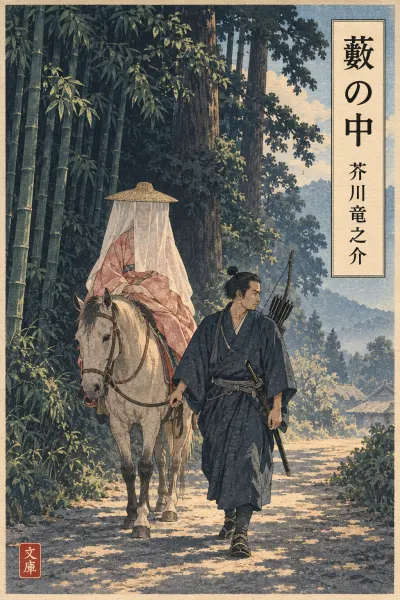
Part 1 of 8 · JLPT N2
藪の中(検非違使に問われたる木樵りの物語) Yabunonaka, part 1: The Woodcutter Finds a Body
In this part
A woodcutter tells the magistrate how he found the body of a man in a lonely thicket off the Yamashina road that morning. The man lay on his back with a single stab wound to the chest, and nearby were only a length of rope and a comb. The trampled ground suggests a fierce struggle, but there was no sword and no horse.
AI translation · independently checked
さようでございます。Just so, my lord.
あの死骸を見つけたのは、わたしに違いございません。It was indeed I who found that body.
わたしは今朝いつもの通り、裏山の杉を伐りに参りました。This morning, as I always do, I went to fell cedars on the hill behind my house.
すると山陰の藪の中に、あの死骸があったのでございます。And there, in the thicket in the shadow of the hill, lay that body.
あった処でございますか?Where it lay, you ask?
それは山科の駅路からは、四五町ほど隔たって居りましょう。That would be some four or five chō (roughly half a kilometer) from the Yamashina post road.
竹の中に痩せ杉の交った、人気のない所でございます。It is a deserted spot, bamboo mixed with spindly cedars.
死骸は縹の水干に、都風のさび烏帽子をかぶったまま、仰向けに倒れて居りました。The dead man lay on his back, still in a pale-blue hunting robe and a creased court cap in the fashion of the capital.
何しろ一刀とは申すものの、胸もとの突き傷でございますから、死骸のまわりの竹の落葉は、蘇芳に滲みたようでございます。It was, to be sure, only a single stroke, but since it was a stab wound to the chest, the fallen bamboo leaves around the body looked as though they had been steeped in crimson dye.
いえ、血はもう流れては居りません。No, the blood was no longer flowing.
傷口も乾いて居ったようでございます。The wound, too, seemed to have dried.
おまけにそこには、馬蠅が一匹、わたしの足音も聞えないように、べったり食いついて居りましたっけ。And what is more, a horsefly had fastened itself there, clinging so tight it seemed not even to hear my footsteps.
太刀か何かは見えなかったか?Did you not see a sword or anything of the kind?
いえ、何もございません。No, there was nothing at all.
ただその側の杉の根がたに、縄が一筋落ちて居りました。Only, at the foot of a cedar beside it, a length of rope lay on the ground.
それから、――そうそう、縄のほかにも櫛が一つございました。And then — ah yes, besides the rope there was also a comb.
死骸のまわりにあったものは、この二つぎりでございます。Those two things were all there was around the body.
が、草や竹の落葉は、一面に踏み荒されて居りましたから、きっとあの男は殺される前に、よほど手痛い働きでも致したのに違いございません。But the grass and the fallen bamboo leaves had been trampled all over, so that man must surely have put up a very hard fight before he was killed.
何、馬はいなかったか?What's that? Was there no horse?
あそこは一体馬なぞには、はいれない所でございます。That place is one a horse could never get into in the first place.
何しろ馬の通う路とは、藪一つ隔たって居りますから。After all, it is a whole stretch of thicket away from the road where horses pass.
Vocabulary
| Word | Meaning | JLPT |
|---|---|---|
| 死骸しがい | corpse, dead bodyFormal and blunt word. 遺体 is the more respectful modern term. | — |
| 参りましたまいる | to go (humble)dictionary form: 参るHumble form of 行く/来る. The woodcutter uses it to show deference to the magistrate. | N4 |
| 藪やぶ | thicket, bamboo groveKey word of the title. 藪の中 has come to mean 'a mystery whose truth can never be known'. | — |
| 隔たってへだたる | to be distant, to be separated (from)dictionary form: 隔たるTakes から: AからB隔たる, 'to be B away from A'. | N1 |
| 町ちょう | chō, an old unit of distance (about 109 m)Read ちょう as a unit, not まち. 四五町 is roughly 400–500 m. | N5 |
| 人気ひとけ | sign of people, human presenceRead ひとけ here, not にんき ('popularity'). It is usually found in 人気のない, 'deserted'. | N3 |
| 水干すいかん | hunting robe, a simple robe worn by lower-ranking menClassical clothing of the Heian period. 縹 (はなだ) is a light indigo blue. | — |
| 烏帽子えぼし | tall black court cap worn by adult menさび烏帽子 is a lacquered cap with a creased, crinkled finish. | — |
| 仰向けあおむけ | face up, on one's backOpposite: うつ伏せ (face down). | — |
| 蘇芳すおう | sappanwood; a dark red dyeHere it describes leaves stained red as if dyed. | — |
| 縄なわ | ropeCounted with 筋 (すじ) for long thin things: 一筋. | N3 |
| 櫛くし | combA woman's item, so it hints that a woman was present. | N2 |
| 手痛いていたい | severe, fierce手痛い働き here means a hard fight or a fierce struggle. | — |
Grammar
〜に違いない/違いございません N3 must be, surely
This pattern expresses strong certainty. ございません is the very polite form of ない, which suits the speaker's humble tone.
あの死骸を見つけたのは、わたしに違いございません。
It was indeed I who found that body.
〜たまま N4 still in the state of ~, with ~ left as is
The past form plus まま shows that a state continues unchanged. The dead man still has his cap on.
都風のさび烏帽子をかぶったまま、仰向けに倒れて居りました
lay on his back, still wearing a creased court cap in the fashion of the capital
〜とは申すものの N2 although one says ~; granted that ~
〜とは申すものの is a humble version of 〜とはいうものの. It concedes a point and then adds a contrast: it was a single stroke, but it was a stab to the chest.
一刀とは申すものの、胸もとの突き傷でございますから
it was, to be sure, only a single stroke, but since it was a stab wound to the chest
〜っけ N3 sentence-final particle of recollection
Added to a past form, っけ shows the speaker recalling a detail as it comes back to mind. Here it is attached to humble 居りました.
べったり食いついて居りましたっけ。
it had fastened itself there, clinging tight.
〜ぎり(きり) N3 only, no more than
ぎり is a variant of きり, meaning 'just this and nothing more'. It is similar to だけ but sounds more colloquial and old-fashioned.
死骸のまわりにあったものは、この二つぎりでございます。
Those two things were all there was around the body.