Part 6 of 8 · JLPT N2
藪の中(多襄丸の白状(つづき)) Yabunonaka, part 6: The Duel Fought for Masago
In this part
Tajōmaru lures Masago to her bound husband, disarms her when she attacks him with a dagger, and takes her by force. When she begs that one of the two men must die and says she will go with the survivor, he frees Takehiro and kills him in a fair sword fight at the twenty-third pass. Masago has vanished, so Tajōmaru takes the weapons, flees, and proudly demands the death penalty.
AI translation · independently checked
わたしは男を片附けてしまうと、今度はまた女の所へ、男が急病を起したらしいから、見に来てくれと云いに行きました。Once I had dealt with the man, I went back to the woman and told her that her husband seemed to have been taken suddenly ill, and that she should come and see him.
これも図星に当ったのは、申し上げるまでもありますまい。I need hardly tell you that this too hit the mark.
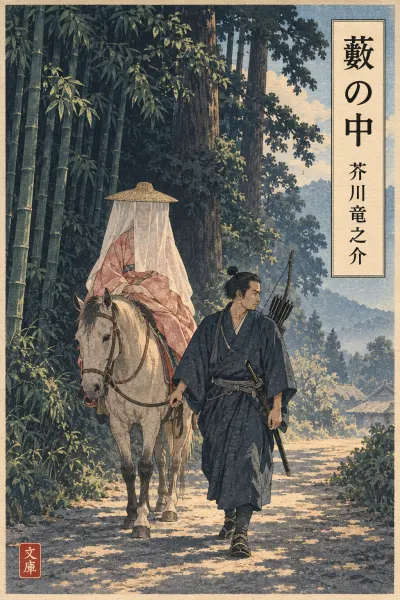
女は市女笠を脱いだまま、わたしに手をとられながら、藪の奥へはいって来ました。The woman had taken off her wide travelling hat, and she let me lead her by the hand deep into the thicket.
ところがそこへ来て見ると、男は杉の根に縛られている、――女はそれを一目見るなり、いつのまに懐から出していたか、きらりと小刀を引き抜きました。But when we got there, the man was bound to the root of a cedar—and the instant the woman saw this, she drew a small dagger with a flash; I had not even noticed when she had taken it from the fold of her robe.
わたしはまだ今までに、あのくらい気性の烈しい女は、一人も見た事がありません。Never before in all my life have I seen a woman with so fierce a temper.
もしその時でも油断していたらば、一突きに脾腹を突かれたでしょう。Had I been off my guard even for a moment, she would have run me through the side with a single thrust.
いや、それは身を躱したところが、無二無三に斬り立てられる内には、どんな怪我も仕兼ねなかったのです。No—even though I dodged aside, with her slashing at me so wildly, I could easily have suffered some injury.
が、わたしも多襄丸ですから、どうにかこうにか太刀も抜かずに、とうとう小刀を打ち落しました。But I am Tajōmaru, after all, and somehow or other, without even drawing my sword, I finally knocked the dagger out of her hand.
いくら気の勝った女でも、得物がなければ仕方がありません。However strong-willed a woman may be, she can do nothing without a weapon.
わたしはとうとう思い通り、男の命は取らずとも、女を手に入れる事は出来たのです。At last, just as I had intended, I was able to make the woman mine without having to take the man's life.
男の命は取らずとも、――そうです。Without having to take the man's life. Yes, that is so.
わたしはその上にも、男を殺すつもりはなかったのです。I had no intention of going further and killing him.
所が泣き伏した女を後に、藪の外へ逃げようとすると、女は突然わたしの腕へ、気違いのように縋りつきました。But as I was about to escape from the thicket, leaving the woman weeping on the ground behind me, she suddenly clung to my arm like a madwoman.
しかも切れ切れに叫ぶのを聞けば、あなたが死ぬか夫が死ぬか、どちらか一人死んでくれ、二人の男に恥を見せるのは、死ぬよりもつらいと云うのです。And what she was crying out, in broken gasps, was this: either you must die or my husband must die. One of you must die for me, for to be shamed before two men is worse than death.
いや、その内どちらにしろ、生き残った男につれ添いたい、――そうも喘ぎ喘ぎ云うのです。And more: whichever of you is left alive, she said, she would go with him as his wife. She said that too, panting for breath.
わたしはその時猛然と、男を殺したい気になりました。At that moment a fierce desire to kill the man came over me.
(陰鬱なる興奮)(Gloomy excitement.)
こんな事を申し上げると、きっとわたしはあなた方より残酷な人間に見えるでしょう。When I tell you such things, I am sure I seem a crueller man than you gentlemen.
しかしそれはあなた方が、あの女の顔を見ないからです。But that is because you did not see that woman's face.
殊にその一瞬間の、燃えるような瞳を見ないからです。Above all, because you did not see her eyes in that one instant, blazing as if on fire.
わたしは女と眼を合せた時、たとい神鳴に打ち殺されても、この女を妻にしたいと思いました。When our eyes met, I thought: even if I am struck dead by lightning, I will make this woman my wife.
妻にしたい、――わたしの念頭にあったのは、ただこう云う一事だけです。To make her my wife. That was the one and only thing in my mind.
これはあなた方の思うように、卑しい色欲ではありません。It was not base lust, as you gentlemen suppose.
もしその時色欲のほかに、何も望みがなかったとすれば、わたしは女を蹴倒しても、きっと逃げてしまったでしょう。If lust had been all I wanted at that moment, I would surely have kicked her aside and made off.
男もそうすればわたしの太刀に、血を塗る事にはならなかったのです。Then the man would not have stained my sword with his blood either.
が、薄暗い藪の中に、じっと女の顔を見た刹那、わたしは男を殺さない限り、ここは去るまいと覚悟しました。But the instant I gazed hard at the woman's face in that dim thicket, I made up my mind that I would not leave the place unless I killed the man.
しかし男を殺すにしても、卑怯な殺し方はしたくありません。Yet even if I was going to kill him, I did not want to kill him in a cowardly way.
わたしは男の縄を解いた上、太刀打ちをしろと云いました。I untied the man's rope and told him to fight me with his sword.
(杉の根がたに落ちていたのは、その時捨て忘れた縄なのです。)男は血相を変えたまま、太い太刀を引き抜きました。(The rope that was lying at the foot of the cedar is the one I threw down and forgot at that time.) His face livid, the man drew his heavy sword.
と思うと口も利かずに、憤然とわたしへ飛びかかりました。The next moment, without a word, he flew at me in a rage.
――その太刀打ちがどうなったかは、申し上げるまでもありますまい。I need hardly tell you how that sword fight ended.
わたしの太刀は二十三合目に、相手の胸を貫きました。At the twenty-third pass, my sword pierced his chest.
二十三合目に、――どうかそれを忘れずに下さい。At the twenty-third pass. I beg you not to forget that.
わたしは今でもこの事だけは、感心だと思っているのです。Even now, that one thing still strikes me as admirable.
わたしと二十合斬り結んだものは、天下にあの男一人だけですから。For he is the only man under heaven who has ever crossed swords with me twenty times.
(快活なる微笑)(A cheerful smile.)
わたしは男が倒れると同時に、血に染まった刀を下げたなり、女の方を振り返りました。The moment the man fell, I turned toward the woman, my blood-stained sword still hanging from my hand.
すると、――どうです、あの女はどこにもいないではありませんか?And then, would you believe it, the woman was nowhere to be seen!
わたしは女がどちらへ逃げたか、杉むらの間を探して見ました。I searched among the cedars to see which way she had fled.
が、竹の落葉の上には、それらしい跡も残っていません。But on the fallen bamboo leaves there was no trace that might have been hers.
また耳を澄ませて見ても、聞えるのはただ男の喉に、断末魔の音がするだけです。And when I strained my ears, all I could hear was the death rattle in the man's throat.
事によるとあの女は、わたしが太刀打を始めるが早いか、人の助けでも呼ぶために、藪をくぐって逃げたのかも知れない。Perhaps, the moment I began the sword fight, the woman had slipped away through the thicket to call someone for help.
――わたしはそう考えると、今度はわたしの命ですから、太刀や弓矢を奪ったなり、すぐにまたもとの山路へ出ました。When that thought struck me, I knew it was my own life at stake now. So I took his sword and his bow and arrows and went straight back out to the mountain road.
そこにはまだ女の馬が、静かに草を食っています。The woman's horse was still there, quietly grazing.
その後の事は申し上げるだけ、無用の口数に過ぎますまい。To tell you what happened after that would be nothing but a waste of words.
ただ、都へはいる前に、太刀だけはもう手放していました。Only, before I entered the capital, I had already parted with the sword.
――わたしの白状はこれだけです。That is the whole of my confession.
どうせ一度は樗の梢に、懸ける首と思っていますから、どうか極刑に遇わせて下さい。Since I have always expected that my head would one day hang from the top of a chinaberry tree, I ask you: please sentence me to the extreme penalty.
(昂然たる態度)(A proud, defiant bearing.)
Vocabulary
| Word | Meaning | JLPT |
|---|---|---|
| 片附けてかたづける | to deal with, to dispose of (here: to tie up the husband)dictionary form: 片付けるOlder spelling 片附ける. Usually means 'to tidy up'. Here it is a euphemism for getting someone out of the way. | N4 |
| 図星ずぼし | bull's-eye; hitting the mark図星に当たる / 図星だ = to guess exactly right. | — |
| 小刀さすが | small dagger (刺刀), a short blade worn at the waist or kept in the robeOld reading. In modern Japanese 小刀 is read こがたな (penknife). | — |
| 油断ゆだん | carelessness, being off guard油断する = to let one's guard down. | N2 |
| 無二無三むにむざん | recklessly, wildly, with single-minded furyFour-character idiom of Buddhist origin. | — |
| 得物えもの | weapon (one's weapon of choice)Not to be confused with 獲物 (えもの, prey). | — |
| 縋りつきましたすがりつく | to cling to desperatelydictionary form: 縋り付くOften written すがりつく in kana today. | — |
| つれ添いたいつれそう | to live together as husband and wifedictionary form: 連れ添う | — |
| 猛然もうぜん | fiercely, violently, all at onceUsed as 猛然と + verb. | — |
| 刹那せつな | instant, momentBuddhist word for the smallest unit of time. 〜した刹那 = the instant that… | — |
| 太刀打ちたちうち | sword fightToday mostly used figuratively: 太刀打ちできない = to be no match for. | — |
| 断末魔だんまつま | death throes; the moment of death断末魔の音/叫び = death rattle / dying scream. | — |
| 樗おうち | chinaberry tree (bead tree)The heads of executed criminals were once displayed on this tree. | — |
| 極刑ごっけい | the extreme penalty, death sentenceCommonly read きょっけい in modern Japanese. | — |
Grammar
〜までもありますまい N2 there is surely no need to…
〜までもない means 'it goes without saying / no need to'. ますまい is a literary polite negative conjecture. Together they make a confident, swaggering 'I hardly need tell you'.
これも図星に当ったのは、申し上げるまでもありますまい。
I need hardly tell you that this too hit the mark.
〜なり N1 as soon as, the moment that
Dictionary form + なり shows that a second action follows immediately and abruptly after the first. Here it shows how quickly the woman reacts to the sight of her bound husband.
女はそれを一目見るなり、いつのまに懐から出していたか、きらりと小刀を引き抜きました。
The instant she saw it, she whipped out a small dagger with a flash. When she had taken it from the fold of her robe, I never noticed.
〜かねない N2 might well (do something bad)
Verb stem + かねない means there is a real risk of an undesirable outcome. Here 仕兼ねなかった is past: he could easily have been hurt.
どんな怪我も仕兼ねなかったのです。
I might have come to any kind of harm.
〜ずとも N1 even without doing
A literary form of 〜なくても, attached to the negative stem. 取らずとも = without taking (his life).
男の命は取らずとも、女を手に入れる事は出来たのです。
I was able to make the woman mine without having to take the man's life.
〜ない限り N2 unless, as long as … not
Sets a condition that must be met first. Here it pairs with the literary negative volitional 去るまい (I will not leave).
わたしは男を殺さない限り、ここは去るまいと覚悟しました。
I made up my mind that I would not leave the place unless I killed the man.
〜が早いか N1 no sooner … than; the instant
Dictionary form + が早いか shows that something happens at the very moment another action begins. Here it marks how quickly the woman may have fled.
わたしが太刀打を始めるが早いか、人の助けでも呼ぶために、藪をくぐって逃げたのかも知れない。
The moment I began the sword fight, she may have slipped away through the thicket to call someone for help.