Part 2 of 8 · JLPT N2
藪の中(検非違使に問われたる旅法師の物語) Yabunonaka, part 2: The Monk Recalls the Traveling Couple
In this part
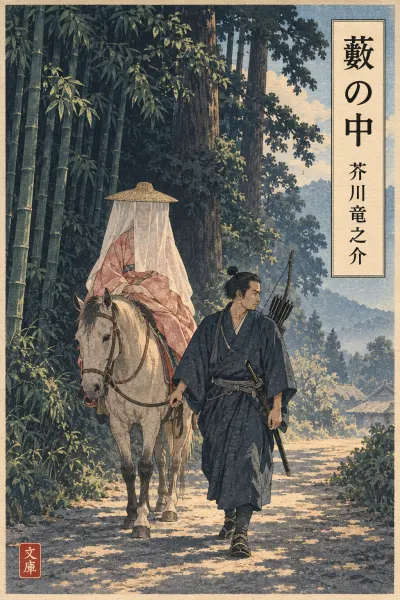
A traveling Buddhist monk testifies to the police commissioner that he passed the dead man on the road from Sekiyama toward Yamashina at about noon the day before. The man was armed with a sword, a bow and a black quiver of arrows, and walked beside a woman on a pale horse whose face was hidden by a veil. The monk ends by sighing over how fleeting human life is.
AI translation · independently checked
あの死骸の男には、確かに昨日遇って居ります。That dead man — yes, I certainly met him yesterday.
昨日の、――さあ、午頃でございましょう。Yesterday at — well, now, it would have been about noon.
場所は関山から山科へ、参ろうと云う途中でございます。The place was along the road, as I was making my way from Sekiyama toward Yamashina.
あの男は馬に乗った女と一しょに、関山の方へ歩いて参りました。He was walking toward Sekiyama together with a woman who rode on horseback.
女は牟子を垂れて居りましたから、顔はわたしにはわかりません。The woman had a veil hanging down from her hat, so I could not make out her face.
見えたのはただ萩重ねらしい、衣の色ばかりでございます。All I could see was the colour of her robe, which seemed to be of the bush-clover layering.
馬は月毛の、――確か法師髪の馬のようでございました。The horse was a pale dun — with a mane cropped short like a monk's head, if I remember rightly.
丈でございますか?Its height, Your Honour?
丈は四寸もございましたか?Would it have stood some four inches above the standard?
――何しろ沙門の事でございますから、その辺ははっきり存じません。— In any case, being only a man of religion, I cannot say for certain about such matters.
男は、――いえ、太刀も帯びて居れば、弓矢も携えて居りました。The man — no, he wore a long sword at his side, and he carried a bow and arrows as well.
殊に黒い塗り箙へ、二十あまり征矢をさしたのは、ただ今でもはっきり覚えて居ります。In particular, I remember clearly even now that he had twenty or more war arrows set in a black lacquered quiver.
あの男がかようになろうとは、夢にも思わずに居りましたが、真に人間の命なぞは、如露亦如電に違いございません。Never in my dreams did I imagine he would come to such an end, but truly, a human life must be like the dew and like the lightning.
やれやれ、何とも申しようのない、気の毒な事を致しました。Oh dear, oh dear — what a pitiful thing has come to pass, more than words can tell.
Vocabulary
| Word | Meaning | JLPT |
|---|---|---|
| 死骸しがい | corpse, dead bodyA formal, rather stark word; 死体 is the everyday modern equivalent. | — |
| 牟子むし | veil of thin cloth hanging from a woman's travel hatHistorical item worn by women on journeys to hide the face; 垂れる means to let it hang down. | — |
| 萩重ねはぎがさね | 'bush-clover' colour layering of a robeA classical colour combination of layered garments, typically purplish-red over green, named after the autumn flower 萩. | — |
| 月毛つきげ | pale dun / cream-coloured (of a horse's coat)Literally 'moon hair'; a traditional term for horse colouring. | — |
| 法師髪ほうしがみ | close-cropped maneCompared to a monk's (法師) shaven or cropped hair. | — |
| 沙門しゃもん | Buddhist monk, mendicantFrom Sanskrit śramaṇa; the speaker uses it humbly of himself, implying he knows little of worldly things like horses. | — |
| 太刀たち | long sword (worn slung at the hip)Irregular reading: not たとう but たち. | — |
| 携えてたずさえる | to carry (with one), to have in handdictionary form: 携えるWritten, formal verb; compare 携帯 (mobile phone, 'carried item'). | — |
| 箙えびら | quiver (for arrows)塗り箙 is a lacquered quiver. | — |
| 征矢そや | war arrow, battle arrowAs opposed to arrows for hunting or ceremony. | — |
| 如露亦如電にょろやくにょでん | 'like the dew, and also like lightning' — transient, fleetingA phrase from the Diamond Sutra describing the impermanence of all things; read in the Buddhist (go-on) style. | — |
| 気の毒きのどく | pitiful, unfortunateExpresses sympathy for someone else's misfortune: 'what a shame / poor man'. | N3 |
Grammar
〜でございます / 〜でございましょう N4 humble-polite 'is' / 'probably is'
ございます is the very polite form of ある, and でございます replaces です. The monk uses it throughout to show deep respect to the commissioner; でございましょう softens it into a guess.
昨日の、――さあ、午頃でございましょう。
Yesterday at — well, now, it would have been about noon.
〜らしい N4 seems to be, apparently
Attached to a noun, らしい marks a judgment based on what one observes. Here the monk only glimpsed the robe, so he says it looked like the bush-clover layering.
見えたのはただ萩重ねらしい、衣の色ばかりでございます。
All I could see was the colour of her robe, which seemed to be of the bush-clover layering.
〜も〜ば、〜も N2 not only … but also …
The conditional ば joins two parallel facts, each marked by も, to list them together. Here it stresses that the man was carrying both a sword and a bow with arrows.
太刀も帯びて居れば、弓矢も携えて居りました。
He wore a long sword at his side, and he carried a bow and arrows as well.
〜ようとは夢にも思わない N2 never even dreamed that …
The volitional/conjectural form よう with とは marks an unexpected outcome, and 夢にも思わない ('not think even in a dream') strengthens the denial. The monk had no idea the man would end up dead.
あの男がかようになろうとは、夢にも思わずに居りましたが
Never in my dreams did I imagine he would come to such an end, but
〜に違いない(違いございません) N3 must be, surely is
Expresses strong certainty. 違いございません is the humble-polite form of 違いない, matching the monk's deferential speech.
真に人間の命なぞは、如露亦如電に違いございません。
Truly, a human life must be like the dew and like the lightning.
〜ようがない(申しようのない) N3 there is no way to …
The verb stem plus ようがない means something cannot be done at all; there is no way to do it. In 申しようのない, the humble 申す ('no way to say') modifies the noun, meaning 'beyond words'.
何とも申しようのない、気の毒な事を致しました。
A pitiful thing has befallen him, more than words can tell.