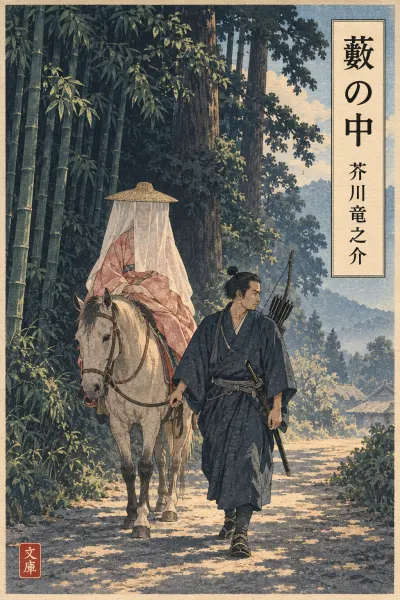
Part 8 of 8 · JLPT N2
藪の中(巫女の口を借りたる死霊の物語) Yabunonaka, part 8: The Dead Husband's Testimony
In this part
Speaking through a medium, the dead samurai says that after the assault the bandit persuaded his wife to leave with him, and that she begged the bandit to kill her husband. The bandit, shaken, kicked her down and asked the samurai whether he wanted her killed or spared. While the samurai hesitated, she fled. The bandit cut one of the samurai's ropes and left, and the samurai stabbed himself with his wife's small sword. As he died, someone unseen drew the blade out of his chest.
AI translation · independently checked
――盗人は妻を手ごめにすると、そこへ腰を下したまま、いろいろ妻を慰め出した。The bandit, having violated my wife, sat down right there and began to console her in all sorts of ways.
おれは勿論口は利けない。I, of course, could not speak.
体も杉の根に縛られている。My body, too, was bound to the root of a cedar.
が、おれはその間に、何度も妻へ目くばせをした。But all the while, again and again, I signalled to my wife with my eyes.
この男の云う事を真に受けるな、何を云っても嘘と思え、――おれはそんな意味を伝えたいと思った。Don't believe what this man says; whatever he says, think it a lie. That was what I wanted to convey to her.
しかし妻は悄然と笹の落葉に坐ったなり、じっと膝へ目をやっている。But my wife sat forlorn on the fallen bamboo leaves and kept her eyes fixed on her knees.
それがどうも盗人の言葉に、聞き入っているように見えるではないか?And did it not look, for all the world, as though she were listening raptly to the bandit's words?
おれは妬しさに身悶えをした。I writhed with jealousy.
が、盗人はそれからそれへと、巧妙に話を進めている。But the bandit went on, from one point to the next, cunningly pressing his case.
一度でも肌身を汚したとなれば、夫との仲も折り合うまい。Once her body had been defiled, even a single time, she could hardly get along with her husband again.
そんな夫に連れ添っているより、自分の妻になる気はないか?Rather than stay with such a husband, would she not like to become his wife instead?
自分はいとしいと思えばこそ、大それた真似も働いたのだ、――盗人はとうとう大胆にも、そう云う話さえ持ち出した。It was precisely because he loved her that he had dared to do so outrageous a thing. In the end the bandit was bold enough to bring up even that.
盗人にこう云われると、妻はうっとりと顔を擡げた。When the bandit spoke to her like this, my wife raised her face as if entranced.
おれはまだあの時ほど、美しい妻を見た事がない。Never, before or since, have I seen my wife as beautiful as she was then.
しかしその美しい妻は、現在縛られたおれを前に、何と盗人に返事をしたか?But what answer did that beautiful wife give the bandit, right there in front of me as I sat bound?
おれは中有に迷っていても、妻の返事を思い出すごとに、嗔恚に燃えなかったためしはない。Even as I wander in the realm between death and rebirth, never once have I recalled her answer without burning with rage.
妻は確かにこう云った、――「ではどこへでもつれて行って下さい。」(長き沈黙)My wife said, unmistakably: "Then take me with you, wherever you go." (A long silence.)
妻の罪はそれだけではない。Nor was that the whole of her sin.
それだけならばこの闇の中に、いまほどおれも苦しみはしまい。Had it been only that, I would not be suffering as I suffer now in this darkness.
しかし妻は夢のように、盗人に手をとられながら、藪の外へ行こうとすると、たちまち顔色を失ったなり、杉の根のおれを指さした。But as my wife, as though in a dream, was about to go out of the thicket with the bandit leading her by the hand, she suddenly turned pale and pointed at me, there by the cedar root.
「あの人を殺して下さい。わたしはあの人が生きていては、あなたと一しょにはいられません。」――妻は気が狂ったように、何度もこう叫び立てた。"Kill that man. As long as he is alive, I cannot be with you." Like a woman gone mad, my wife screamed this again and again.
「あの人を殺して下さい。」――この言葉は嵐のように、今でも遠い闇の底へ、まっ逆様におれを吹き落そうとする。"Kill that man." Even now these words, like a storm, threaten to blow me headlong down into the depths of a distant darkness.
一度でもこのくらい憎むべき言葉が、人間の口を出た事があろうか?Have words so hateful ever, even once, passed a human being's lips?
一度でもこのくらい呪わしい言葉が、人間の耳に触れた事があろうか?Have words so accursed ever, even once, reached a human being's ears?
一度でもこのくらい、――(突然迸るごとき嘲笑)その言葉を聞いた時は、盗人さえ色を失ってしまった。Have ever, even once, such... (A sudden burst of scornful laughter.) When he heard those words, even the bandit turned pale.
「あの人を殺して下さい。」――妻はそう叫びながら、盗人の腕に縋っている。"Kill that man." Screaming this, my wife clung to the bandit's arm.
盗人はじっと妻を見たまま、殺すとも殺さぬとも返事をしない。The bandit only stared at her and gave no answer, neither that he would kill me nor that he would not.
――と思うか思わない内に、妻は竹の落葉の上へ、ただ一蹴りに蹴倒された、(再び迸るごとき嘲笑)盗人は静かに両腕を組むと、おれの姿へ眼をやった。Then, almost before I could think it, my wife was kicked down onto the fallen bamboo leaves with a single kick. (Another burst of scornful laughter.) The bandit calmly folded his arms and turned his eyes to me.
「あの女はどうするつもりだ? 殺すか、それとも助けてやるか? 返事はただ頷けば好い。殺すか?」――おれはこの言葉だけでも、盗人の罪は赦してやりたい。"What do you want done with that woman? Shall I kill her, or shall I spare her? Just nod for your answer. Shall I kill her?" For those words alone, I would gladly forgive the bandit his crimes.
(再び、長き沈黙)(Again, a long silence.)
妻はおれがためらう内に、何か一声叫ぶが早いか、たちまち藪の奥へ走り出した。While I hesitated, my wife gave some sort of cry and the next instant ran off into the depths of the thicket.
盗人も咄嗟に飛びかかったが、これは袖さえ捉えなかったらしい。The bandit sprang at her at once, but it seems he could not even catch her sleeve.
おれはただ幻のように、そう云う景色を眺めていた。I simply watched the scene as though it were a vision.
盗人は妻が逃げ去った後、太刀や弓矢を取り上げると、一箇所だけおれの縄を切った。After my wife had fled, the bandit picked up my sword and my bow and arrows and cut my rope in one place only.
「今度はおれの身の上だ。」――おれは盗人が藪の外へ、姿を隠してしまう時に、こう呟いたのを覚えている。"Now it's my own neck at stake." I remember him muttering this as he vanished out of the thicket.
その跡はどこも静かだった。After that, all was quiet.
いや、まだ誰かの泣く声がする。No, there was still the sound of someone weeping.
おれは縄を解きながら、じっと耳を澄ませて見た。As I untied the rope, I listened intently.
が、その声も気がついて見れば、おれ自身の泣いている声だったではないか?But that voice, when I came to realise it, was it not my own voice, weeping?
(三度、長き沈黙)(A third long silence.)
おれはやっと杉の根から、疲れ果てた体を起した。At last I raised my exhausted body from the cedar root.
おれの前には妻が落した、小刀が一つ光っている。Before me lay the small sword my wife had dropped, glinting.
おれはそれを手にとると、一突きにおれの胸へ刺した。I took it in my hand and drove it into my chest with a single thrust.
何か腥い塊がおれの口へこみ上げて来る。Something like a lump that reeked of blood rose up into my mouth.
が、苦しみは少しもない。Yet there was no pain at all.
ただ胸が冷たくなると、一層あたりがしんとしてしまった。Only, as my chest grew cold, everything around me became still more hushed.
ああ、何と云う静かさだろう。Ah, what a stillness it was.
この山陰の藪の空には、小鳥一羽囀りに来ない。Into the sky above this thicket in the shadow of the hills, not a single small bird came to sing.
ただ杉や竹の杪に、寂しい日影が漂っている。Only a lonely sunlight drifted among the tips of the cedars and bamboo.
日影が、――それも次第に薄れて来る。The sunlight... that too gradually faded.
――もう杉や竹も見えない。Now I could no longer see the cedars or the bamboo.
おれはそこに倒れたまま、深い静かさに包まれている。Lying fallen there, I was wrapped in a deep stillness.
その時誰か忍び足に、おれの側へ来たものがある。Then someone came up beside me with stealthy steps.
おれはそちらを見ようとした。I tried to look that way.
が、おれのまわりには、いつか薄闇が立ちこめている。But around me, at some point, a dim darkness had closed in.
誰か、――その誰かは見えない手に、そっと胸の小刀を抜いた。Someone... that someone, with an unseen hand, gently drew the small sword from my chest.
同時におれの口の中には、もう一度血潮が溢れて来る。At the same moment, blood welled up into my mouth once more.
おれはそれぎり永久に、中有の闇へ沈んでしまった。And with that I sank forever into the darkness between death and rebirth.
………...
(大正十年十二月)(December, the tenth year of Taishō)
Vocabulary
| Word | Meaning | JLPT |
|---|---|---|
| 手ごめてごめ | rape, violation (of a woman)dictionary form: 手籠めOld-fashioned euphemism, usually in 手ごめにする 'to violate'. | — |
| 慰めなぐさめる | to console, to comfortdictionary form: 慰めるHere with 〜出す: 'began to console'. | N2 |
| 目くばせめくばせ | a signal with the eyes, a meaningful glancedictionary form: 目配せUsed in 目くばせをする. | — |
| 真に受けるまにうける | to take at face value, to believe literally真 is read ま here, not しん. | — |
| 悄然しょうぜん | dejected, forlornLiterary; used adverbially with と. | — |
| 身悶えみもだえ | writhing, squirming (in anguish)Used in 身悶えをする. | — |
| 大それたおおそれた | outrageous, audacious, presumptuousUsed only before a noun. | — |
| 中有ちゅうう | the intermediate state between death and rebirthBuddhist term, also called 中陰; traditionally lasts forty-nine days. | — |
| 嗔恚しんい | rage, wrathBuddhist word for anger, one of the three poisons. Very literary. | — |
| 縋ってすがる | to cling todictionary form: 縋るAlso figurative: 'to rely on' someone. | — |
| 咄嗟とっさ | in an instant, on the spur of the momentUsually in 咄嗟に. | N1 |
| 小刀さすが | small sword, daggerArchaic reading; in modern Japanese 小刀 is usually read こがたな, meaning a small knife. | — |
| 腥いなまぐさい | reeking of blood or raw fleshNow usually written 生臭い. | N1 |
| 杪うら | tip, top (of a tree or branch)Old word; compare 末 (うら) in classical Japanese. | N1 |
Grammar
〜たなり N1 remaining in that state; just as it was
A past-tense verb followed by なり shows that the state continues while something else happens, much like 〜たまま. It sounds literary and is often used for a fixed, unchanging posture.
妻は悄然と笹の落葉に坐ったなり、じっと膝へ目をやっている。
My wife sat forlorn on the fallen bamboo leaves and kept her eyes fixed on her knees.
〜ではないか N3 is it not...? (emphatic assertion)
This is a rhetorical question that asserts something with surprise or indignation. Here it shows the dead man's bitter certainty about what he saw.
それがどうも盗人の言葉に、聞き入っているように見えるではないか?
And did it not look, for all the world, as though she were listening raptly to the bandit's words?
〜まい N2 probably not; will not
まい is a literary negative of conjecture, roughly equal to 〜ないだろう. In 苦しみはしまい, the verb is split with は for emphasis: 'would not suffer'.
それだけならばこの闇の中に、いまほどおれも苦しみはしまい。
Had it been only that, I would not be suffering as I suffer now in this darkness.
〜ばこそ N1 precisely because
Adding こそ to a conditional ば strongly emphasises the reason, implying 'it is only because of this'. The bandit claims love was the sole reason for his crime.
自分はいとしいと思えばこそ、大それた真似も働いたのだ
It was precisely because he loved her that he had dared to do so outrageous a thing.
〜ためしはない N1 has never once happened
ためし means 'precedent'. Combined with a negative, as in 燃えなかったためしはない, it forms a double negative: 'there has never been a time I did not burn', meaning 'I have always burned'.
妻の返事を思い出すごとに、嗔恚に燃えなかったためしはない。
Never once have I recalled her answer without burning with rage.
〜が早いか N1 no sooner than; the moment
After a dictionary-form verb, が早いか means the second action follows the first almost instantly. It is a written, narrative pattern.
何か一声叫ぶが早いか、たちまち藪の奥へ走り出した。
She gave some sort of cry and the next instant ran off into the depths of the thicket.