Part 7 of 7 · JLPT N3
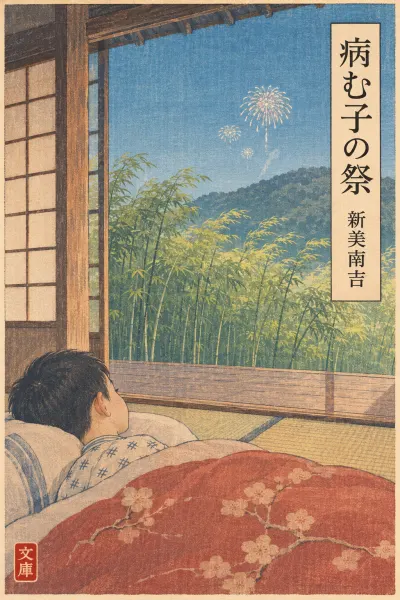
病む子の祭 Yamu Ko no Matsuri, part 7: The Shell That Still Sings
In this part
As the festival music passes by and fades away, the sick boy Yoshibō grows weaker while his elder sister, alone with him, becomes more and more uneasy. They recall a flower-hiding game from before he fell ill, and she offers to go and dig up the shell he hid; she brings it back, and it fits together with another shell from his bag. He blows into it like a whistle and says he hears the wind and the flutes and feels himself floating away with them. She runs off in terror to fetch their mother, and cherry petals fall on him as the thicket rustles.
AI translation · independently checked
女の子箱にしまって、裏口から出ていく。The girl puts it away in the box and goes out by the back door.
はやしの音が近づいてくる。The sound of the festival music comes closer.
微風の中から桜の花びらが病気の子のわきに落ちる。Carried on a light breeze, cherry petals fall beside the sick child.
病気の子は動かない。The sick child does not move.
女の子入ってくる。The girl comes back in.
長女 おはやしがこっちへやってくるかね。ELDER DAUGHTER: Is the festival band coming this way?
三男 塩屋さんとこまでくるきりだい。THIRD SON: They only come as far as the salt shop.
あそこからまた帰ってしまうんだ。Then they go back again from there.
長女 あの太鼓ね、おキンちゃんとこのにいさんがたたいてるのよ。ELDER DAUGHTER: You know that drum? It's O-Kin-chan's big brother playing it.
今年はじめてだって。They say it's his first year.
(はやしの音止む)(The festival music stops.)
長女 あら、もう塩屋さんとこのまえまできたわ。ELDER DAUGHTER: Oh, they've already come as far as the front of the salt shop.
あそこのしいの木の下で休むのよ。They rest under the chinquapin tree there.
三男 …………THIRD SON: ...
長女 (心細くなって)かあさんもう帰ってらっしゃらないかしら。ELDER DAUGHTER: (growing uneasy) I wonder if Mother won't be back soon.
よし坊ちゃん、ねむくない?Yoshibō, aren't you sleepy?
すこし風が出てきたわね。The wind has picked up a little, hasn't it?
障子しめましょうか?Shall I close the paper screens?
三男 しめなくてもいいや。THIRD SON: You don't have to close them.
(このあたりから病気の子の声、とみに衰える)(From about here on, the sick child's voice grows suddenly weaker.)
長女 でも、あたしなんだか寒いわ。ELDER DAUGHTER: But I feel sort of cold.
裏のやぶがさわいでるわ。The bamboo thicket out back is rustling.
(はやしの音、再びはじまる。そしてだんだん遠ざかっていく)(The festival music starts again, then gradually moves away.)
長女 あら、もう帰っていくのね。ELDER DAUGHTER: Oh, they're going back already.
(間)(A pause.)
長女 よし坊ちゃん。ELDER DAUGHTER: Yoshibō.
(間)(A pause.)
長女 よし坊ちゃん。ELDER DAUGHTER: Yoshibō.
三男 まだきこえるね、ねえちゃん。THIRD SON: I can still hear it, sis.
長女 ええ、まだきこえるわ。ELDER DAUGHTER: Yes, I can still hear it too.
もうじき、土塀の家の角をまがると、きこえなくなるわ。Soon, when they turn the corner by the house with the earthen wall, we won't be able to hear it anymore.
ほら、もうきこえなくなったでしょう。There, you can't hear it anymore, can you?
三男 まだきこえるよ。THIRD SON: I can still hear it.
長女 でももう蚊が鳴くほどだけよ。ELDER DAUGHTER: But only about as loud as a mosquito humming.
(間)(A pause.)
長女 もうなんにもきこえなくなってよ。ELDER DAUGHTER: Now you can't hear anything at all.
こんどは、村のあっちのはしへいくのだわね。Next they'll go to the far end of the village, I suppose.
三男 まだきこえるよ。THIRD SON: I can still hear it.
長女 あんたの耳の中に笛の音が残ってるんだわ。ELDER DAUGHTER: It's just the sound of the flute left over inside your ears.
三男 まだきこえるよ。THIRD SON: I can still hear it.
(間)(A pause.)
長女 なにをそんなにあたしの顔見てるの。ELDER DAUGHTER: Why are you staring at my face like that?
いやよ、よし坊ちゃん。Stop it, Yoshibō.
三男 もうせん、ねえちゃんと花のかくしっこしたろう。THIRD SON: A while ago, we played hide-the-flower, didn't we, sis?
長女 いつのこと?ELDER DAUGHTER: When was that?
三男 ぼくが病気になるまえにしたよ。THIRD SON: We played it before I got sick.
貝がらでふせて土の下にかくしたじゃないか。We covered them with shells and hid them under the earth, remember?
長女 あ、そうね。ELDER DAUGHTER: Oh, that's right.
あんときよし坊ちゃんがかくしてきたの、あたしいくらさがしても見つけなかったわね。That time, no matter how hard I searched, I couldn't find the one you hid, could I?
そして、よし坊ちゃんが、あの日の夕方から病気になったから、あれきりになったんだわ。And then you got sick that very evening, so that was the end of it.
どこへかくしといたの?Where did you hide it?
三男 裏のきんかんの木の下だよ。THIRD SON: Under the kumquat tree out back.
長女 あら、よし坊ちゃんずるいわ。ELDER DAUGHTER: Oh, Yoshibō, that's cheating!
かけひの向こうはやぶだから、いけないってきめてあったじゃないの。We agreed that past the bamboo water pipe was the thicket, so it was out of bounds, didn't we?
ずるいわ、よし坊ちゃんたら。You cheated, Yoshibō, really!
三男 まだあるかなあ。THIRD SON: I wonder if it's still there.
長女 あんなとこだれもほらなくてよ。ELDER DAUGHTER: Nobody would dig in a place like that.
あたし見てこようか。Shall I go and look?
(女の子裏口から出ていく。やがて貝のからを持って帰ってくる)(The girl goes out by the back door. Before long she comes back holding a shell.)
長女 あったわ。ELDER DAUGHTER: It was there.
かけひで洗ってきてよ。I washed it at the water pipe.
三男 花はあった?THIRD SON: Was the flower there?
長女 しなびてたわ。ELDER DAUGHTER: It had withered.
三男 しなびてた?THIRD SON: It had withered?
長女 しなびるわよ、冬を越したんですもの。ELDER DAUGHTER: Of course it withered. It's been through a whole winter.
三男 ぼくのかばんのお弁当入れるところにね、もうひとつ貝があるから持ってきて。THIRD SON: In my school bag, in the place where I put my lunch, there's another shell, so bring it here.
(女の子さがして持ってくる)(The girl looks for it and brings it.)
三男 それ合わせてごらんよ。THIRD SON: Try fitting them together.
うまく合う?Do they fit nicely?
長女 うまく合うわ。ELDER DAUGHTER: They fit nicely.
ほら、ちょうどてのひらを合わせたみたい。Look, it's just like two palms pressed together.
(それを病気の子に渡す)(She hands it to the sick child.)
三男 まだ鳴るかなあ。THIRD SON: I wonder if it still whistles.
(口にふくんで弱々しくふく。鳴らない)(He puts it to his lips and blows feebly. It makes no sound.)
長女 土の中にあった間に、どこかきっと欠けたのよ。ELDER DAUGHTER: It must have got chipped somewhere while it was in the ground.
三男 鳴るよ。THIRD SON: It does whistle.
……じっときいてると、いっぱいになるよ。...If you listen quietly, it fills right up.
……風の音や笛の音がするよ。...I can hear the wind and the flutes.
……たくさんの音がするよ。...I can hear lots of sounds.
どこか遠くの方へ消えていくよ。They're fading away somewhere far off.
長女 うそよ。ELDER DAUGHTER: That's not true.
なにもきこえやしないわ。You can't hear a thing.
(病気の子、貝をくわえたまま耳をすましている。間)(The sick child listens intently, the shell still at his lips. A pause.)
三男 ねえちゃん、……ぼくなんだか軽くなった。THIRD SON: Sis... I feel sort of light.
あ、ぼくもとんでくよ。Oh, I'm flying away too.
風の音や笛の音の中をいっしょに……おかあちゃん……ああ、ぼくもとんでくの……。Together through the sound of the wind and the flutes... Mama... oh, I'm flying away too...
長女 なにいってるの、よし坊ちゃん。ELDER DAUGHTER: What are you saying, Yoshibō?
あんた、どこ見てんの。What are you looking at?
三男 花びらや笛の音といっしょに流れてくの。THIRD SON: I'm drifting away with the petals and the sound of the flutes.
(女の子とつぜん恐怖にとらわれて立ちあがる)(Suddenly seized with fear, the girl stands up.)
三男 かあちゃん……。THIRD SON: Mama...
長女 (さけぶ)よし坊ちゃん!ELDER DAUGHTER: (crying out) Yoshibō!
かあさん!Mother!
あたし、かあさんよんでくるわ。I'll go and get Mother.
よし坊ちゃん、待ってんのよ!Yoshibō, you wait for me, all right?
(女の子裏口からかけ去る)(The girl runs off through the back door.)
三男 (弱く)かあちゃん……よし坊とね、鳥もいっしょにとんでくの。THIRD SON: (weakly) Mama... the birds are flying away too, together with Yoshibō.
(間)(A pause.)
(やぶのさわぐ音)(The sound of the thicket rustling.)
三男 (さらに弱く)かあちゃん……ぼく遠いの……。THIRD SON: (even more weakly) Mama... I'm far away...
いっそう、やぶのさわぐ音。The thicket rustles even louder.
風の中から桜の花びらが落ちる。Cherry petals fall from the wind.
病気の子の上に、かたわらに。Onto the sick child, and beside him.
―幕―— CURTAIN —
Vocabulary
| Word | Meaning | JLPT |
|---|---|---|
| 微風びふう | light breezeWritten word; 微 means 'slight, tiny'. In speech people say そよ風. | — |
| 心細くこころぼそい | uneasy, lonely and helplessdictionary form: 心細いLiterally 'heart grows thin': the feeling of being alone without support. | N1 |
| とみにとみに | suddenly, sharplyOld-fashioned written adverb for a rapid change. | — |
| 衰えるおとろえる | to grow weak, to decline | N1 |
| やぶやぶ | thicket (here of bamboo)dictionary form: 藪A key image of the play; its rustling signals the boy's fading. | — |
| 遠ざかっていくとおざかる | to move away into the distancedictionary form: 遠ざかるOpposite of 近づく 'to come closer'. | N1 |
| かけひかけひ | bamboo water pipedictionary form: 筧A split bamboo pipe that carries spring water to a house; also かけい. | — |
| しなびてたしなびる | to wither, to shriveldictionary form: しなびるUsed for plants or fruit that dry out and shrink. | N1 |
| 越したこす | to get through (a season)dictionary form: 越す冬を越す = to pass the winter. | N3 |
| ふくんでふくむ | to hold in the mouthdictionary form: 含むIts more common meaning is 'to include'. | N3 |
| 欠けたかける | to be chipped, to break offdictionary form: 欠ける | N3 |
| 耳をすましてみみをすます | to listen intentlydictionary form: 耳を澄ますLiterally 'to make the ears clear'. | — |
| 恐怖きょうふ | fear, terror恐怖にとらわれる = to be seized by fear. | N3 |
| かたわらかたわら | beside, by one's sidedictionary form: 傍らLiterary word for そば or わき. | N1 |
Grammar
〜きり N2 only; ever since, never again
きり marks a limit. After a noun or verb it means 'only' (くるきり 'only come as far as'). In あれきり it means things stopped at that point and never went on.
あれきりになったんだわ。
so that was the end of it.
〜ほど N3 to the extent of, about as much as
ほど compares a degree to an example. Here the faint music is compared to a mosquito's hum.
でももう蚊が鳴くほどだけよ。
But only about as loud as a mosquito humming.
〜ですもの N2 because, after all (giving a reason)
もの at the end of a sentence gives a reason, often with a sense of justification. It sounds soft and feminine or childish.
しなびるわよ、冬を越したんですもの。
Of course it withered. It's been through a whole winter.
〜やしない N1 not at all (strong denial)
や is inserted between the verb stem and しない to deny something firmly. きこえやしない means 'you can't hear a thing at all'.
なにもきこえやしないわ。
You can't hear a thing.
〜たまま N3 while still ~, leaving as is
た-form + まま means an action happens while an earlier state continues unchanged. He listens with the shell still held in his mouth.
貝をくわえたまま耳をすましている。
listens intently, the shell still at his lips.