Upper intermediate · JLPT N2
文鳥Bunchō — A Java Sparrow for the Study
- JLPT N2
- 10,502 characters
- 8 parts
- about 88 minutes
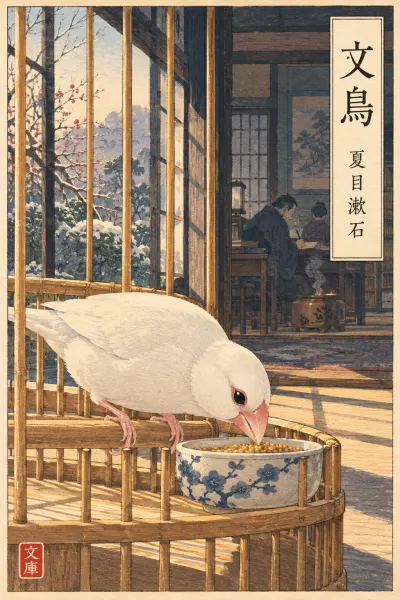
Bunchō is a short, quiet first-person sketch by Natsume Sōseki, first published in 1908. A busy writer who has just moved to Waseda lets his young friend Miekichi talk him into keeping a white Java sparrow. Almost nothing dramatic happens. The narrator watches the bird peck at millet, listens to its 'chiyo, chiyo' call over the scratch of his pen, fumbles with seed and water, and drifts into memories of a woman from his past. The tone is dry and self-mocking on the surface, with a tenderness underneath that he never quite admits to. The bird's small, precise movements are described with great care, and the narrator's own carelessness sits quietly beside them. For a learner, the reward is a compact, carefully observed story with a limited cast and setting, so vocabulary repeats often. The challenges are the older kanji spellings, long descriptive sentences, the gap between Miekichi's polite speech and the narrator's gruff replies, and flashbacks that slip in without much warning.
Contents
Before you read
- The narrator calls himself 自分, not 私 or 僕. Read 自分 as 'I' throughout. Learn the bird-keeping words early, because they recur in almost every part: 籠 (cage), 粟 (millet), 餌 (feed), 水入れ/餌壺 (water and seed dishes), 止まり木 (perch), 縁側 (veranda), and 火鉢/炭取 (brazier, charcoal scuttle).
- Expect older spellings: 云う for 言う, 這入る for 入る, 易える for 替える. The words are still familiar; only the kanji differ. Read them aloud and they will usually click.
- Dialogue sets the two men's voices apart. Miekichi speaks politely and a little fussily (〜なくっちゃいけません, 〜ておやんなさい), while the narrator answers curtly in old-fashioned male speech (〜たまえ, 〜かね). Who sounds like whom often tells you who is speaking when the text omits it.
- Many long descriptive sentences hinge on a few patterns. 〜たまま means 'while still ...', 〜と見えて means 'apparently / it seems that ...', 〜や否や means 'no sooner ... than', and 〜てある describes a resulting state. Find these first, then break the sentence at them.
- Memories of the woman (Parts 4–6) begin abruptly, usually right after the bird blinks or a puff of smoke appears. When the scene suddenly seems to change, check for a time cue such as 昔 or a shift into reminiscence before assuming you have misread.
Words to know
The most useful words from the notes across the story.
| Word | Meaning | JLPT |
|---|---|---|
| 霜しも | frost | N3 |
| 伽藍がらん | large temple hall; (here) a vast, empty roomBuddhist term; related to がらんとした 'empty, deserted'. | — |
| 粟あわ | foxtail millet (bird seed) | — |
| 帯上げおびあげ | obi-age, a silk scarf tucked along the top of a kimono sashdictionary form: 帯揚げThere is no English equivalent; it is a decorative cloth that supports the sash's bow. | — |
| 濁ってにごる | to become cloudy, muddydictionary form: 濁る | N2 |
| 縁側えんがわ | veranda; wooden corridor along the outside of a Japanese houseHere closed off with glass doors, so it catches the sun. | N1 |
| 華奢きゃしゃ | delicate, slender, fragileA na-adjective, often used of thin limbs or fine objects. | N1 |
| 行水ぎょうずい | a bath in a tub of waterUsed here for the bird's bath. For people it means a quick wash in a basin. | — |
| 受合うけあう | to undertake, to take responsibility fordictionary form: 受け合うHere written without okurigana. It can also mean 'to guarantee'. | — |
| 餌壺えつぼ | seed dish, feeding pot (for a bird)餌 (えさ) means animal feed; here it combines as え-. | — |
| 這入るはいる | to go in, to enterOld spelling of 入る. | N5 |
| 端書はがき | postcardOlder spelling; today it is usually written 葉書. | N5 |
| 寝坊ねぼう | late riser; sleeping in寝坊する = to oversleep. | N4 |
| 淋しいさびしい | lonely, forlornLiterary kanji variant of 寂しい. | N4 |
| 粗末そまつ | plain, crude, cheaply madeAlso used humbly: 粗末な物ですが ('it's nothing much, but...'). | N3 |
Plot summary
Show the full summary (contains spoilers)
In October the narrator moves to Waseda. Miekichi urges him to keep a Java sparrow, and he hands over five yen, then forgets about it. In early winter Miekichi and Toyotaka arrive with a white bird, cages, millet and instructions. The narrator grows fond of the bird. He admires its feet, its eating and its calls, and it reminds him of a woman he once teased. Absorbed in writing his novel, he leaves its care to the household and often forgets it himself. One night the cage is knocked over, probably by a cat. The bird weakens, and while Miekichi's affair over a girl's marriage keeps the narrator away for two days, it dies without food or water. He throws the body down before the maid and sends Miekichi a bitter postcard. The children bury the bird, and Fudeko writes a sign for the grave. Miekichi replies with only a polite word of regret.
About the author
Natsume Sōseki (1867–1916) is one of the most important novelists of modern Japan. He studied English literature at Tokyo Imperial University and later spent time studying in London on a government scholarship. After teaching English, he became famous with 吾輩は猫である (I Am a Cat) and 坊っちゃん (Botchan). He then left academia to write fiction as a staff writer for the Asahi Shimbun, which serialised many of his works, including こころ (Kokoro). His portrait appeared on the Japanese 1000-yen note for many years.