Part 2 of 8 · JLPT N2
文鳥 Bunchō, part 2: The Cage Arrives, and a Late Morning
In this part
Miekichi and Toyotaka bring a lacquered cage, a bathing cage, a box, millet and dishes, and Miekichi lectures the narrator on how to look after the white Java sparrow. Pressed into it, the narrator reluctantly agrees. The next morning he oversleeps, finally brings the cage into the light past eight, and the bird looks at him for the first time.
AI translation · independently checked
三重吉は大得意である。Miekichi was immensely pleased with himself.
まあ御覧なさいと云う。"Now, just take a look," he said.
豊隆その洋灯をもっとこっちへ出せなどと云う。"Toyotaka, bring that lamp further over this way," and so forth.
そのくせ寒いので鼻の頭が少し紫色になっている。And yet the cold had turned the tip of his nose slightly purple.
なるほど立派な籠ができた。It was, to be sure, a handsome cage he had had made.
台が漆で塗ってある。The base was finished in lacquer.
竹は細く削った上に、色が染けてある。The bamboo had been whittled fine and then stained.
それで三円だと云う。And all of it, he said, for three yen.
安いなあ豊隆と云っている。"Cheap, eh, Toyotaka?" he was saying.
豊隆はうん安いと云っている。"Yes, cheap," Toyotaka was saying.
自分は安いか高いか判然と判らないが、まあ安いなあと云っている。I could not tell for certain whether it was cheap or dear, but I, too, was saying, "Well, that is cheap."
好いのになると二十円もするそうですと云う。"I'm told a good one can cost as much as twenty yen," he said.
二十円はこれで二返目である。This was the second time twenty yen had come up.
二十円に比べて安いのは無論である。That it was cheap compared with twenty yen went without saying.
この漆はね、先生、日向へ出して曝しておくうちに黒味が取れてだんだん朱の色が出て来ますから、――そうしてこの竹は一返善く煮たんだから大丈夫ですよなどと、しきりに説明をしてくれる。"This lacquer, sir, if you set it out in the sun and let it weather, the blackness wears off and little by little the vermilion comes through — and this bamboo has been well boiled once, so it'll be quite all right," he went on, explaining away earnestly.
何が大丈夫なのかねと聞き返すと、まあ鳥を御覧なさい、奇麗でしょうと云っている。When I asked him back, "What will be all right?", he said, "Now, just look at the bird. Isn't it pretty?"
なるほど奇麗だ。It was pretty, certainly.
次の間へ籠を据えて四尺ばかりこっちから見ると少しも動かない。When the cage was set down in the next room and I looked at it from about four feet away, the bird did not stir in the least.
薄暗い中に真白に見える。In the dimness it showed pure white.
籠の中にうずくまっていなければ鳥とは思えないほど白い。It was so white that, had it not been crouching in a cage, one could hardly have taken it for a bird.
何だか寒そうだ。Somehow it looked cold.
寒いだろうねと聞いてみると、そのために箱を作ったんだと云う。When I asked, "It must be cold, mustn't it?", he said that was why he had made the box.
夜になればこの箱に入れてやるんだと云う。At night, he said, you put it into this box.
籠が二つあるのはどうするんだと聞くと、この粗末な方へ入れて時々行水を使わせるのだと云う。When I asked what the two cages were for, he said you put the bird into this plainer one and let it take a bath now and then.
これは少し手数が掛るなと思っていると、それから糞をして籠を汚しますから、時々掃除をしておやりなさいとつけ加えた。While I was thinking that this would be rather a nuisance, he added, "And then it makes droppings and dirties the cage, so you should clean it out for it every so often."
三重吉は文鳥のためにはなかなか強硬である。Where the Java sparrow was concerned, Miekichi was quite unbending.
それをはいはい引受けると、今度は三重吉が袂から粟を一袋出した。When I had readily taken all this on with a "Yes, yes," Miekichi in his turn produced a bag of millet from his sleeve.
これを毎朝食わせなくっちゃいけません。"You must feed it this every morning.
もし餌をかえてやらなければ、餌壺を出して殻だけ吹いておやんなさい。If you don't change the seed, take out the seed dish and just blow away the husks.
そうしないと文鳥が実のある粟を一々拾い出さなくっちゃなりませんから。Otherwise the bird will have to pick out the full grains one at a time.
水も毎朝かえておやんなさい。Change its water every morning too.
先生は寝坊だからちょうど好いでしょうと大変文鳥に親切を極めている。You're a late riser, sir, so that ought to suit you nicely," he said, being kindness itself towards the bird.
そこで自分もよろしいと万事受合った。So I, too, said "Very well" and undertook the whole business.
ところへ豊隆が袂から餌壺と水入を出して行儀よく自分の前に並べた。At this point Toyotaka produced a seed dish and a water pot from his sleeve and set them out neatly in front of me.
こういっさい万事を調えておいて、実行を逼られると、義理にも文鳥の世話をしなければならなくなる。When everything has been arranged like this and one is pressed to carry it out, one finds oneself obliged to look after a Java sparrow, if only out of duty.
内心ではよほど覚束なかったが、まずやってみようとまでは決心した。Inwardly I had grave doubts, but I went so far as to resolve that I would at least give it a try.
もしできなければ家のものが、どうかするだろうと思った。If I could not manage, I thought, the household would see to it somehow.
やがて三重吉は鳥籠を叮嚀に箱の中へ入れて、縁側へ持ち出して、ここへ置きますからと云って帰った。Presently Miekichi put the cage carefully into the box, carried it out onto the veranda, said, "I'll leave it here," and went home.
自分は伽藍のような書斎の真中に床を展べて冷かに寝た。I laid out my bedding in the middle of my study, vast as a temple hall, and went coldly to sleep.
夢に文鳥を背負い込んだ心持は、少し寒かったが眠ってみれば不断の夜のごとく穏かである。In my dreams the feeling of having been saddled with a Java sparrow was a little chilly, but once I was asleep the night was as peaceful as any other.
翌朝眼が覚めると硝子戸に日が射している。When I woke the next morning, the sun was shining on the glass doors.
たちまち文鳥に餌をやらなければならないなと思った。At once I thought that I must feed the bird.
けれども起きるのが退儀であった。But getting up was a bother.
今にやろう、今にやろうと考えているうちに、とうとう八時過になった。While I kept thinking I would do it in a moment, in a moment, it was at last past eight o'clock.
仕方がないから顔を洗うついでをもって、冷たい縁を素足で踏みながら、箱の葢を取って鳥籠を明海へ出した。There being nothing else for it, I took the chance while washing my face, and, treading the cold veranda boards with bare feet, took the lid off the box and brought the cage out into the light.
文鳥は眼をぱちつかせている。The bird was blinking.
もっと早く起きたかったろうと思ったら気の毒になった。When I thought how it must have wanted to be up earlier, I felt sorry for it.
文鳥の眼は真黒である。The bird's eyes were jet black.
瞼の周囲に細い淡紅色の絹糸を縫いつけたような筋が入っている。Around the lids ran a line, as though a fine thread of pale pink silk had been stitched there.
眼をぱちつかせるたびに絹糸が急に寄って一本になる。Each time it blinked, the silk thread drew suddenly together into a single line.
と思うとまた丸くなる。But no sooner does it seem to have become one line than it goes round again.
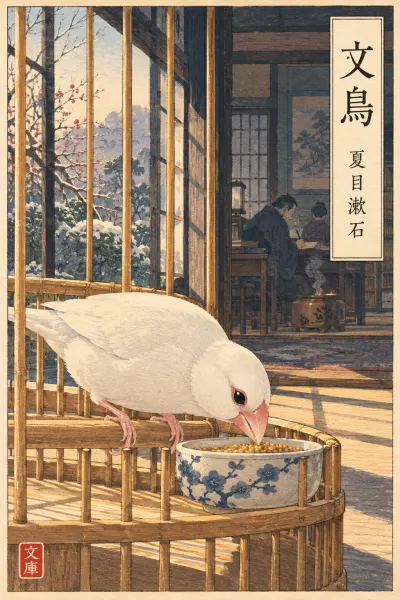
籠を箱から出すや否や、文鳥は白い首をちょっと傾けながらこの黒い眼を移して始めて自分の顔を見た。The moment I took the cage out of the box, the bird, tilting its white head slightly, turned those black eyes and looked at my face for the first time.
そうしてちちと鳴いた。And it gave a little "chi, chi."
Vocabulary
| Word | Meaning | JLPT |
|---|---|---|
| 大得意だいとくい | triumphant, extremely proud of oneself得意 alone means 'proud' or 'good at'. 大 intensifies it. | — |
| 判然はんぜん | clearly, distinctlyLiterary. Usually 判然と or 判然としない ('unclear'). | — |
| 無論むろん | of course, naturallySomewhat formal equivalent of もちろん. | N1 |
| 粗末そまつ | plain, crude, cheaply madeAlso used humbly: 粗末な物ですが ('it's nothing much, but...'). | N3 |
| 行水ぎょうずい | a bath in a tub of waterUsed here for the bird's bath. For people it means a quick wash in a basin. | — |
| 強硬きょうこう | firm, unyielding, insistentNormally used of attitudes in politics or negotiations, so it is used ironically here. | N1 |
| 袂たもと | the hanging pouch of a kimono sleevePeople carried small items in it, much like a pocket. | — |
| 粟あわ | foxtail millet (bird seed) | — |
| 寝坊ねぼう | late riser; sleeping in寝坊する = to oversleep. | N4 |
| 受合うけあう | to undertake, to take responsibility fordictionary form: 受け合うHere written without okurigana. It can also mean 'to guarantee'. | — |
| 覚束なかったおぼつかない | doubtful, uncertain, unsure of oneselfdictionary form: 覚束ない | — |
| 伽藍がらん | a large temple buildingSuggests a vast, empty hall, and is related to がらんとした ('empty, bare'). | — |
| 退儀たいぎ | tiresome, too much trouble (退儀 is Sōseki's variant spelling of the standard 大儀)dictionary form: 大儀Older spelling. Today this is written 大儀. | — |
| 気の毒きのどく | pitiful; feeling sorry for someone気の毒になる = to come to feel sorry for. | N3 |
Grammar
〜てある N4 has been done (resulting state)
A transitive verb in te-form + ある describes a state left by someone's deliberate action. The focus is on the finished cage rather than on who lacquered it.
台が漆で塗ってある。
The base was finished in lacquer.
〜なくっちゃいけません N4 must, have to
This is a colloquial contraction of 〜なくてはいけません, with an added emphatic っ. Miekichi uses it, and the variant なくっちゃなりません, to lay down the rules for the bird's care.
これを毎朝食わせなくっちゃいけません。
"You must feed it this every morning.
〜ておやんなさい N4 do (something) for it, please
This combines 〜てやる ('do for someone lower') with the polite お〜なさい. おやんなさい is a slurred form of おやりなさい. It is a gentle command to do a favour for the bird.
水も毎朝かえておやんなさい。
Change its water every morning too.
〜ほど N3 so ... that; to the extent that
A clause before ほど expresses the degree of the following adjective. Here the bird is white to the point that one would not think it a bird.
籠の中にうずくまっていなければ鳥とは思えないほど白い。
It was so white that, had it not been crouching in a cage, one could hardly have taken it for a bird.
〜ついでに(ついでをもって) N3 while one is at it; taking the opportunity of
ついで means an opportunity to do one thing while doing another. ついでをもって is an older, more formal variant of ついでに.
顔を洗うついでをもって
taking the chance while washing my face
〜や否や N1 as soon as, the moment that
This literary pattern attaches to a verb's dictionary form. It indicates that the second action follows the first immediately.
籠を箱から出すや否や
The moment I took the cage out of the box