Part 1 of 8 · JLPT N2
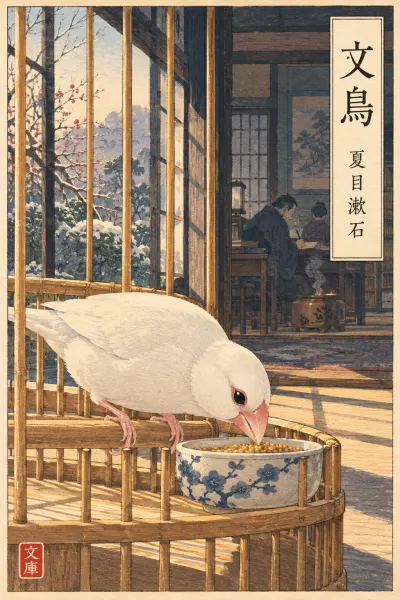
文鳥 Bunchō, part 1: A Bird Promised, Then Delivered
In this part
Soon after the narrator moves to Waseda in October, his friend Miekichi urges him to keep a Java sparrow and buy a cage, and he readily hands over a five-yen note. Weeks pass, autumn turns to frost, Miekichi visits often without mentioning the bird, and the narrator forgets all about it. Then one early winter evening Miekichi bursts in with Toyotaka, carrying cages and a large box.
AI translation · independently checked
十月早稲田に移る。In October I moved to Waseda.
伽藍のような書斎にただ一人、片づけた顔を頬杖で支えていると、三重吉が来て、鳥を御飼いなさいと云う。I was sitting all alone in my study, a room as vast and bare as a temple hall, propping my composed face on my hand, when Miekichi came in and told me I ought to keep a bird.
飼ってもいいと答えた。I answered that I wouldn't mind keeping one.
しかし念のためだから、何を飼うのかねと聞いたら、文鳥ですと云う返事であった。Still, just to be sure, I asked him what sort of bird I was to keep, and the reply was: a Java sparrow.
文鳥は三重吉の小説に出て来るくらいだから奇麗な鳥に違なかろうと思って、じゃ買ってくれたまえと頼んだ。Since Java sparrows even turned up in Miekichi's stories, I supposed it must be a pretty bird, and asked him to buy me one, then.
ところが三重吉は是非御飼いなさいと、同じような事を繰り返している。Miekichi, however, kept repeating much the same thing: I really must keep one.
うむ買うよ買うよとやはり頬杖を突いたままで、むにゃむにゃ云ってるうちに三重吉は黙ってしまった。While I went on mumbling, "Yes, yes, I'll buy one, I'll buy one," with my chin still on my hand, Miekichi fell silent.
おおかた頬杖に愛想を尽かしたんだろうと、この時始めて気がついた。Only then did it occur to me that he had probably given up on me in disgust at my sitting there with my chin in my hand.
すると三分ばかりして、今度は籠を御買いなさいと云いだした。Then, after about three minutes, he started up again, this time telling me to buy a cage.
これも宜しいと答えると、是非御買いなさいと念を押す代りに、鳥籠の講釈を始めた。When I answered that this too would be fine, instead of insisting that I really must buy one, he launched into a lecture on bird cages.
その講釈はだいぶ込み入ったものであったが、気の毒な事に、みんな忘れてしまった。The lecture was a rather involved affair, but I regret to say that I have forgotten every word of it.
ただ好いのは二十円ぐらいすると云う段になって、急にそんな高価のでなくっても善かろうと云っておいた。Only, when he reached the point of saying that a good one would cost around twenty yen, I hastily remarked that it need hardly be as expensive as all that.
三重吉はにやにやしている。Miekichi grinned.
それから全体どこで買うのかと聞いて見ると、なにどこの鳥屋にでもありますと、実に平凡な答をした。Next, when I asked him where on earth one bought such a thing, he gave the thoroughly ordinary answer: "Oh, any bird shop will have them."
籠はと聞き返すと、籠ですか、籠はその何ですよ、なにどこにかあるでしょう、とまるで雲を攫むような寛大な事を云う。"And the cage?" I asked in turn, and he said, "The cage? Well, the cage is, you know… oh, there'll be one somewhere," an answer as generous as it was impossible to grasp, like trying to catch hold of a cloud.
でも君あてがなくっちゃいけなかろうと、あたかもいけないような顔をして見せたら、三重吉は頬ぺたへ手をあてて、何でも駒込に籠の名人があるそうですが、年寄だそうですから、もう死んだかも知れませんと、非常に心細くなってしまった。"But surely, my dear fellow, it won't do unless you have somewhere in mind," I said, putting on a face as though it really would not do, whereupon Miekichi laid a hand on his cheek and said, "I believe there's a master cage-maker over in Komagome, but they say he's an old man, so he may well be dead by now," and grew exceedingly forlorn.
何しろ言いだしたものに責任を負わせるのは当然の事だから、さっそく万事を三重吉に依頼する事にした。At any rate, it was only proper that whoever had proposed the thing should bear responsibility for it, so I promptly decided to leave the whole business to Miekichi.
すると、すぐ金を出せと云う。At which he at once told me to hand over the money.
金はたしかに出した。I certainly did hand it over.
三重吉はどこで買ったか、七子の三つ折の紙入を懐中していて、人の金でも自分の金でも悉皆この紙入の中に入れる癖がある。Miekichi kept in the fold of his kimono a three-fold wallet of nanako silk, bought heaven knows where, and he had a habit of stuffing all money into it, whether it belonged to others or to himself.
自分は三重吉が五円札をたしかにこの紙入の底へ押し込んだのを目撃した。I saw with my own eyes Miekichi push a five-yen note down to the bottom of that wallet.
かようにして金はたしかに三重吉の手に落ちた。In this manner the money unquestionably passed into Miekichi's hands.
しかし鳥と籠とは容易にやって来ない。The bird and the cage, however, were in no hurry to arrive.
そのうち秋が小春になった。Meanwhile autumn gave way to the mild, sunny days of early winter.
三重吉はたびたび来る。Miekichi came by often.
よく女の話などをして帰って行く。As often as not he would talk about women and the like, and then go home.
文鳥と籠の講釈は全く出ない。Of Java sparrows and lectures on cages there was no mention at all.
硝子戸を透して五尺の縁側には日が好く当る。The sun came through the glass doors and shone warmly on the five-foot veranda.
どうせ文鳥を飼うなら、こんな暖かい季節に、この縁側へ鳥籠を据えてやったら、文鳥も定めし鳴き善かろうと思うくらいであった。Indeed, I even thought that if I was going to keep a Java sparrow anyway, it would surely sing well if I set its cage out on this veranda in warm weather like this.
三重吉の小説によると、文鳥は千代千代と鳴くそうである。According to Miekichi's story, the Java sparrow sings "Chiyo, Chiyo."
その鳴き声がだいぶん気に入ったと見えて、三重吉は千代千代を何度となく使っている。He seems to have been quite taken with that call, for he uses "Chiyo, Chiyo" over and over again.
あるいは千代と云う女に惚れていた事があるのかも知れない。Perhaps he was once in love with a woman called Chiyo.
しかし当人はいっこうそんな事を云わない。But the man himself has never said anything of the kind.
自分も聞いてみない。Nor have I thought to ask him.
ただ縁側に日が善く当る。The sun simply shone warmly on the veranda.
そうして文鳥が鳴かない。And no Java sparrow sang.
そのうち霜が降り出した。Before long the frosts set in.
自分は毎日伽藍のような書斎に、寒い顔を片づけてみたり、取乱してみたり、頬杖を突いたりやめたりして暮していた。Day after day I passed my time in that temple-hall of a study, now composing my cold face, now letting it fall to pieces, now propping my chin on my hand and now giving it up.
戸は二重に締め切った。I kept the doors shut tight, both sets of them.
火鉢に炭ばかり継いでいる。I did nothing but feed charcoal into the brazier.
文鳥はついに忘れた。In the end I forgot all about the Java sparrow.
ところへ三重吉が門口から威勢よく這入って来た。It was then that Miekichi came striding briskly in at the gate.
時は宵の口であった。It was early in the evening.
寒いから火鉢の上へ胸から上を翳して、浮かぬ顔をわざとほてらしていたのが、急に陽気になった。Because of the cold I had been hunched over the brazier from the chest up, deliberately warming my glum face, but now I suddenly brightened.
三重吉は豊隆を従えている。Miekichi had Toyotaka in tow.
豊隆はいい迷惑である。For Toyotaka it was a fine nuisance.
二人が籠を一つずつ持っている。Each of the two was carrying a cage.
その上に三重吉が大きな箱を兄き分に抱えている。On top of that, Miekichi, playing the big brother, was hugging a large box.
五円札が文鳥と籠と箱になったのはこの初冬の晩であった。It was on this early winter evening that the five-yen note turned into a Java sparrow, a cage and a box.
Vocabulary
| Word | Meaning | JLPT |
|---|---|---|
| 文鳥ぶんちょう | Java sparrow (a small finch kept as a pet)Literally 'patterned bird'; a popular cage bird in Meiji Japan. | — |
| 伽藍がらん | large temple hall; (here) a vast, empty roomBuddhist term; related to がらんとした 'empty, deserted'. | — |
| 頬杖ほおづえ | resting one's cheek or chin on one's handUsed with 突く or 支える: 頬杖を突く. | — |
| 講釈こうしゃく | lecture, long-winded explanationOften slightly ironic: a know-it-all explanation. | — |
| 念を押すねんをおす | to press the point, to make doubly sureCompare 念のため 'just to be sure'. | — |
| 心細くこころぼそい | forlorn, uneasy, helplessdictionary form: 心細いLiterally 'heart grows thin'. | N1 |
| 紙入かみいれ | wallet, purse (for paper money)dictionary form: 紙入れOlder word; modern Japanese uses 財布 or 札入れ. | — |
| 悉皆しっかい | all, entirely, without exceptionOld-fashioned literary adverb; modern equivalent すべて. | — |
| 目撃もくげき | to witness, to see with one's own eyesdictionary form: 目撃するFormal word, often used of crimes; here used with mock solemnity. | — |
| 小春こはる | mild, spring-like days of early winter; Indian summerTraditionally the tenth month of the lunar calendar; 小春日和 = a mild late-autumn day. | — |
| 縁側えんがわ | veranda; wooden corridor along the outside of a Japanese houseHere closed off with glass doors, so it catches the sun. | N1 |
| 惚れほれる | to fall in love, to be smittendictionary form: 惚れるColloquial and emotional; 〜に惚れる 'to fall for someone'. | — |
| 火鉢ひばち | charcoal brazierThe main indoor heater of the period; 炭を継ぐ = to add charcoal. | — |
| 宵の口よいのくち | early evening, just after dark | — |
Grammar
〜たまえ N1 do ~ (mild command from a superior)
Attached to the 連用形 of a verb, たまえ is an old-fashioned male command used toward equals or juniors. It marks the narrator's brusque, senior tone toward Miekichi.
じゃ買ってくれたまえと頼んだ
I asked him to buy me one, then
〜うちに N3 while ~ (and before one notices)
Verb ている/てる + うちに marks a span of time during which something else happens. Here Miekichi falls silent while the narrator is still mumbling.
むにゃむにゃ云ってるうちに三重吉は黙ってしまった
while I was mumbling away, Miekichi fell silent
〜かも知れない N4 may, might, perhaps
Expresses possibility without certainty. 知れない is often written in kanji in older texts; modern texts use かもしれない.
もう死んだかも知れません
he may well be dead by now
〜と見えて N1 apparently ~, so…; it seems that ~, and so
Presents an inference drawn from visible evidence, then states the evidence or result. The narrator infers that Miekichi likes the call because he uses it so often.
その鳴き声がだいぶん気に入ったと見えて、三重吉は千代千代を何度となく使っている
He seems to have been quite taken with that call, for he uses "Chiyo, Chiyo" over and over again