Part 3 of 8 · JLPT N2
文鳥 Bunchō, part 3: Feeding the New Bird
In this part
The narrator sets the cage on its box and admires the Java sparrow's delicate feet and quick movements. Following Miekichi's fussy instructions, he clumsily puts in the seed and water, frightening the bird and coming to dislike his own large hand. Later, as he sits stuck at his writing desk, the bird calls out 'chiyo, chiyo', just as Miekichi had promised it would.
AI translation · independently checked
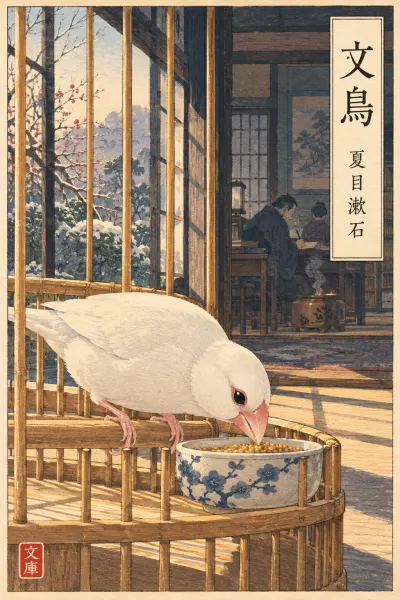
自分は静かに鳥籠を箱の上に据えた。I quietly set the birdcage on top of the box.
文鳥はぱっと留り木を離れた。The Java sparrow sprang off its perch.
そうしてまた留り木に乗った。Then it settled on a perch again.
留り木は二本ある。There were two perches.
黒味がかった青軸をほどよき距離に橋と渡して横に並べた。They were green stems with a blackish tinge, laid side by side across the cage like bridges, a nicely judged distance apart.
その一本を軽く踏まえた足を見るといかにも華奢にできている。Looking at the feet that rested lightly on one of them, I saw how very delicately they were made.
細長い薄紅の端に真珠を削ったような爪が着いて、手頃な留り木を甘く抱え込んでいる。At the tips of the long, slender, pale crimson toes were claws like shavings of pearl, and they clasped the perch, which was just the right size, very neatly.
すると、ひらりと眼先が動いた。Then something flickered before my eyes.
文鳥はすでに留り木の上で方向を換えていた。The sparrow had already turned round on its perch.
しきりに首を左右に傾ける。It kept tilting its head from side to side.
傾けかけた首をふと持ち直して、心持前へ伸したかと思ったら、白い羽根がまたちらりと動いた。It suddenly straightened its half-tilted head and stretched it a little forward, and the next moment its white wings flicked again.
文鳥の足は向うの留り木の真中あたりに具合よく落ちた。The sparrow's feet came down neatly on about the middle of the other perch.
ちちと鳴く。It chirped, 'chi-chi'.
そうして遠くから自分の顔を覗き込んだ。Then it peered into my face from a distance.
自分は顔を洗いに風呂場へ行った。I went to the bathroom to wash my face.
帰りに台所へ廻って、戸棚を明けて、昨夕三重吉の買って来てくれた粟の袋を出して、餌壺の中へ餌を入れて、もう一つには水を一杯入れて、また書斎の縁側へ出た。On the way back I went round by the kitchen, opened the cupboard, took out the bag of millet that Miekichi had bought for me the evening before, put seed into one of the dishes, filled the other with water, and went out once more onto the veranda of my study.
三重吉は用意周到な男で、昨夕叮嚀に餌をやる時の心得を説明して行った。Miekichi was a man who thought of everything, and the evening before he had carefully explained the points to bear in mind when feeding the bird.
その説によると、むやみに籠の戸を明けると文鳥が逃げ出してしまう。According to his account, if you opened the cage door carelessly, the sparrow would get out and fly away.
だから右の手で籠の戸を明けながら、左の手をその下へあてがって、外から出口を塞ぐようにしなくっては危険だ。So it was dangerous unless, while opening the cage door with your right hand, you held your left hand underneath and blocked the opening from outside.
餌壺を出す時も同じ心得でやらなければならない。The same care had to be taken when taking the dishes out.
とその手つきまでして見せたが、こう両方の手を使って、餌壺をどうして籠の中へ入れる事ができるのか、つい聞いておかなかった。He had even shown me the motions with his hands, but I had somehow failed to ask him how, with both hands occupied like that, one could get the dish into the cage.
自分はやむをえず餌壺を持ったまま手の甲で籠の戸をそろりと上へ押し上げた。Having no choice, I kept hold of the dish and gently pushed the cage door upwards with the back of my hand.
同時に左の手で開いた口をすぐ塞いだ。At the same moment I blocked the opening with my left hand.
鳥はちょっと振り返った。The bird glanced round.
そうして、ちちと鳴いた。Then it chirped, 'chi-chi'.
自分は出口を塞いだ左の手の処置に窮した。I was at a loss what to do with the left hand that was blocking the opening.
人の隙を窺って逃げるような鳥とも見えないので、何となく気の毒になった。It did not look like the kind of bird that would watch for a careless moment and escape, and I felt somehow sorry for it.
三重吉は悪い事を教えた。Miekichi had taught me something bad.
大きな手をそろそろ籠の中へ入れた。Slowly, slowly, I put my big hand into the cage.
すると文鳥は急に羽搏を始めた。At once the sparrow began to beat its wings.
細く削った竹の目から暖かいむく毛が、白く飛ぶほどに翼を鳴らした。It flapped them so hard that its warm down went flying out, white, through the gaps in the finely shaved bamboo.
自分は急に自分の大きな手が厭になった。Suddenly I loathed my own big hand.
粟の壺と水の壺を留り木の間にようやく置くや否や、手を引き込ました。The moment I had managed to put the millet dish and the water dish down between the perches, I drew my hand back.
籠の戸ははたりと自然に落ちた。The cage door dropped shut of its own accord with a soft clap.
文鳥は留り木の上に戻った。The sparrow went back up onto its perch.
白い首を半ば横に向けて、籠の外にいる自分を見上げた。Turning its white neck half sideways, it looked up at me outside the cage.
それから曲げた首を真直にして足の下にある粟と水を眺めた。Then it straightened its bent neck and gazed at the millet and water beneath its feet.
自分は食事をしに茶の間へ行った。I went to the living room to eat.
その頃は日課として小説を書いている時分であった。At that time I was writing a novel as my daily task.
飯と飯の間はたいてい机に向って筆を握っていた。Between meals I generally sat at my desk with a pen in my hand.
静かな時は自分で紙の上を走るペンの音を聞く事ができた。When all was quiet, I could hear for myself the sound of the pen running over the paper.
伽藍のような書斎へは誰も這入って来ない習慣であった。It was the custom that no one came into my study, which was as vast and empty as a temple hall.
筆の音に淋しさと云う意味を感じた朝も昼も晩もあった。There were mornings, afternoons and evenings when I felt in the sound of the pen something that meant loneliness.
しかし時々はこの筆の音がぴたりとやむ、またやめねばならぬ、折もだいぶあった。But there were also a good many times when the sound of the pen would stop dead, or had to be stopped.
その時は指の股に筆を挟んだまま手の平へ顎を載せて硝子越に吹き荒れた庭を眺めるのが癖であった。At such times it was my habit, with the pen still held between my fingers, to rest my chin on my palm and gaze through the glass at the wind-ravaged garden.
それが済むと載せた顎を一応撮んで見る。When that was done, I would give the chin I had been resting a pinch, just to see.
それでも筆と紙がいっしょにならない時は、撮んだ顎を二本の指で伸して見る。If pen and paper still refused to come together, I would stretch the pinched chin with two fingers, just to see.
すると縁側で文鳥がたちまち千代千代と二声鳴いた。Then, out on the veranda, the sparrow suddenly sang out twice: 'chiyo, chiyo'.
筆を擱いて、そっと出て見ると、文鳥は自分の方を向いたまま、留り木の上から、のめりそうに白い胸を突き出して、高く千代と云った。I put down my pen and slipped out quietly to look, and there was the sparrow, still facing me, thrusting out its white breast from the perch so far it seemed about to topple forward, and it called 'chiyo' in a high voice.
三重吉が聞いたらさぞ喜ぶだろうと思うほどな美い声で千代と云った。It said 'chiyo' in a voice so lovely that I thought how delighted Miekichi would be to hear it.
三重吉は今に馴れると千代と鳴きますよ、きっと鳴きますよ、と受合って帰って行った。Before he went home, Miekichi had assured me: 'Once it gets used to you, it'll sing "chiyo", it will, you'll see.'
Vocabulary
| Word | Meaning | JLPT |
|---|---|---|
| 据えたすえる | to set (something) firmly in placedictionary form: 据えるImplies placing something carefully so that it stays put. | N1 |
| 留り木とまりぎ | perch (in a birdcage)dictionary form: 止まり木Usually written 止まり木 today; 留 here is an older spelling. | — |
| 華奢きゃしゃ | delicate, slender, fragileA na-adjective, often used of thin limbs or fine objects. | N1 |
| 傾けるかたむける | to tilt, to inclineRead かたぶける here, an older variant of かたむける. | N1 |
| 用意周到よういしゅうとう | thoroughly prepared, leaving nothing to chanceA four-character compound describing a meticulous person. | — |
| 心得こころえ | know-how; rules to keep in mind | N1 |
| 塞ぐふさぐ | to block, to close up (an opening) | N2 |
| やむをえずやむをえず | unavoidably, having no other choicedictionary form: やむを得ず | — |
| 窮したきゅうする | to be at a loss, to be stuckdictionary form: 窮する〜に窮する: to be at one's wits' end over something. Formal and literary. | — |
| 窺ってうかがう | to watch for (a chance), to spy ondictionary form: 窺う隙を窺う = to wait for an unguarded moment. | — |
| 伽藍がらん | a large Buddhist temple hallHere suggests a room that is huge and empty; compare がらんとした 'empty, deserted'. | — |
| 癖くせ | habit (often an unconscious one) | N3 |
| 受合ってうけあう | to assure, to guaranteedictionary form: 受け合うNow usually written 請け合う. | — |
Grammar
〜たかと思ったら N2 no sooner had … than; the next moment
Marks one action followed almost immediately by another, often unexpected. Here the bird stretches its head forward and at once its wings move.
心持前へ伸したかと思ったら、白い羽根がまたちらりと動いた。
It stretched its head a little forward, and the next moment its white wings flicked again.
〜なくっては(危険だ) N3 unless you …, it is (dangerous)
〜なくては is a negative conditional, 'if you do not do …', followed by a bad result. なくっては is a colloquial, emphatic form, here echoing Miekichi's warning.
外から出口を塞ぐようにしなくっては危険だ。
It was dangerous unless you blocked the opening from outside.
〜たまま N4 while still …; leaving something as it is
Attached to a past-tense verb, it means the state continues while something else happens. The narrator pushes the door up while still holding the dish.
自分はやむをえず餌壺を持ったまま手の甲で籠の戸をそろりと上へ押し上げた。
Having no choice, I kept hold of the dish and gently pushed the cage door upwards with the back of my hand.
〜や否や N1 as soon as; the moment that
A literary pattern after the dictionary form of a verb, saying the second action follows immediately. He pulls his hand out the instant the dishes are down.
粟の壺と水の壺を留り木の間にようやく置くや否や、手を引き込ました。
The moment I had managed to put the millet dish and the water dish down between the perches, I drew my hand back.
〜ねばならぬ N2 must, have to
The classical equivalent of 〜なければならない: ね is the old negative ず in conditional form, and ぬ is the old negative ない.
またやめねばならぬ、折もだいぶあった。
There were also a good many times when it had to be stopped.