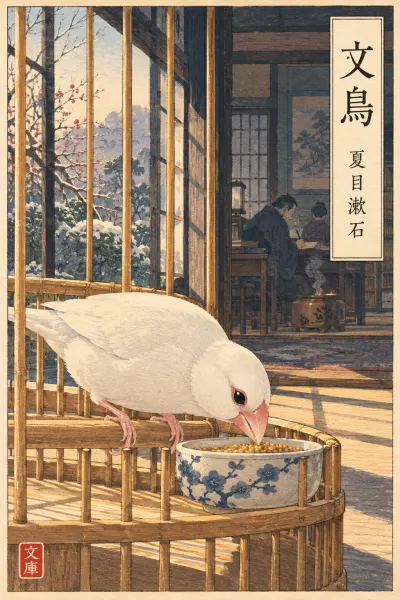
Part 8 of 8 · JLPT N2
文鳥 Bunchō, part 8: Death and Burial of the Sparrow
In this part
The narrator finds the Java sparrow dead in its cage, with its food and water gone. He throws the body down before the young maid, sends Miekichi a bitter postcard blaming the household's cruelty, and the children bury the bird in the back garden. The next morning he finds Fudeko's little sign on the grave, and Miekichi's reply offers only a polite word of regret.
AI translation · independently checked
餌壺には粟の殻ばかり溜っている。The food dish held nothing but millet husks.
啄むべきは一粒もない。There was not a single grain left to peck.
水入は底の光るほど涸れている。The water dish had run so dry that its bottom shone.
西へ廻った日が硝子戸を洩れて斜めに籠に落ちかかる。The sun, now gone round to the west, seeped through the glass doors and fell slantwise across the cage.
台に塗った漆は、三重吉の云ったごとく、いつの間にか黒味が脱けて、朱の色が出て来た。The lacquer on the stand, just as Miekichi had said, had lost its blackness without my noticing, and the vermilion had come through.
自分は冬の日に色づいた朱の台を眺めた。I gazed at the vermilion stand, coloured by the winter sun.
空になった餌壺を眺めた。I gazed at the empty food dish.
空しく橋を渡している二本の留り木を眺めた。I gazed at the two perches, still spanning the cage like bridges, to no purpose now.
そうしてその下に横わる硬い文鳥を眺めた。And I gazed at the stiff Java sparrow lying beneath them.
自分はこごんで両手に鳥籠を抱えた。I stooped and took the birdcage up in both arms.
そうして、書斎へ持って這入った。Then I carried it into the study.
十畳の真中へ鳥籠を卸して、その前へかしこまって、籠の戸を開いて、大きな手を入れて、文鳥を握って見た。I set the cage down in the middle of the ten-mat room, knelt formally before it, opened its little door, put in my large hand, and closed it round the sparrow.
柔かい羽根は冷きっている。The soft feathers had gone quite cold.
拳を籠から引き出して、握った手を開けると、文鳥は静に掌の上にある。When I drew my fist out of the cage and opened it, the sparrow lay quietly on my palm.
自分は手を開けたまま、しばらく死んだ鳥を見つめていた。With my hand still open, I stared for some time at the dead bird.
それから、そっと座布団の上に卸した。Then I laid it gently on the floor cushion.
そうして、烈しく手を鳴らした。And I clapped my hands, hard.
十六になる小女が、はいと云って敷居際に手をつかえる。The maid, a girl of sixteen, answered "Yes, sir," and knelt at the threshold with her hands to the floor.
自分はいきなり布団の上にある文鳥を握って、小女の前へ抛り出した。Without warning I snatched the sparrow up from the cushion and flung it down in front of her.
小女は俯向いて畳を眺めたまま黙っている。The girl bowed her head and kept her eyes on the mats, saying nothing.
自分は、餌をやらないから、とうとう死んでしまったと云いながら、下女の顔を睥めつけた。Telling her that the bird had died at last because she had not fed it, I glared into her face.
下女はそれでも黙っている。Still the maid said nothing.
自分は机の方へ向き直った。I turned back to my desk.
そうして三重吉へ端書をかいた。And I wrote a postcard to Miekichi.
「家人が餌をやらないものだから、文鳥はとうとう死んでしまった。たのみもせぬものを籠へ入れて、しかも餌をやる義務さえ尽くさないのは残酷の至りだ」と云う文句であった。It ran: "Because my household failed to feed it, the Java sparrow has died at last. To put a creature nobody asked for into a cage, and then not even do one's duty of feeding it, is the very height of cruelty."
自分は、これを投函して来い、そうしてその鳥をそっちへ持って行けと下女に云った。I told the maid to go and post this, and to take the bird away.
下女は、どこへ持って参りますかと聞き返した。The maid asked where she should take it.
どこへでも勝手に持って行けと怒鳴りつけたら、驚いて台所の方へ持って行った。When I shouted at her to take it wherever she liked, she started and carried it off towards the kitchen.
しばらくすると裏庭で、子供が文鳥を埋るんだ埋るんだと騒いでいる。After a while the children were making a great noise in the back garden: they were going to bury the sparrow, bury the sparrow.
庭掃除に頼んだ植木屋が、御嬢さん、ここいらが好いでしょうと云っている。The gardener, who had been engaged to tidy the garden, was saying, "How about round about here, miss?"
自分は進まぬながら、書斎でペンを動かしていた。Though my heart was not in it, I kept my pen moving in the study.
翌日は何だか頭が重いので、十時頃になってようやく起きた。The next day my head felt heavy somehow, and it was ten o'clock before I finally got up.
顔を洗いながら裏庭を見ると、昨日植木屋の声のしたあたりに、小さい公札が、蒼い木賊の一株と並んで立っている。Looking out at the back garden as I washed my face, I saw a small notice board standing beside a clump of green horsetail, near the spot where the gardener's voice had been the day before.
高さは木賊よりもずっと低い。It was a good deal shorter than the horsetail.
庭下駄を穿いて、日影の霜を踏み砕いて、近づいて見ると、公札の表には、この土手登るべからずとあった。I put on my garden clogs, crunched across the frost in the shade, and went up close: on the face of the board was written, "Do not climb this bank."
筆子の手蹟である。It was in Fudeko's hand.
午後三重吉から返事が来た。In the afternoon a reply came from Miekichi.
文鳥は可愛想な事を致しましたとあるばかりで家人が悪いとも残酷だともいっこう書いてなかった。It said only that what had befallen the sparrow was a great pity; of my household being at fault, or of cruelty, it said not a word.
Vocabulary
| Word | Meaning | JLPT |
|---|---|---|
| 啄むついばむ | to peck (at food)Used of birds picking up grain with the beak. | — |
| 涸れてかれる | to run drydictionary form: 涸れるWritten with 涸 for water drying up; 枯れる is for plants withering. | N1 |
| 漆うるし | lacquerBlack lacquer laid over vermilion wears thin with time and lets the red show through. | — |
| 留り木とまりぎ | perch (in a birdcage)dictionary form: 留まり木From 留まる / 止まる, 'to alight', plus 木, 'wood'. | — |
| かしこまってかしこまる | to sit up formally (kneeling)dictionary form: かしこまるAlso means 'to be respectful or deferential'; here it describes his formal kneeling posture. | — |
| 手をつかえるてをつかえる | to place one's hands on the floor (in a bow)An old-fashioned expression for a servant's respectful posture when answering a call. | — |
| 睥めつけたねめつける | to glare atdictionary form: 睥めつけるA literary word, more often written 睨めつける. | — |
| 端書はがき | postcardOlder spelling; today it is usually written 葉書. | N5 |
| 残酷ざんこく | cruelty; cruel | N1 |
| 投函とうかんする | to post (a letter)dictionary form: 投函するHere the text gives the compound a colloquial reading, as if it were 出す, 'to send off'. | — |
| 公札こうさつ | public notice board; posted signProperly an official public notice; the formal word for a child's grave marker adds irony. | — |
| 木賊とくさ | horsetail (scouring rush)A tall, jointed green plant often grown in Japanese gardens. | — |
| 霜しも | frost | N3 |
| 手蹟しゅせき | handwritingAlso written 手跡. | — |
Grammar
〜べき N2 that should / could be (done)
The dictionary form plus べき makes a modifier meaning 'that ought to be done'. Here べきは works as a noun phrase: 'the thing to be pecked'.
啄むべきは一粒もない。
There was not a single grain left to peck.
〜ごとく N1 as; just as
A literary equivalent of 〜ように. Attached to a clause with の, it means 'just as (someone) said'.
三重吉の云ったごとく
just as Miekichi had said
〜たまま N4 while still in the state of ~
The past form plus まま shows that a state continues unchanged while something else happens. His hand stays open while he stares at the bird.
自分は手を開けたまま、しばらく死んだ鳥を見つめていた。
With my hand still open, I stared for some time at the dead bird.
〜ものだから N3 because (excuse or complaint)
This gives a reason, often with a tone of justification or grievance. Here it puts the blame squarely on the household.
家人が餌をやらないものだから、文鳥はとうとう死んでしまった。
Because my household failed to feed it, the Java sparrow has died at last.
〜ぬながら N2 although not ~
ぬ is the classical negative (= ない), and ながら here is concessive: 'although'. 進まぬながら means 'though unwilling', so he writes without any heart for it.
自分は進まぬながら、書斎でペンを動かしていた。
Though my heart was not in it, I kept my pen moving in the study.
〜べからず N1 must not ~ (prohibition)
A classical prohibitive form typical of public notices. The child has borrowed the stiff official style for the grave sign.
この土手登るべからずとあった。
on it was written, "Do not climb this bank."