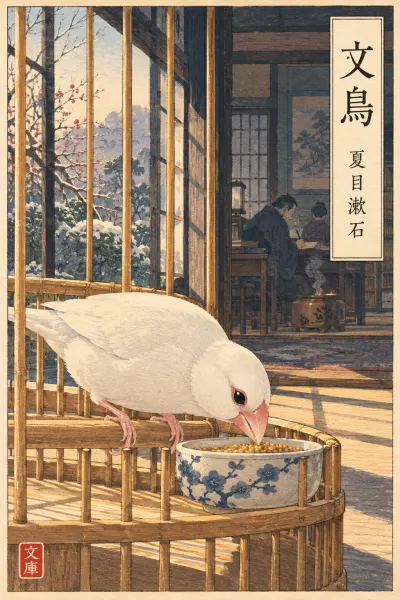
Part 6 of 8 · JLPT N2
文鳥 Bunchō, part 6: A Bird That Will Not Be Tamed
In this part
The narrator watches his sparrow stand on one leg and then drowsily put out the other, something Miekichi never mentioned. As his novel keeps him busy he leaves much of the bird's care to the household, and his attempts to hand-feed it fail. One day he hears a rustling and finds the bird bathing in its tiny water dish, so he moves it to a spare cage and showers it with a watering can. Its blinking reminds him of a woman he once teased with a reflected spring sunbeam.
AI translation · independently checked
自分は不思議に思った。I thought it strange.
文鳥について万事を説明した三重吉もこの事だけは抜いたと見える。Miekichi, who had explained everything there was to know about Java sparrows, had evidently left out this one thing.
自分が炭取に炭を入れて帰った時、文鳥の足はまだ一本であった。When I came back with the charcoal scuttle filled, the sparrow was still standing on one leg.
しばらく寒い縁側に立って眺めていたが、文鳥は動く気色もない。I stood watching for a while on the cold veranda, but the bird showed no sign of moving.
音を立てないで見つめていると、文鳥は丸い眼をしだいに細くし出した。As I gazed at it without making a sound, the sparrow began little by little to narrow its round eyes.
おおかた眠たいのだろうと思って、そっと書斎へ這入ろうとして、一歩足を動かすや否や、文鳥はまた眼を開いた。Supposing it was most likely sleepy, I made to slip quietly back into the study, but the moment I moved my foot a single step, the sparrow opened its eyes again.
同時に真白な胸の中から細い足を一本出した。At the same time it brought out its other slender leg from the pure white breast.
自分は戸を閉てて火鉢へ炭をついだ。I shut the door and added charcoal to the brazier.
小説はしだいに忙しくなる。Work on the novel kept me steadily busier.
朝は依然として寝坊をする。In the mornings I overslept as before.
一度家のものが文鳥の世話をしてくれてから、何だか自分の責任が軽くなったような心持がする。Ever since the household had once looked after the sparrow for me, I somehow felt as though my responsibility had grown lighter.
家のものが忘れる時は、自分が餌をやる水をやる。When the household forgot, I gave the bird its food and gave it its water.
籠の出し入れをする。I put the cage out and brought it in.
しない時は、家のものを呼んでさせる事もある。When I did not, I sometimes called someone of the household and had them do it.
自分はただ文鳥の声を聞くだけが役目のようになった。It came about that my only duty was simply to listen to the sparrow's voice.
それでも縁側へ出る時は、必ず籠の前へ立留って文鳥の様子を見た。Even so, whenever I went out onto the veranda, I never failed to stop in front of the cage and see how the sparrow was getting on.
たいていは狭い籠を苦にもしないで、二本の留り木を満足そうに往復していた。Usually it did not seem to mind its narrow cage at all, and hopped back and forth between its two perches with an air of contentment.
天気の好い時は薄い日を硝子越に浴びて、しきりに鳴き立てていた。On fine days it bathed in the thin sunlight through the glass and sang away incessantly.
しかし三重吉の云ったように、自分の顔を見てことさらに鳴く気色はさらになかった。But, as Miekichi had claimed, there was no sign whatever of its singing especially at the sight of my face.
自分の指からじかに餌を食うなどと云う事は無論なかった。Eating straight from my finger was, of course, out of the question.
折々機嫌のいい時は麺麭の粉などを人指指の先へつけて竹の間からちょっと出して見る事があるが文鳥はけっして近づかない。Now and then, when I was in a good humour, I would put a little breadcrumb or the like on the tip of my forefinger and poke it briefly between the bamboo bars, but the sparrow would never come near.
少し無遠慮に突き込んで見ると、文鳥は指の太いのに驚いて白い翼を乱して籠の中を騒ぎ廻るのみであった。When I pushed it in a little less politely, the sparrow, startled by the thickness of the finger, merely fluttered its white wings in disorder and flapped about the cage.
二三度試みた後、自分は気の毒になって、この芸だけは永久に断念してしまった。After trying two or three times, I began to feel sorry for it, and gave up this particular trick for good.
今の世にこんな事のできるものがいるかどうだかはなはだ疑わしい。I very much doubt whether anyone in the present age is capable of such a thing.
おそらく古代の聖徒の仕事だろう。It is most likely the work of the saints of old.
三重吉は嘘を吐いたに違ない。Miekichi must have been lying.
或日の事、書斎で例のごとくペンの音を立てて侘びしい事を書き連ねていると、ふと妙な音が耳に這入った。One day, as I sat in the study, my pen scratching as usual while I wrote out one dreary thing after another, a curious sound suddenly reached my ears.
縁側でさらさら、さらさら云う。Out on the veranda something went rustle, rustle.
女が長い衣の裾を捌いているようにも受取られるが、ただの女のそれとしては、あまりに仰山である。It might have been taken for a woman sweeping aside the hem of a long silk robe, but for an ordinary woman it was far too grand a sound.
雛段をあるく、内裏雛の袴の襞の擦れる音とでも形容したらよかろうと思った。I thought it might best be described as the rustle of the pleats of a court doll's hakama brushing together as it walks along the tiered doll stand.
自分は書きかけた小説をよそにして、ペンを持ったまま縁側へ出て見た。Leaving the novel I had begun to one side, I went out onto the veranda with the pen still in my hand.
すると文鳥が行水を使っていた。And there was the sparrow, taking a bath.
水はちょうど易え立てであった。The water had only just been changed.
文鳥は軽い足を水入の真中に胸毛まで浸して、時々は白い翼を左右にひろげながら、心持水入の中にしゃがむように腹を圧しつけつつ、総身の毛を一度に振っている。The sparrow stood with its light feet in the middle of the water dish, soaked up to its breast feathers; now and then it spread its white wings to left and right, and pressing its belly down as if crouching a little into the dish, it shook out all the feathers of its body at once.
そうして水入の縁にひょいと飛び上る。Then it hopped nimbly up onto the rim of the dish.
しばらくしてまた飛び込む。After a moment it jumped in again.
水入の直径は一寸五分ぐらいに過ぎない。The water dish was no more than an inch and a half or so across.
飛び込んだ時は尾も余り、頭も余り、背は無論余る。When the bird jumped in, its tail stuck out, its head stuck out, and its back, of course, stuck out.
水に浸かるのは足と胸だけである。Only its feet and breast were actually in the water.
それでも文鳥は欣然として行水を使っている。Even so, the sparrow was bathing with evident delight.
自分は急に易籠を取って来た。I hurriedly fetched the spare cage.
そうして文鳥をこの方へ移した。And I moved the sparrow into it.
それから如露を持って風呂場へ行って、水道の水を汲んで、籠の上からさあさあとかけてやった。Then I took a watering can to the bathroom, filled it from the tap, and poured the water over the top of the cage in a gentle shower.
如露の水が尽きる頃には白い羽根から落ちる水が珠になって転がった。By the time the watering can ran dry, the water falling from the white feathers was rolling off in beads.
文鳥は絶えず眼をぱちぱちさせていた。The sparrow kept blinking its eyes without pause.
昔紫の帯上でいたずらをした女が、座敷で仕事をしていた時、裏二階から懐中鏡で女の顔へ春の光線を反射させて楽しんだ事がある。Long ago, once, while a certain woman, she of the mischief with the purple sash ribbon, was sewing in the sitting room, I amused myself by catching the spring sunlight in a pocket mirror from an upstairs back room and flashing it onto her face.
女は薄紅くなった頬を上げて、繊い手を額の前に翳しながら、不思議そうに瞬をした。The woman lifted her faintly flushed cheeks and, shading her brow with a slender hand, blinked as if puzzled.
この女とこの文鳥とはおそらく同じ心持だろう。This woman and this sparrow probably felt much the same.
Vocabulary
| Word | Meaning | JLPT |
|---|---|---|
| 万事ばんじ | everything, all mattersLiterally 'ten thousand things'; formal or literary. | — |
| 気色けしき | sign, indication (of doing something)Older usage of the word. 〜気色もない means 'shows no sign of ~'. Not to be confused with 景色 'scenery'. | — |
| 依然としていぜんとして | as before, stillWritten-style adverb for an unchanged state. | — |
| 役目やくめ | duty, role | N2 |
| 苦にもくにする | to mind, to be bothered bydictionary form: 苦にする苦にもしない means 'not minding in the least'. | — |
| 断念だんねんする | to give up, to abandon (a plan)dictionary form: 断念する | — |
| 仰山ぎょうさん | exaggerated, grand, excessiveHere a standard literary word for 'too much'. In Kansai dialect ぎょうさん means 'a lot'. | — |
| 行水ぎょうずい | a quick bath in a tub of water行水を使う means 'to take such a bath'. Here it is used humorously of the bird. | — |
| 総身そうみ | the whole body | — |
| 欣然としてきんぜん | joyfully, gladlydictionary form: 欣然Literary kango; 欣 means 'rejoice'. | — |
| 易籠かえかご | spare cage used while the main cage is cleaned易 is an old spelling of 替える 'to change'. | — |
| 如露じょろ | watering canNow usually written じょうろ; the kanji are phonetic. | — |
| 帯上おびあげ | obiage, a silk scarf tucked into the top of a kimono sashdictionary form: 帯揚げNo English equivalent. It is a decorative cloth that also helps hold the obi bow in place. | — |
| 翳しながらかざす | to hold up (a hand) to shade one's eyesdictionary form: 翳す | — |
Grammar
〜と見える N1 it seems that, evidently
Attached to a plain-form verb, it states an inference drawn from what the speaker can observe. Here the narrator concludes that Miekichi must have left out this detail.
三重吉もこの事だけは抜いたと見える。
Miekichi had evidently left out this one thing.
Verb stem + 出す N3 to begin to ~
Added to the masu-stem, 出す marks the start of an action. It often suggests an action that begins on its own or gradually. Here the bird's eyes start to narrow.
文鳥は丸い眼をしだいに細くし出した。
The sparrow began little by little to narrow its round eyes.
〜や否や N1 the moment ~, no sooner ~ than
Attached to the dictionary form, it means the second event follows the first immediately. The bird opens its eyes the instant the narrator moves.
一歩足を動かすや否や、文鳥はまた眼を開いた。
The moment I moved my foot a single step, the sparrow opened its eyes again.
Verb stem + 立て N2 freshly ~, just ~ed
Attached to a masu-stem, 立て forms a noun meaning that the action has only just been done, as in 焼き立て 'fresh-baked'. Here the water has just been changed.
水はちょうど易え立てであった。
The water had only just been changed.
〜つつ N2 while ~ing
A written equivalent of 〜ながら that links two actions done at the same time. It appears here alongside ながら in one long descriptive sentence.
心持水入の中にしゃがむように腹を圧しつけつつ、総身の毛を一度に振っている。
Pressing its belly down as if crouching a little into the dish, it shook out all its feathers at once.