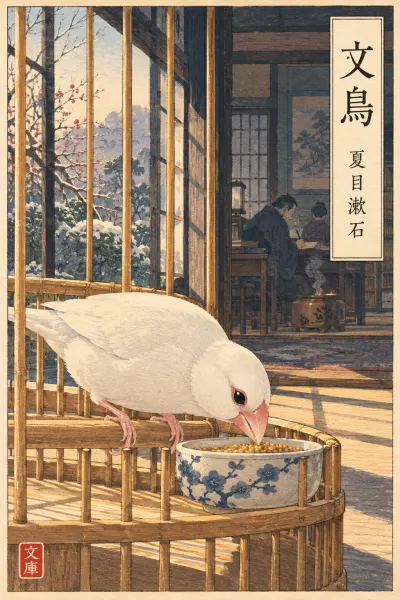
Part 5 of 8 · JLPT N2
文鳥 Bunchō, part 5: Frosty Mornings and a One-Legged Bird
In this part
The narrator writes all day to the sound of his pen and the bird's calls. On frosty mornings he lingers in bed, and a puff of cigarette smoke briefly conjures the face of a woman from his past, while the household puts the cage out and changes the feed and water. Later, working in his cold study, he finds the charcoal scuttle empty. When his clapping goes unheard, he gets up and opens the door, and sees the bird sitting unusually still on its perch, balanced on a single leg.
AI translation · independently checked
その日は一日淋しいペンの音を聞いて暮した。I spent that whole day listening to the lonely sound of my pen.
その間には折々千代千代と云う声も聞えた。Now and then, in between, I could also hear a voice calling chiyo, chiyo.
文鳥も淋しいから鳴くのではなかろうかと考えた。It occurred to me that perhaps the Java sparrow, too, was calling because it was lonely.
しかし縁側へ出て見ると、二本の留り木の間を、あちらへ飛んだり、こちらへ飛んだり、絶間なく行きつ戻りつしている。But when I went out onto the veranda, I found it flying between its two perches, now this way, now that, going back and forth without a pause.
少しも不平らしい様子はなかった。It did not look the least bit discontented.
夜は箱へ入れた。At night I put it in the box.
明る朝目が覚めると、外は白い霜だ。When I woke the next morning, there was white frost outside.
文鳥も眼が覚めているだろうが、なかなか起きる気にならない。The Java sparrow was no doubt awake as well, but I could not bring myself to get up.
枕元にある新聞を手に取るさえ難儀だ。Even reaching for the newspaper by my pillow was a labour.
それでも煙草は一本ふかした。Still, I did manage to smoke a cigarette.
この一本をふかしてしまったら、起きて籠から出してやろうと思いながら、口から出る煙の行方を見つめていた。I lay watching where the smoke drifted as it left my mouth, thinking that once I had finished this one, I would get up and let the bird out of its cage.
するとこの煙の中に、首をすくめた、眼を細くした、しかも心持眉を寄せた昔の女の顔がちょっと見えた。Then, in that smoke, I glimpsed for a moment the face of a woman from long ago, her neck drawn in, her eyes narrowed, and her brows ever so slightly knitted.
自分は床の上に起き直った。I sat up in bed.
寝巻の上へ羽織を引掛けて、すぐ縁側へ出た。I threw a haori over my nightclothes and went straight out onto the veranda.
そうして箱の葢をはずして、文鳥を出した。Then I took the lid off the box and brought the Java sparrow out.
文鳥は箱から出ながら千代千代と二声鳴いた。As it came out of the box, the Java sparrow called chiyo, chiyo, twice.
三重吉の説によると、馴れるにしたがって、文鳥が人の顔を見て鳴くようになるんだそうだ。According to Miekichi's theory, as a Java sparrow grows used to you, it comes to sing when it sees your face.
現に三重吉の飼っていた文鳥は、三重吉が傍にいさえすれば、しきりに千代千代と鳴きつづけたそうだ。Indeed, he said, the Java sparrow Miekichi had kept would sing chiyo, chiyo on and on, so long as Miekichi was beside it.
のみならず三重吉の指の先から餌を食べると云う。Not only that, it apparently ate its feed from the tip of Miekichi's finger.
自分もいつか指の先で餌をやって見たいと思った。I thought that some day I too would like to try feeding it from my fingertip.
次の朝はまた怠けた。The next morning I was idle again.
昔の女の顔もつい思い出さなかった。Nor, as it happened, did I think of the woman's face from long ago.
顔を洗って、食事を済まして、始めて、気がついたように縁側へ出て見ると、いつの間にか籠が箱の上に乗っている。Only after I had washed my face and finished breakfast did I go out onto the veranda, as if it had suddenly occurred to me, and found that at some point the cage had been set on top of the box.
文鳥はもう留り木の上を面白そうにあちら、こちらと飛び移っている。The Java sparrow was already hopping cheerfully from perch to perch, this way and that.
そうして時々は首を伸して籠の外を下の方から覗いている。And every so often it stretched out its neck and peered out of the cage from below.
その様子がなかなか無邪気である。There was something quite innocent in the way it did so.
昔紫の帯上でいたずらをした女は襟の長い、背のすらりとした、ちょっと首を曲げて人を見る癖があった。The woman who long ago had played that mischief with a purple obiage had a long neck and a slender figure, and a habit of tilting her head a little when she looked at you.
粟はまだある。There was still millet left.
水もまだある。There was still water too.
文鳥は満足している。The Java sparrow was content.
自分は粟も水も易えずに書斎へ引込んだ。I withdrew into my study without changing either the millet or the water.
昼過ぎまた縁側へ出た。After noon I went out onto the veranda again.
食後の運動かたがた、五六間の廻り縁を、あるきながら書見するつもりであった。I meant to read as I walked along the veranda, five or six ken of it running round the house, by way of exercise after my meal.
ところが出て見ると粟がもう七分がた尽きている。But when I came out, I saw that the millet was already some seven-tenths gone.
水も全く濁ってしまった。The water, too, had turned quite cloudy.
書物を縁側へ抛り出しておいて、急いで餌と水を易えてやった。Tossing my book down on the veranda, I hurried to change its feed and water.
次の日もまた遅く起きた。The following day I again got up late.
しかも顔を洗って飯を食うまでは縁側を覗かなかった。What is more, I did not so much as glance at the veranda until I had washed and eaten.
書斎に帰ってから、あるいは昨日のように、家人が籠を出しておきはせぬかと、ちょっと縁へ顔だけ出して見たら、はたして出してあった。Back in my study, wondering whether someone in the house might have put the cage out as they had the day before, I poked just my head out onto the veranda, and sure enough, it had been put out.
その上餌も水も新しくなっていた。Its feed and water had been freshened as well.
自分はやっと安心して首を書斎に入れた。Relieved at last, I drew my head back into the study.
途端に文鳥は千代千代と鳴いた。At that very moment the Java sparrow called chiyo, chiyo.
それで引込めた首をまた出して見た。So I put my head, which I had drawn back in, out again and looked.
けれども文鳥は再び鳴かなかった。But the Java sparrow did not call a second time.
けげんな顔をして硝子越に庭の霜を眺めていた。It was gazing through the glass at the frost in the garden with a puzzled look.
自分はとうとう机の前に帰った。In the end I went back to my desk.
書斎の中では相変らずペンの音がさらさらする。In the study the pen went on scratching softly as before.
書きかけた小説はだいぶんはかどった。The novel I had begun made good progress.
指の先が冷たい。My fingertips were cold.
今朝埋けた佐倉炭は白くなって、薩摩五徳に懸けた鉄瓶がほとんど冷めている。The Sakura charcoal I had banked that morning had turned white, and the iron kettle on the Satsuma trivet had almost gone cold.
炭取は空だ。The charcoal scuttle was empty.
手を敲いたがちょっと台所まで聴えない。I clapped my hands, but the sound did not quite carry to the kitchen.
立って戸を明けると、文鳥は例に似ず留り木の上にじっと留っている。When I got up and opened the door, the Java sparrow, unlike its usual self, was perched quite still on its perch.
よく見ると足が一本しかない。Looking closely, I saw that it had only one leg.
自分は炭取を縁に置いて、上からこごんで籠の中を覗き込んだ。I set the charcoal scuttle down on the veranda, bent over, and peered down into the cage.
いくら見ても足は一本しかない。However long I looked, there was only one leg.
文鳥はこの華奢な一本の細い足に総身を託して黙然として、籠の中に片づいている。The Java sparrow had entrusted its whole body to that one thin, delicate leg, and sat tucked away in the cage in silence.
Vocabulary
| Word | Meaning | JLPT |
|---|---|---|
| 淋しいさびしい | lonely, forlornLiterary kanji variant of 寂しい. | N4 |
| 絶間なくたえまない | without a break, ceaselesslydictionary form: 絶え間ない絶え間 = a gap or pause; usually written 絶え間なく today. | — |
| 霜しも | frostA key seasonal image in this part: winter is setting in. | N3 |
| 難儀なんぎ | a hardship, a botherSomewhat old-fashioned; here it is ironic, since the task is only picking up a newspaper. | — |
| ふかしたふかす | to puff on (a cigarette), to smokedictionary form: ふかすUsed with 煙草. Also means 'to steam' (food) or 'to rev' (an engine). | — |
| 羽織はおり | haori, a short jacket worn over a kimonoThere is no English equivalent, so it is kept in the translation. | — |
| 怠けたなまける | to be idle, to slack offdictionary form: 怠ける | N3 |
| 無邪気むじゃき | innocent, artlessLiterally 'without wicked spirit'; often used of children. | N1 |
| 帯上おびあげ | obiage, a silk sash tucked along the top of a kimono's obidictionary form: 帯揚げThere is no English equivalent, so it is kept in the translation. The woman's 'mischief' with it was told earlier in the story. | — |
| 濁ってにごる | to become cloudy or muddydictionary form: 濁るOpposite of 澄む (to be clear). | N2 |
| けげんなけげん | puzzled, dubiousdictionary form: 怪訝Usually in the phrase けげんな顔をする, 'to look puzzled'. | — |
| はかどったはかどる | (work) to make good progressdictionary form: 捗るUsed of tasks, not people: 仕事がはかどる. | N1 |
| 華奢きゃしゃ | delicate, slender, fragile | N1 |
| 託してたくす | to entrust (something to)dictionary form: 託すAにBを託す = entrust B to A; here the bird entrusts its whole weight to one leg. | — |
Grammar
〜つ〜つ N1 doing A and B alternately
Two verb stems with つ, usually a pair of opposites, describe an action that keeps switching back and forth. 行きつ戻りつ is a set phrase meaning 'going to and fro'.
絶間なく行きつ戻りつしている
going back and forth without a pause
〜さえ N3 even ~
さえ marks an extreme or minimal case to stress how hard everything else must be. Here even picking up the newspaper is too much trouble.
枕元にある新聞を手に取るさえ難儀だ。
Even reaching for the newspaper by my pillow was a labour.
〜さえ〜ば N2 as long as ~, if only ~
With さえ placed before a conditional, the condition becomes the only thing needed. いさえすれば = 'so long as (he) was there'.
三重吉が傍にいさえすれば、しきりに千代千代と鳴きつづけたそうだ
it would sing chiyo, chiyo on and on, so long as Miekichi was beside it
〜によると〜そうだ N4 according to ~, it is said that ~
によると names the source, and the plain form + そうだ marks the statement as hearsay. The narrator is reporting Miekichi's claim, not his own experience.
三重吉の説によると、馴れるにしたがって、文鳥が人の顔を見て鳴くようになるんだそうだ。
According to Miekichi's theory, as a Java sparrow grows used to you, it comes to sing when it sees your face.
〜かたがた N1 while also ~, partly for the purpose of ~
Attached to a noun, かたがた means the action also serves that purpose. Here the walk on the veranda doubles as after-meal exercise.
食後の運動かたがた、五六間の廻り縁を、あるきながら書見するつもりであった。
I meant to read as I walked along the veranda, five or six ken of it running round the house, by way of exercise after my meal.
〜はせぬか N1 might (not) ~? (literary worry or guess)
This is the stem + は + literary negative せぬ + か, an old-fashioned form of 〜しないか. It expresses a guess about whether something has happened. 出しておきはせぬか = 'perhaps they have put it out'.
家人が籠を出しておきはせぬかと、ちょっと縁へ顔だけ出して見たら、はたして出してあった。
wondering whether someone in the house might have put the cage out, I poked just my head out onto the veranda, and sure enough, it had been put out.