Part 4 of 8 · JLPT N2
文鳥 Bunchō, part 4: Feeding, Watering and a Memory
In this part
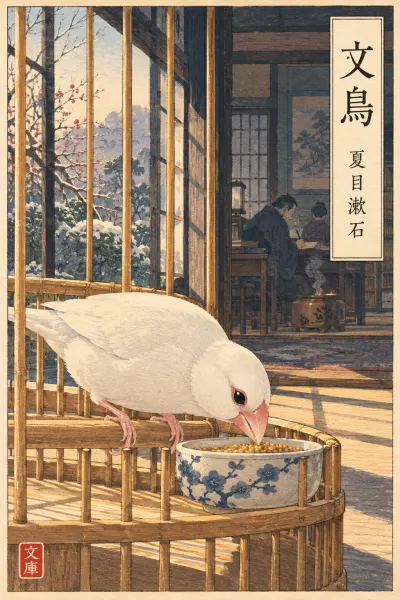
The narrator crouches by the cage and watches the Java sparrow peck at its millet, marvelling at how light the bird is, how still the seed dish stays, and the tiny, rapid sound of its eating. The next morning, when the bird blinks and tucks in its neck to look at him, he remembers a beautiful woman he once teased with the tassel of her sash, two or three days after her marriage was arranged. He then carefully reaches into the cage, blows away the husks and changes the very cold water.
AI translation · independently checked
自分はまた籠の傍へしゃがんだ。I crouched by the cage once more.
文鳥は膨らんだ首を二三度竪横に向け直した。The sparrow turned its puffed-out neck this way and that, two or three times.
やがて一団の白い体がぽいと留り木の上を抜け出した。Presently a little white bundle of a body slipped off the perch with a hop.
と思うと奇麗な足の爪が半分ほど餌壺の縁から後へ出た。The next moment, its pretty claws were poking out halfway past the rim of the seed dish.
小指を掛けてもすぐ引っ繰り返りそうな餌壺は釣鐘のように静かである。The seed dish, which looked as if it would tip over at the touch of a little finger, stayed as still as a temple bell.
さすがに文鳥は軽いものだ。A Java sparrow is a light thing indeed.
何だか淡雪の精のような気がした。Somehow it seemed to me like the spirit of a light spring snow.
文鳥はつと嘴を餌壺の真中に落した。All at once the sparrow dropped its beak into the middle of the seed dish.
そうして二三度左右に振った。Then it shook it from side to side two or three times.
奇麗に平して入れてあった粟がはらはらと籠の底に零れた。The millet, which had been put in and smoothed neatly level, scattered and spilled onto the floor of the cage.
文鳥は嘴を上げた。The sparrow raised its beak.
咽喉の所で微な音がする。There was a faint sound in its throat.
また嘴を粟の真中に落す。Again it dropped its beak into the middle of the millet.
また微な音がする。Again came the faint sound.
その音が面白い。It was a delightful sound.
静かに聴いていると、丸くて細やかで、しかも非常に速かである。When I listened quietly, it was round and delicate, and extremely quick besides.
菫ほどな小さい人が、黄金の槌で瑪瑙の碁石でもつづけ様に敲いているような気がする。It was as if a person no bigger than a violet were tapping away, over and over, at agate go stones with a golden hammer.
嘴の色を見ると紫を薄く混ぜた紅のようである。The colour of the beak, when I looked at it, was like crimson with a faint tinge of purple mixed in.
その紅がしだいに流れて、粟をつつく口尖の辺は白い。That crimson gradually ran thinner, until the tip of the beak, where it pecked the millet, was white.
象牙を半透明にした白さである。It was the whiteness of ivory made half transparent.
この嘴が粟の中へ這入る時は非常に早い。When this beak went into the millet, it moved very quickly.
左右に振り蒔く粟の珠も非常に軽そうだ。The grains of millet it flung to left and right looked very light, too.
文鳥は身を逆さまにしないばかりに尖った嘴を黄色い粒の中に刺し込んでは、膨くらんだ首を惜気もなく右左へ振る。The sparrow, all but standing on its head, would thrust its pointed beak in among the yellow grains, then swing its puffed-out neck right and left without the least restraint.
籠の底に飛び散る粟の数は幾粒だか分らない。There was no telling how many grains of millet went flying across the floor of the cage.
それでも餌壺だけは寂然として静かである。Even so, the seed dish alone stayed perfectly, serenely still.
重いものである。It was a heavy thing.
餌壺の直径は一寸五分ほどだと思う。I would say the dish was about an inch and a half across.
自分はそっと書斎へ帰って淋しくペンを紙の上に走らしていた。I went quietly back to my study and ran my pen lonesomely across the paper.
縁側では文鳥がちちと鳴く。Out on the veranda, the sparrow chirped, chi-chi.
折々は千代千代とも鳴く。Now and then it also cried 'Chiyo, Chiyo.'
外では木枯が吹いていた。Outside, the wintry wind was blowing.
夕方には文鳥が水を飲むところを見た。In the evening I watched the sparrow drink.
細い足を壺の縁へ懸けて、小い嘴に受けた一雫を大事そうに、仰向いて呑み下している。Resting its thin feet on the rim of the dish, it took a single drop in its little beak and, tilting its head back, swallowed it down as though it were something precious.
この分では一杯の水が十日ぐらい続くだろうと思ってまた書斎へ帰った。At this rate, I thought, one dish of water would last about ten days, and I went back to my study again.
晩には箱へしまってやった。At night I put it away in its box.
寝る時硝子戸から外を覗いたら、月が出て、霜が降っていた。When I looked out through the glass doors before going to bed, the moon was up and frost was falling.
文鳥は箱の中でことりともしなかった。The sparrow made not the slightest stir inside its box.
明る日もまた気の毒な事に遅く起きて、箱から籠を出してやったのは、やっぱり八時過ぎであった。The next day, too, I regret to say, I got up late, and it was again past eight o'clock when I took the cage out of the box.
箱の中ではとうから目が覚めていたんだろう。It must have been awake in the box long before that.
それでも文鳥はいっこう不平らしい顔もしなかった。Even so, the sparrow showed no sign of complaint whatever.
籠が明るい所へ出るや否や、いきなり眼をしばたたいて、心持首をすくめて、自分の顔を見た。The instant the cage was brought out into the light, it blinked its eyes, drew its neck in ever so slightly, and looked me in the face.
昔し美しい女を知っていた。Long ago I knew a beautiful woman.
この女が机に凭れて何か考えているところを、後から、そっと行って、紫の帯上げの房になった先を、長く垂らして、頸筋の細いあたりを、上から撫で廻したら、女はものう気に後を向いた。Once, when she was leaning on her desk lost in thought, I crept quietly up behind her, let the tasselled end of her purple obi-age dangle down long, and stroked it from above around the slender nape of her neck; she turned round languidly.
その時女の眉は心持八の字に寄っていた。Her eyebrows at that moment were drawn ever so slightly together into a frown.
それで眼尻と口元には笑が萌していた。And yet at the corners of her eyes and mouth a smile was beginning to show.
同時に恰好の好い頸を肩まですくめていた。At the same time she had drawn her shapely neck down to her shoulders.
文鳥が自分を見た時、自分はふとこの女の事を思い出した。When the sparrow looked at me, I suddenly remembered this woman.
この女は今嫁に行った。She is married now.
自分が紫の帯上でいたずらをしたのは縁談のきまった二三日後である。It was two or three days after her marriage had been settled that I played that trick with the purple obi-age.
餌壺にはまだ粟が八分通り這入っている。The seed dish was still about eight-tenths full of millet.
しかし殻もだいぶ混っていた。But there were a good many husks mixed in as well.
水入には粟の殻が一面に浮いて、苛く濁っていた。In the water dish, millet husks floated all over the surface, and the water was badly clouded.
易えてやらなければならない。It would have to be changed.
また大きな手を籠の中へ入れた。Once again I put my big hand into the cage.
非常に要心して入れたにもかかわらず、文鳥は白い翼を乱して騒いだ。Although I put it in with the greatest care, the sparrow flapped its white wings in disarray and made a commotion.
小い羽根が一本抜けても、自分は文鳥にすまないと思った。Even if a single small feather came out, I felt I would owe the bird an apology.
殻は奇麗に吹いた。I blew the husks away cleanly.
吹かれた殻は木枯がどこかへ持って行った。The wintry wind carried the blown husks off somewhere.
水も易えてやった。I changed the water too.
水道の水だから大変冷たい。Being tap water, it was very cold.
Vocabulary
| Word | Meaning | JLPT |
|---|---|---|
| しゃがんだしゃがむ | to crouch, to squat downdictionary form: しゃがむ | N2 |
| 餌壺えつぼ | seed dish, feeding pot (for a bird)餌 (えさ) means animal feed; here it combines as え-. | — |
| 釣鐘つりがね | large hanging temple bellA byword for something heavy and immovable. | N1 |
| 淡雪あわゆき | light, soft snow that melts quicklyPoetic word, often for late-spring snow. | — |
| 粟あわ | foxtail millet (birdseed) | — |
| 零れたこぼれる | to spill, to fall outdictionary form: 零れるUsually written こぼれる today. | N2 |
| 這入るはいる | to go in, to enterOld spelling of 入る. | N5 |
| 惜気もなくおしげもなく | unsparingly, without holding backdictionary form: 惜しげもなくLiterally 'without any sign of begrudging'. | — |
| 木枯こがらし | cold, dry wind of early winterdictionary form: 木枯らしLiterally 'tree-wither', the wind that strips the leaves. | — |
| 霜しも | frost | N3 |
| 帯上げおびあげ | obi-age, a silk scarf tucked along the top of a kimono sashdictionary form: 帯揚げThere is no English equivalent; it is a decorative cloth that supports the sash's bow. | — |
| ものう気ものうげ | languid, listless-lookingdictionary form: 物憂げ〜げ adds 'appearing ~'. | — |
| 縁談えんだん | marriage proposal, marriage arrangement | N1 |
| 濁ってにごる | to become cloudy, muddydictionary form: 濁る | N2 |
| 易えてかえる | to change, replacedictionary form: 替えるOld kanji choice for 替える/換える. | N3 |
Grammar
〜ないばかりに N1 all but ~, very nearly ~
Attached to a negative verb, it means the action goes so far that it almost amounts to the named one. Here the bird nearly turns upside down as it digs into the millet.
身を逆さまにしないばかりに尖った嘴を黄色い粒の中に刺し込んでは
all but standing on its head, it would thrust its pointed beak in among the yellow grains
〜ては、〜 N3 repeatedly do A, then B
て-form plus は links two actions that happen again and again in a cycle. The bird stabs into the seed, then shakes its neck, over and over.
黄色い粒の中に刺し込んでは、膨くらんだ首を惜気もなく右左へ振る
it would thrust it in among the yellow grains, then swing its puffed-out neck right and left
〜や否や N1 as soon as ~, the instant ~
Follows the dictionary form of a verb to show that the second action follows immediately on the first. It is formal and literary.
籠が明るい所へ出るや否や、いきなり眼をしばたたいて
the instant the cage was brought out into the light, it blinked its eyes
〜にもかかわらず N2 despite ~, although ~
Marks something that would lead you to expect a different result. Despite his care, the bird panics.
非常に要心して入れたにもかかわらず、文鳥は白い翼を乱して騒いだ
although I put it in with the greatest care, the sparrow flapped its white wings and made a commotion
〜てやる N4 do ~ for (someone lower or an animal)
Shows the speaker doing a favour for a pet, a child or someone of lower status. It colours his chores with care for the bird.
水も易えてやった。
I changed the water too.
〜ような気がする N3 it feels as if ~
Expresses a subjective impression rather than a fact. The narrator likens the sound to a tiny figure tapping go stones.
黄金の槌で瑪瑙の碁石でもつづけ様に敲いているような気がする
it was as if someone were tapping away at agate go stones with a golden hammer