Part 7 of 8 · JLPT N2
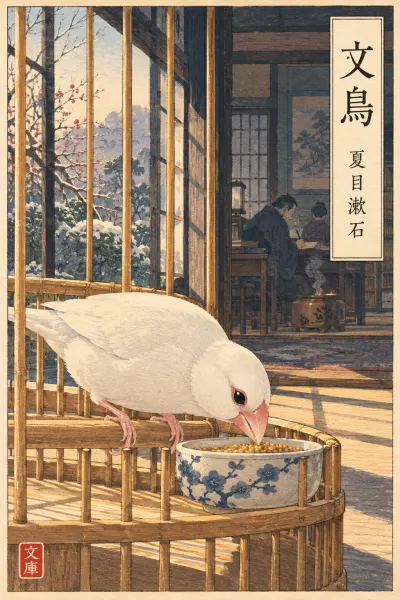
文鳥 Bunchō, part 7: Neglect, a Fallen Cage, and Silence
In this part
As the days pass the Java sparrow sings well, but the narrator often neglects its food and forgets to put the cage away at night. One night the cage is found knocked off its box, which he blames on a cat. The bird sings again the next day, but then stops, grows weak and ruffled, and the narrator is kept away for two days by Miekichi's troubling affair of a girl's marriage. When he comes home he finds the sparrow lying dead on the floor of its cage.
AI translation · independently checked
日数が立つにしたがって文鳥は善く囀ずる。As the days went by, the Java sparrow sang well.
しかしよく忘れられる。But it was often forgotten.
或る時は餌壺が粟の殻だけになっていた事がある。Once, the food dish held nothing but millet husks.
ある時は籠の底が糞でいっぱいになっていた事がある。Once, the floor of the cage was covered with droppings.
ある晩宴会があって遅く帰ったら、冬の月が硝子越に差し込んで、広い縁側がほの明るく見えるなかに、鳥籠がしんとして、箱の上に乗っていた。One evening I came home late from a dinner party. The winter moon was shining in through the glass, and the wide veranda was faintly lit; amid that dim light the birdcage sat silent on top of its box.
その隅に文鳥の体が薄白く浮いたまま留り木の上に、有るか無きかに思われた。In one corner, on the perch, the sparrow's body floated pale and white, so faint I could hardly tell whether it was there or not.
自分は外套の羽根を返して、すぐ鳥籠を箱のなかへ入れてやった。I threw back the cape of my overcoat and at once put the birdcage inside the box.
翌日文鳥は例のごとく元気よく囀っていた。The next day the sparrow was singing as lively as ever.
それからは時々寒い夜も箱にしまってやるのを忘れることがあった。After that, even on cold nights, I sometimes forgot to put it away in the box.
ある晩いつもの通り書斎で専念にペンの音を聞いていると、突然縁側の方でがたりと物の覆った音がした。One evening, as I sat in my study as usual, intent on the sound of my pen, there was suddenly a clatter from the veranda, as of something overturning.
しかし自分は立たなかった。But I did not get up.
依然として急ぐ小説を書いていた。I went on writing a novel that was due soon.
わざわざ立って行って、何でもないといまいましいから、気にかからないではなかったが、やはりちょっと聞耳を立てたまま知らぬ顔ですましていた。It would have been annoying to go all the way out there only to find it was nothing, so although it did not quite leave my mind, I kept my ears pricked a little and went on as if I had heard nothing.
その晩寝たのは十二時過ぎであった。That night it was past twelve when I went to bed.
便所に行ったついで、気がかりだから、念のため一応縁側へ廻って見ると――On my way to the lavatory, since it was on my mind, I went round to the veranda just to make sure, and looked—
籠は箱の上から落ちている。The cage had fallen off the box.
そうして横に倒れている。And it was lying on its side.
水入も餌壺も引繰返っている。The water dish and the food dish were both overturned.
粟は一面に縁側に散らばっている。Millet was scattered all over the veranda.
留り木は抜け出している。The perch had come loose.
文鳥はしのびやかに鳥籠の桟にかじりついていた。The sparrow was clinging quietly to the bars of the cage.
自分は明日から誓ってこの縁側に猫を入れまいと決心した。I resolved that from the next day on I would on no account let a cat onto this veranda.
翌日文鳥は鳴かなかった。The next day the sparrow did not sing.
粟を山盛入れてやった。I gave it a heaped dish of millet.
水を漲るほど入れてやった。I filled its water to the brim.
文鳥は一本足のまま長らく留り木の上を動かなかった。The sparrow stood on one leg on the perch and did not move for a long while.
午飯を食ってから、三重吉に手紙を書こうと思って、二三行書き出すと、文鳥がちちと鳴いた。After lunch I thought I would write to Miekichi, and I had written two or three lines when the sparrow chirped.
自分は手紙の筆を留めた。I stopped my pen.
文鳥がまたちちと鳴いた。The sparrow chirped again.
出て見たら粟も水もだいぶん減っている。I went out to look, and found that a good deal of the millet and water had gone.
手紙はそれぎりにして裂いて捨てた。I left the letter at that, tore it up and threw it away.
翌日文鳥がまた鳴かなくなった。The next day the sparrow stopped singing again.
留り木を下りて籠の底へ腹を圧しつけていた。It had come down from the perch and was pressing its belly against the floor of the cage.
胸の所が少し膨らんで、小さい毛が漣のように乱れて見えた。Its breast was a little puffed up, and the tiny feathers looked ruffled like ripples on water.
自分はこの朝、三重吉から例の件で某所まで来てくれと云う手紙を受取った。That morning I received a letter from Miekichi asking me to come to a certain place about that matter.
十時までにと云う依頼であるから、文鳥をそのままにしておいて出た。As he asked me to be there by ten, I went out and left the sparrow as it was.
三重吉に逢って見ると例の件がいろいろ長くなって、いっしょに午飯を食う。When I met Miekichi, the matter dragged on in all sorts of ways, and we had lunch together.
いっしょに晩飯を食う。We had supper together.
その上明日の会合まで約束して宅へ帰った。On top of that, I agreed to a meeting the next day as well, and then went home.
帰ったのは夜の九時頃である。It was about nine at night when I got back.
文鳥の事はすっかり忘れていた。I had completely forgotten about the sparrow.
疲れたから、すぐ床へ這入って寝てしまった。I was tired, so I got straight into bed and fell asleep.
翌日眼が覚めるや否や、すぐ例の件を思いだした。The next morning, the moment I woke, that matter came back to me.
いくら当人が承知だって、そんな所へ嫁にやるのは行末よくあるまい、まだ子供だからどこへでも行けと云われる所へ行く気になるんだろう。However willing the girl herself may be, marrying her off into a place like that cannot bode well for her future. She is still a child, so no doubt she is ready to go wherever she is told to go.
いったん行けばむやみに出られるものじゃない。Once she has gone, she will not be able to leave so easily.
世の中には満足しながら不幸に陥って行く者がたくさんある。There are plenty of people in this world who sink into misery while quite content.
などと考えて楊枝を使って、朝飯を済ましてまた例の件を片づけに出掛けて行った。Thinking such things, I cleaned my teeth, finished breakfast, and went out again to settle that matter.
帰ったのは午後三時頃である。It was about three in the afternoon when I got back.
玄関へ外套を懸けて廊下伝いに書斎へ這入るつもりで例の縁側へ出て見ると、鳥籠が箱の上に出してあった。I hung my overcoat in the entrance hall and meant to go along the corridor to my study, but when I stepped out onto the veranda, I found that the birdcage had been put out on top of its box.
けれども文鳥は籠の底に反っ繰り返っていた。But the sparrow lay on its back on the floor of the cage.
二本の足を硬く揃えて、胴と直線に伸ばしていた。Its two legs were held stiffly together, stretched out in a straight line with its body.
自分は籠の傍に立って、じっと文鳥を見守った。I stood beside the cage and gazed steadily at the sparrow.
黒い眼を眠っている。Its black eyes were closed.
瞼の色は薄蒼く変った。The colour of its eyelids had turned a pale blue.
Vocabulary
| Word | Meaning | JLPT |
|---|---|---|
| 囀ずるさえずる | to sing, to chirp (of birds)dictionary form: 囀るUsual modern spelling is 囀る; the okurigana ずる here is an older style. | N1 |
| 餌壺えつぼ | food dish (in a birdcage)餌 'feed' + 壺 'pot'. | — |
| 粟あわ | foxtail milletStaple food for caged birds. | — |
| 縁側えんがわ | veranda, the wooden corridor along the edge of a Japanese houseHere enclosed with glass panes. | N1 |
| 外套がいとう | overcoatOld-fashioned; today コート is usual. | — |
| 覆ったくつがえる | to be overturned, to tip overdictionary form: 覆る | — |
| いまいましいいまいましい | annoying, gallingExpresses irritation at something that makes you feel foolish. | — |
| 聞耳ききみみをたてる | to prick up one's ears, listen closelydictionary form: 聞き耳を立てる | — |
| 気がかりきがかり | worrying, on one's mind | — |
| 桟さん | bar, slat (of a cage or frame) | — |
| 漲るみなぎる | to overflow, to be full to the brimAlso used figuratively: 力が漲る 'brimming with energy'. | — |
| 例の件れいのけん | that matter (already known to both parties)例の 'the usual / that' points to something the speakers share knowledge of; here a marriage arrangement. | — |
| 行末ゆくすえ | the future, one's prospects | — |
| 陥っておちいる | to fall into (a bad state)dictionary form: 陥るTypically with misfortune, danger, crisis: 不幸に陥る. | — |
Grammar
〜にしたがって N3 as ~, in proportion to ~
Attached to a verb, it shows that one change happens along with another. Here the bird's singing improves as the days pass.
日数が立つにしたがって文鳥は善く囀ずる。
As the days went by, the Java sparrow sang well.
〜た事がある N4 there were times when ~
〜ていた事がある: there were times when something was in a certain state. Here ことがある reports an occasional occurrence, not a life experience ('have ever done'). Paired with 或る時は… ある時は…, it lists separate incidents of neglect.
或る時は餌壺が粟の殻だけになっていた事がある。
Once, the food dish held nothing but millet husks.
〜ないではなかった N2 it was not that ~ didn't happen; somewhat ~
A double negative that gives a hesitant, partial affirmative. The narrator admits he was somewhat bothered, while playing it down.
気にかからないではなかったが
although it did not quite leave my mind
〜まい N2 will not ~ (negative intention) / probably not ~ (negative guess)
〜まい: negative intention (will not ~) or negative conjecture (probably not ~). In 入れまい it expresses a firm resolve not to do something.
自分は明日から誓ってこの縁側に猫を入れまいと決心した。
I resolved that from the next day on I would on no account let a cat onto this veranda.
〜や否や N1 the moment ~, no sooner ~ than
Attached to the dictionary form, it shows the second action follows instantly on the first. A formal, literary expression.
翌日眼が覚めるや否や、すぐ例の件を思いだした。
The next morning, the moment I woke, that matter came back to me.
〜ものじゃない N2 one cannot (generally) ~
With a potential verb, ものではない states that something is generally impossible by nature. Here: once married into a family, a woman cannot simply leave.
いったん行けばむやみに出られるものじゃない。
Once she has gone, she will not be able to leave so easily.