Part 4 of 8 · JLPT N2
花のき村と盗人たち(二) Hana Noki Mura to Nusubitotachi, part 4: A Little Boy Trusts the Thief
In this part
Children playing at cops and robbers shout "Thief!" and the startled chief nearly bolts before he realises it is only a game. A well-dressed little boy in straw sandals then hands him a calf to hold and runs off to join the others. Laughing at first, the chief finds himself weeping: no one has ever trusted him before, and this trust from the child and the calf fills him with joy.
AI translation · independently checked
とつぜん、Suddenly,
「ぬすとだッ。」"Thief!"
「ぬすとだッ。」"Thief!"
「そら、やっちまえッ。」"Come on, get him!"
という、おおぜいの子供の声がしました。came the voices of a crowd of children.
子供の声でも、こういうことを聞いては、盗人としてびっくりしないわけにはいかないので、かしらはひょこんと跳びあがりました。Even if the voices were only children's, a thief who heard such things could not help being startled, and so the chief gave a little jump.
そして、川にとびこんで向こう岸へ逃げようか、藪の中にもぐりこんで、姿をくらまそうか、と、とっさのあいだに考えたのであります。In that instant he thought: should he dive into the river and escape to the far bank, or burrow into the thicket and vanish from sight?
しかし子供達は、縄切れや、おもちゃの十手をふりまわしながら、あちらへ走っていきました。But the children ran off the other way, waving scraps of rope and toy truncheons.
子供達は盗人ごっこをしていたのでした。The children had been playing at thieves and catchers.
「なんだ、子供達の遊びごとか。」"Huh, just the kids playing a game."
とかしらは張り合いがぬけていいました。said the chief, all the fight gone out of him.
「遊びごとにしても、盗人ごっことはよくない遊びだ。いまどきの子供はろくなことをしなくなった。あれじゃ、さきが思いやられる。」"Game or no game, playing thieves is a bad game. Kids these days don't do anything decent anymore. Carry on like that and heaven knows what'll become of them."
じぶんが盗人のくせに、かしらはそんなひとりごとをいいながら、また草の中にねころがろうとしたのでありました。Muttering this to himself, though he was a thief himself, the chief was about to lie down in the grass again.
そのときうしろから、Just then, from behind him,
「おじさん。」"Mister."
と声をかけられました。someone called out to him.
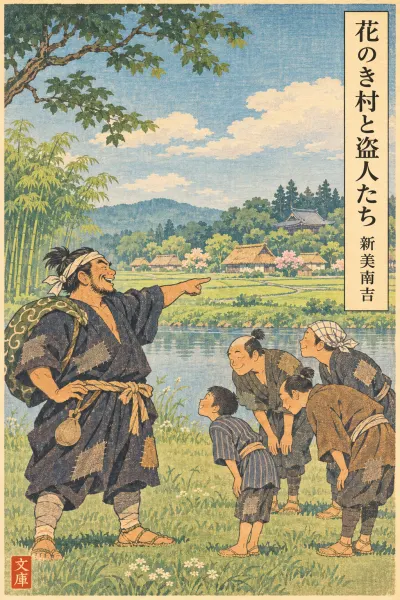
ふりかえって見ると、七歳くらいの、かわいらしい男の子が牛の仔をつれて立っていました。He turned to look, and there stood a sweet little boy of about seven, leading a calf.
顔だちの品のいいところや、手足の白いところを見ると、百姓の子供とは思われません。Seeing his refined features and his white hands and feet, one could hardly take him for a farmer's child.
旦那衆の坊っちゃんが、下男について野あそびに来て、下男にせがんで仔牛を持たせてもらったのかも知れません。Perhaps he was the young son of some well-to-do family who had come out to play in the fields with a manservant, and had begged the servant to let him hold the calf.
だがおかしいのは、遠くへでもいく人のように、白い小さい足に、小さい草鞋をはいていることでした。What was odd, though, was that he wore small straw sandals on his small white feet, like someone setting out on a long journey.
「この牛、持っていてね。」"Hold this cow for me, will you?"
かしらが何もいわないさきに、子供はそういって、ついとそばに来て、赤い手綱をかしらの手にあずけました。Before the chief could say a word, the child said this, came straight up beside him and left the red reins in the chief's hand.
かしらはそこで、何かいおうとして口をもぐもぐやりましたが、まだいい出さないうちに子供は、あちらの子供たちのあとを追って走っていってしまいました。The chief worked his mouth, meaning to say something, but before he could get a word out, the child had run off after the other children.
あの子供たちの仲間になるために、この草鞋をはいた子供はあとをも見ずにいってしまいました。To join those children in their game, the boy in the straw sandals went off without so much as a backward glance.
ぼけんとしているあいだに牛の仔を持たされてしまったかしらは、くッくッと笑いながら牛の仔を見ました。The chief, who had been made to hold the calf while he stood there dazed, chuckled softly to himself as he looked at it.
たいてい牛の仔というものは、そこらをぴょんぴょんはねまわって、持っているのがやっかいなものですが、この牛の仔はまたたいそうおとなしく、ぬれたうるんだ大きな眼をしばたたきながら、かしらのそばに無心に立っているのでした。Calves, as a rule, go skipping and bounding all over the place and are a nuisance to hold, but this calf was remarkably gentle; it stood innocently beside the chief, blinking its big, moist, glistening eyes.
「くッくッくッ。」"Heh, heh, heh."
とかしらは、笑いが腹の中からこみあげてくるのが、とまりませんでした。The chief could not stop the laughter welling up from deep in his belly.
「これで弟子たちに自慢ができるて。きさまたちが馬鹿づらさげて、村の中をあるいているあいだに、わしはもう牛の仔をいっぴき盗んだ、といって。」"Now I've got something to brag about to my apprentices. 'While you lot were wandering round the village with your stupid faces hanging out, I'd already gone and stolen a calf,' I'll say."
そしてまた、くッくッくッと笑いました。And again he chuckled, "Heh, heh, heh."
あんまり笑ったので、こんどは涙が出て来ました。He laughed so much that this time tears came to his eyes.
「ああ、おかしい。あんまり笑ったんで涙が出て来やがった。」"Oh, that's funny. I laughed so hard the blasted tears have come."
ところが、その涙が、流れて流れてとまらないのでありました。But those tears kept flowing and flowing and would not stop.
「いや、はや、これはどうしたことだい、わしが涙を流すなんて、これじゃ、まるで泣いてるのと同じじゃないか。」"Well, well, what's all this, then? Me, shedding tears? Why, this is just the same as crying!"
そうです。That is right.
ほんとうに、盗人のかしらは泣いていたのであります。The chief of the thieves really was crying.
――かしらは嬉しかったのです。—The chief was happy.
じぶんは今まで、人から冷たい眼でばかり見られて来ました。All his life until now, people had looked at him with nothing but cold eyes.
じぶんが通ると、人々はそら変なやつが来たといわんばかりに、窓をしめたり、すだれをおろしたりしました。Whenever he passed by, people would shut their windows or let down their blinds, as if to say, "Look out, here comes a shady character."
じぶんが声をかけると、笑いながら話しあっていた人たちも、きゅうに仕事のことを思い出したように向こうをむいてしまうのでありました。Whenever he spoke to anyone, even people who had been chatting and laughing together would suddenly turn away, as though they had just remembered some work they had to do.
池の面にうかんでいる鯉でさえも、じぶんが岸に立つと、がばッと体をひるがえしてしずんでいくのでありました。Even the carp floating on the surface of a pond would flip round with a splash and sink out of sight when he stood on the bank.
あるとき猿廻しの背中に負われている猿に、柿の実をくれてやったら、一口もたべずに地べたにすててしまいました。Once, when he gave a persimmon to the monkey riding on a monkey-showman's back, it threw it on the ground without taking a single bite.
みんながじぶんを嫌っていたのです。Everyone had disliked him.
みんながじぶんを信用してはくれなかったのです。No one had ever been willing to trust him.
ところが、この草鞋をはいた子供は、盗人であるじぶんに牛の仔をあずけてくれました。And yet this child in straw sandals had left a calf in his care, though he was a thief.
じぶんをいい人間であると思ってくれたのでした。The boy had thought him a good person.
またこの仔牛も、じぶんをちっともいやがらず、おとなしくしております。And this calf, too, did not mind him in the least, but stood there quietly.
じぶんが母牛ででもあるかのように、そばにすりよっています。It nestled up beside him as though he were its mother.
子供も仔牛も、じぶんを信用しているのです。Both the child and the calf trusted him.
こんなことは、盗人のじぶんには、はじめてのことであります。For a thief like him, this was something that had never happened before.
人に信用されるというのは、何といううれしいことでありましょう。How wonderful a thing it is to be trusted by others!
…………
Vocabulary
| Word | Meaning | JLPT |
|---|---|---|
| 十手じって | jitte, a short iron truncheon carried by Edo-period constablesA metal rod with a hook for catching blades; the symbol of a lawman, so children used toy ones to play at catching thieves. | — |
| 張り合いがぬけてはりあいがぬける | to lose one's drive; to feel deflateddictionary form: 張り合いが抜ける張り合い is the sense of something worth striving for; when it 抜ける, you feel let down. | — |
| ろくなろくな | decent, proper (always with a negative)ろくなことをしない = do nothing good. | N1 |
| 思いやられるおもいやられる | to worry about (what lies ahead)Set phrase 先が思いやられる: 'I dread to think what the future holds.' | — |
| 下男げなん | manservantOld-fashioned word for a male household servant. | — |
| せがんでせがむ | to pester, to begdictionary form: せがむTypical of children nagging an adult for something. | — |
| 草鞋わらじ | straw sandalsWorn tied to the feet for travel; hence the idea of a long journey. | — |
| 手綱たづな | reins, lead rope | — |
| あずけましたあずける | to leave in someone's care, to entrustdictionary form: 預けるA key word here: entrusting something implies trust in the person. | N3 |
| やっかいやっかい | troublesome, a nuisancedictionary form: 厄介 | N3 |
| 無心むしん | innocently, without guileLiterally 'no-mind': free of suspicion or ulterior thoughts. | — |
| こみあげてこみあげる | to well up (laughter, tears, emotion)dictionary form: 込み上げる | — |
| 自慢じまん | boasting, bragging自慢ができる = to have something to brag about. | N3 |
| 信用しんよう | trust, confidenceThe central theme of the passage; 信用される = to be trusted. | N3 |
Grammar
〜ないわけにはいかない N3 cannot help doing; cannot avoid doing
A negative verb plus わけにはいかない says that not doing the action is impossible, here because of the situation. A thief simply could not stay calm on hearing 'Thief!'
盗人としてびっくりしないわけにはいかないので
since, being a thief, he could not help being startled
〜のくせに N3 even though; despite being
Attached to a noun with の, くせに points out a contradiction and carries criticism or irony. The narrator gently mocks the chief for lecturing about bad games when he is a thief himself.
じぶんが盗人のくせに、かしらはそんなひとりごとをいいながら
though he was a thief himself, the chief muttered such things to himself
〜ないうちに N3 before (something happens)
A negative verb plus うちに means 'while something has not yet happened', i.e. before it happens. Here the boy is gone before the chief can speak.
まだいい出さないうちに子供は、あちらの子供たちのあとを追って走っていってしまいました
before he could get a word out, the child had run off after the other children
〜やがる N2 rude or contemptuous verb ending
Added to the verb stem, やがる shows the speaker's irritation or contempt toward an action. The chief uses it in his rough speech even about his own tears, like 'the blasted tears came'.
あんまり笑ったんで涙が出て来やがった。
I laughed so hard the blasted tears have come.
〜といわんばかりに N1 as if to say
いわん is a literary negative form of いう, and ばかりに means 'almost'. The phrase says people's actions all but said the words aloud, though they never actually spoke.
人々はそら変なやつが来たといわんばかりに、窓をしめたり
people would shut their windows, as if to say, 'Look out, here comes a shady character'
〜でさえ(も) N3 even
でさえ marks an extreme example to show how far something goes. Not only people but even the carp in a pond shunned him.
池の面にうかんでいる鯉でさえも、じぶんが岸に立つと、がばッと体をひるがえしてしずんでいくのでありました
even the carp floating on the surface of a pond would flip round with a splash and sink out of sight when he stood on the bank