Part 8 of 8 · JLPT N2
花のき村と盗人たち(四) Hana Noki Mura to Nusubitotachi, part 8: The Mystery of the Little Jizō
In this part
The villagers of Hananoki try to find the child who saved their village from the thieves, but never learn who he was. They decide it must have been the little Jizō by the earthen bridge, since the child wore straw sandals and a new pair had been offered to the Jizō that very day. The narrator ends gently: if this was true, the Jizō saved the village because its people were good-hearted, so a village must be a place where good-hearted people live.
AI translation · independently checked
こうして五人の盗人は、改心したのでしたが、そのもとになったあの子供はいったい誰だったのでしょう。And so the five thieves mended their ways. But who in the world was that child who had brought it all about?
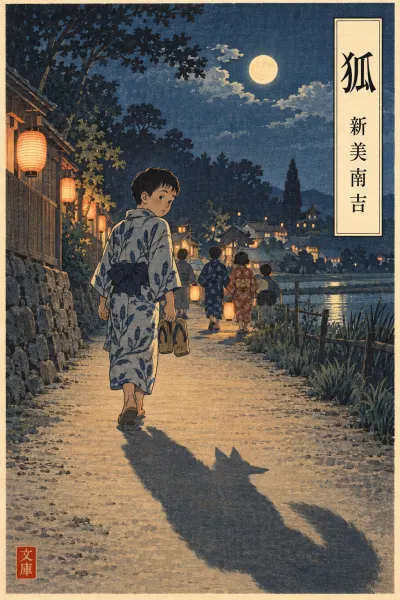
花のき村の人々は、村を盗人の難から救ってくれた、その子供を探して見たのですが、けっきょくわからなくて、ついには、こういうことにきまりました、――それは、土橋のたもとにむかしからある小さい地蔵さんだろう。The people of Hananoki Village tried to find the child who had saved their village from the danger of the thieves, but in the end they could not tell who it was, and at last they settled on this: it must have been the little Jizō that had stood since long ago at the foot of the earthen bridge.
草鞋をはいていたというのがしょうこである。The proof was that the child had been wearing straw sandals.
なぜなら、どういうわけか、この地蔵さんには村人たちがよく草鞋をあげるので、ちょうどその日も新しい小さい草鞋が地蔵さんの足もとにあげられてあったのである。This was because, for some reason, the villagers often offered straw sandals to this Jizō, and on that very day too a new pair of small straw sandals had been placed at his feet.
――というのでした。So they said.
地蔵さんが草鞋をはいて歩いたというのは不思議なことですが、世の中にはこれくらいの不思議はあってもよいと思われます。It is a strange thing for a Jizō to put on straw sandals and go walking about, but it seems to me that the world can well have room for a wonder of this size.
それに、これはもうむかしのことなのですから、どうだって、いいわけです。Besides, all this happened long ago, so it does not really matter one way or the other.
でもこれがもしほんとうだったとすれば、花のき村の人々がみな心の善い人々だったので、地蔵さんが盗人から救ってくれたのです。But if this was true, then it was because the people of Hananoki Village were all good-hearted that the Jizō saved them from the thieves.
そうならば、また、村というものは、心のよい人々が住まねばならぬということにもなるのであります。And if that is so, then it also follows that a village must be a place where good-hearted people live.
Vocabulary
| Word | Meaning | JLPT |
|---|---|---|
| 改心かいしん | to reform, mend one's waysdictionary form: 改心する改 'change' + 心 'heart': literally a change of heart. | — |
| 盗人ぬすびと | thiefOld-fashioned word; today 泥棒 (どろぼう) is more common. Also read ぬすっと. | — |
| 難なん | trouble, misfortune, dangerLiterary; 盗人の難 means 'the danger of thieves'. | N1 |
| 救ってすくう | to save, rescuedictionary form: 救う | N3 |
| けっきょくけっきょく | in the end, after alldictionary form: 結局 | N3 |
| たもとたもと | the foot (of a bridge)dictionary form: 袂橋のたもと is a fixed expression. The word also means the hanging sleeve of a kimono. | — |
| 地蔵じぞう | Jizō, a Buddhist guardian figureJizō is a bodhisattva who protects children and travellers. His small stone statues stand by roads and bridges all over Japan, and people affectionately call him お地蔵さん. | — |
| 草鞋わらじ | straw sandalsWoven rice-straw sandals tied on with cords. Offering them to a roadside Jizō was a common folk custom. | — |
| しょうこしょうこ | proof, evidencedictionary form: 証拠 | N1 |
| 足もとあしもと | at one's feet | — |
| 不思議ふしぎ | strange, mysterious; a wonderUsed here both as a な-adjective (不思議なこと) and as a noun (これくらいの不思議). | N3 |
| 世の中よのなか | the world, society | N3 |
Grammar
〜てくれる N4 do something for (us)
After the て-form, くれる shows that the action benefits the speaker or the speaker's group. Here it expresses the villagers' gratitude toward whoever saved them.
村を盗人の難から救ってくれた、その子供
the child who had saved their village from the thieves
〜てある (passive 〜られてある) N4 has been done (and remains so)
〜てある describes a state left behind by someone's earlier action. In older writing it can follow a passive verb, as in あげられてあった, which means the sandals had been offered and were still lying there.
新しい小さい草鞋が地蔵さんの足もとにあげられてあったのである
a new pair of small straw sandals had been placed at his feet
〜てもよい N4 it is all right if / there may well be
The て-form with もよい (いい) gives permission or acceptance. The narrator is saying it is fine for the world to contain a wonder like this.
世の中にはこれくらいの不思議はあってもよいと思われます
it seems to me that the world can well have room for a wonder of this size
〜とすれば N3 if we suppose that…
This sets up a hypothetical condition and then draws a conclusion from it. With もし it means 'if it really were the case that…'.
でもこれがもしほんとうだったとすれば
But if it were true
〜ねばならぬ N2 must
This is a literary, old-fashioned form of 〜なければならない. The negative ね is attached to the verb's negative stem (住ま-), and ならぬ is the old form of ならない.
村というものは、心のよい人々が住まねばならぬ
a village must be a place where good-hearted people live
〜ということになる N3 it follows that…, it comes to mean that…
〜ということになる means 'it follows that…' or 'it comes to mean that…'. It presents a conclusion drawn from what came before. Here も is inserted (ということにもなる), so it means 'it also follows that…'.
心のよい人々が住まねばならぬということにもなるのであります
it also follows that good-hearted people must live there