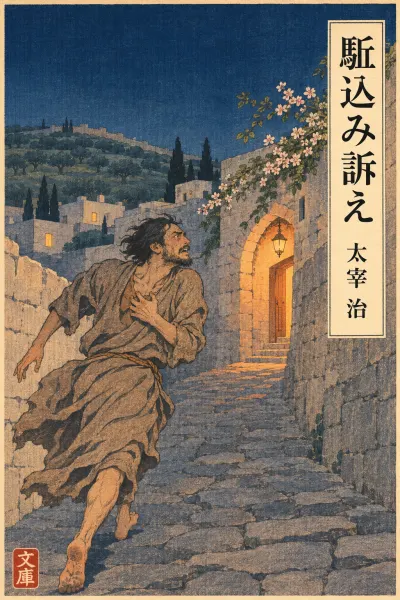
Part 3 of 7 · JLPT N2
駈込み訴え Kakekomi Uttae, part 3: A Blush That Kindles Jealousy
In this part
The master praises the woman who anointed him, and his flushed cheeks convince the narrator that he feels something for her. Torn between jealousy over Mary and over the master himself, the narrator rants, contradicts himself, and resolves to kill the master with his own hands. He then describes the entry into Jerusalem, where the master's ride on a decrepit donkey strikes him as a pitiful sight rather than a triumph.
AI translation · independently checked
全世界、どこの土地でも、私の短い一生を言い伝えられる処には、必ず、この女の今日の仕草も記念として語り伝えられるであろう」そう言い結んだ時に、あの人の青白い頬は幾分、上気して赤くなっていました。…in the whole world, in any land, wherever the story of my short life is told, what this woman did today shall surely be told as well, in remembrance of her." When he finished with those words, that man's pale cheeks had flushed a little red.
私は、あの人の言葉を信じません。I don't believe what that man says.
れいに依って大袈裟なお芝居であると思い、平気で聞き流すことが出来ましたが、それよりも、その時、あの人の声に、また、あの人の瞳の色に、いままで嘗つて無かった程の異様なものが感じられ、私は瞬時戸惑いして、更にあの人の幽かに赤らんだ頬と、うすく涙に潤んでいる瞳とを、つくづく見直し、はッと思い当ることがありました。I took it, as usual, for an overblown bit of play-acting and could let it pass without a care, but more than that, at that moment I sensed something strange in his voice, and in the colour of his eyes, stranger than anything I had ever felt before. I was thrown for an instant, and when I looked hard once more at his faintly reddened cheeks and his eyes wet with a thin film of tears, something suddenly dawned on me.
ああ、いまわしい、口に出すさえ無念至極のことであります。Oh, it's vile. It galls me beyond words even to speak of it.
あの人は、こんな貧しい百姓女に恋、では無いが、まさか、そんな事は絶対に無いのですが、でも、危い、それに似たあやしい感情を抱いたのではないか?Had that man come to feel, for this poor peasant woman, not love, no, surely nothing of the kind, never, but still, dangerously, some dubious feeling very like it?
あの人ともあろうものが。That man, of all people!
あんな無智な百姓女ふぜいに、そよとでも特殊な愛を感じたとあれば、それは、なんという失態。If he had felt even the faintest breath of special love for an ignorant peasant woman of her sort, oh, what a disgrace that would be.
取りかえしの出来ぬ大醜聞。An enormous scandal, beyond all repair.
私は、ひとの恥辱となるような感情を嗅ぎわけるのが、生れつき巧みな男であります。I am a man born with a knack for sniffing out the kind of feelings that bring shame on a person.
自分でもそれを下品な嗅覚だと思い、いやでありますが、ちらと一目見ただけで、人の弱点を、あやまたず見届けてしまう鋭敏の才能を持って居ります。I think it a vulgar nose myself and I hate it, but I have a sharp talent for spotting people's weak points without fail, with no more than a single glance.
あの人が、たとえ微弱にでも、あの無学の百姓女に、特別の感情を動かしたということは、やっぱり間違いありません。That he was stirred, however faintly, to special feelings for that unlettered peasant woman is, just as I thought, beyond any doubt.
私の眼には狂いが無い筈だ。My eyes shouldn't be mistaken.
たしかにそうだ。Yes, it's certain.
ああ、我慢ならない。Oh, I can't stand it.
堪忍ならない。I can't forgive it.
私は、あの人も、こんな体たらくでは、もはや駄目だと思いました。I thought that if even that man had sunk to such a sorry state, he was finished.
醜態の極だと思いました。I thought it the very height of disgrace.
あの人はこれまで、どんなに女に好かれても、いつでも美しく、水のように静かであった。Until then, however much women adored him, he had always stayed beautiful, calm as still water.
いささかも取り乱すことが無かったのだ。He had never lost his composure in the least.
ヤキがまわった。He's lost his edge.
だらしが無え。Pathetic!
あの人だってまだ若いのだし、それは無理もないと言えるかも知れぬけれど、そんなら私だって同じ年だ。He's still young, after all, and you might say it can't be helped, but then, I'm the same age.
しかも、あの人より二月おそく生れているのだ。What's more, I was born two months after him.
若さに変りは無い筈だ。There should be no difference in how young we are.
それでも私は堪えている。And yet I hold myself back.
あの人ひとりに心を捧げ、これ迄どんな女にも心を動かしたことは無いのだ。I have given my heart to him alone, and never until now has any woman moved my heart.
マルタの妹のマリヤは、姉のマルタが骨組頑丈で牛のように大きく、気象も荒く、どたばた立ち働くのだけが取柄で、なんの見どころも無い百姓女でありますが、あれは違って骨も細く、皮膚は透きとおる程の青白さで、手足もふっくらして小さく、湖水のように深く澄んだ大きい眼が、いつも夢みるように、うっとり遠くを眺めていて、あの村では皆、不思議がっているほどの気高い娘でありました。Martha's younger sister Mary: her elder sister Martha is a peasant woman with nothing to recommend her, big-boned and sturdy, as large as an ox, rough-tempered, good for nothing but bustling noisily about her work. But the younger one was different. She was slender-boned, her skin so pale it was almost translucent, her hands and feet small and softly rounded, and her large eyes, deep and clear as a lake, were always gazing far away in rapture, as if in a dream. She was a girl of such noble grace that everyone in that village wondered at her.
私だって思っていたのだ。I had been thinking the same thing myself, you know.
町へ出たとき、何か白絹でも、こっそり買って来てやろうと思っていたのだ。I had thought that when I went into town, I would secretly buy her something, some white silk perhaps, and bring it back for her.
ああ、もう、わからなくなりました。Oh, I don't know anymore.
私は何を言っているのだ。What am I saying?
そうだ、私は口惜しいのです。Yes, it galls me, that's what it is.
なんのわけだか、わからない。I don't know why.
地団駄踏むほど無念なのです。It galls me so much I could stamp my feet.
あの人が若いなら、私だって若い。If he is young, then so am I.
私は才能ある、家も畠もある立派な青年です。I am a fine young man, gifted, with a house and fields of my own.
それでも私は、あの人のために私の特権全部を捨てて来たのです。And still, for his sake, I threw away every privilege I had.
だまされた。I was deceived.
あの人は、嘘つきだ。He's a liar.
旦那さま。Sir.
あの人は、私の女をとったのだ。He took my woman!
いや、ちがった!No, that's wrong!
あの女が、私からあの人を奪ったのだ。That woman stole him from me!
ああ、それもちがう。Oh, that's wrong too.
私の言うことは、みんな出鱈目だ。Everything I say is nonsense.
一言も信じないで下さい。Please don't believe a single word of it.
わからなくなりました。I don't know anymore.
ごめん下さいまし。Forgive me, sir.
ついつい根も葉も無いことを申しました。I let myself say things without a shred of truth in them.
そんな浅墓な事実なぞ、みじんも無いのです。There's not the slightest trace of any such shallow fact.
醜いことを口走りました。I blurted out something ugly.
だけれども、私は、口惜しいのです。But all the same, it galls me.
胸を掻きむしりたいほど、口惜しかったのです。It galled me so much I wanted to tear at my chest.
なんのわけだか、わかりませぬ。Why, I cannot tell.
ああ、ジェラシィというのは、なんてやりきれない悪徳だ。Oh, what an unbearable vice this jealousy is!
私がこんなに、命を捨てるほどの思いであの人を慕い、きょうまでつき随って来たのに、私には一つの優しい言葉も下さらず、かえってあんな賤しい百姓女の身の上を、御頬を染めて迄かばっておやりなさった。Here I have longed for him with a devotion ready to throw away my life, and followed him all the way to this day, yet he has never granted me a single kind word; instead he even went so far as to flush red as he defended that lowly peasant woman.
ああ、やっぱり、あの人はだらしない。Oh, he's gone slack after all.
ヤキがまわった。He's lost his edge.
もう、あの人には見込みがない。There's no hope left in him now.
凡夫だ。A common mortal.
ただの人だ。Just an ordinary man.
死んだって惜しくはない。It would be no loss if he died.
そう思ったら私は、ふいと恐ろしいことを考えるようになりました。Once I thought that, I suddenly found myself thinking something terrible.
悪魔に魅こまれたのかも知れませぬ。Perhaps the Devil had got his hooks into me.
そのとき以来、あの人を、いっそ私の手で殺してあげようと思いました。From that moment on, I made up my mind that I would rather do him the kindness of killing him with my own hands.
いずれは殺されるお方にちがいない。He is surely a man who will be killed sooner or later anyway.
またあの人だって、無理に自分を殺させるように仕向けているみたいな様子が、ちらちら見える。And besides, now and then I catch glimpses of him seeming to steer things on purpose so that he'll get himself killed.
私の手で殺してあげる。I'll kill him with my own hands.
他人の手で殺させたくはない。I don't want anyone else to be the one to kill him.
あの人を殺して私も死ぬ。I'll kill him and then die myself.
旦那さま、泣いたりしてお恥ずかしゅう思います。Sir, I'm ashamed of crying like this.
はい、もう泣きませぬ。Yes, I won't cry any more.
はい、はい。Yes, yes.
落ちついて申し上げます。I'll tell it calmly now.
そのあくる日、私たちは愈愈あこがれのエルサレムに向い、出発いたしました。The next day we at last set out for Jerusalem, the city we had so longed for.
大群集、老いも若きも、あの人のあとにつき従い、やがて、エルサレムの宮が間近になったころ、あの人は、一匹の老いぼれた驢馬を道ばたで見つけて、微笑してそれに打ち乗り、これこそは、「シオンの娘よ、懼るな、視よ、なんじの王は驢馬の子に乗りて来り給う」と予言されてある通りの形なのだと、弟子たちに晴れがましい顔をして教えましたが、私ひとりは、なんだか浮かぬ気持でありました。A great crowd, old and young alike, followed after him, and when at length the temple of Jerusalem was close at hand, he found a decrepit old donkey by the roadside, smiled, and climbed onto it. With a proud, beaming face he taught his disciples that this was exactly the form foretold in the prophecy, "Fear not, daughter of Zion: behold, thy King cometh, sitting upon an ass's colt." But I alone felt somehow downcast.
なんという、あわれな姿であったでしょう。What a pitiful figure he made!
待ちに待った過越の祭、エルサレム宮に乗り込む、これが、あのダビデの御子の姿であったのか。The long-awaited Feast of the Passover, the entry into the temple of Jerusalem: was this the figure of the Son of David?
あの人の一生の念願とした晴れの姿は、この老いぼれた驢馬に跨り、とぼとぼ進むあわれな景観であったのか。Was the glorious appearance he had yearned for all his life nothing but this pitiful scene, plodding along astride a decrepit old donkey?
Vocabulary
| Word | Meaning | JLPT |
|---|---|---|
| 上気じょうきする | to flush, to go red in the face (from emotion)dictionary form: 上気するLiterally 'rising energy'; describes blood rushing to the face. | — |
| 仕草しぐさ | act, gesture, behaviourHere it refers to the woman's act of anointing the master. | — |
| 異様いよう | strange, uncanny, out of the ordinaryA na-adjective with a slightly eerie nuance. | — |
| ふぜいふぜい | (after a noun) the likes of, a mere …dictionary form: 風情Attached to a person it is contemptuous: 百姓女ふぜい 'a mere peasant woman'. | — |
| 醜聞しゅうぶん | scandalLiterary word; everyday Japanese uses スキャンダル. | — |
| 体たらくていたらく | sorry state, disgraceful conditionAlways negative; used to criticise someone's shameful condition. | — |
| ヤキがまわったやきがまわる | to lose one's edge, go soft with agedictionary form: 焼きが回るColloquial. Originally said of a blade that has been over-tempered and lost its sharpness. | — |
| 取柄とりえ | merit, redeeming featuredictionary form: 取り柄Often used in the phrase 〜だけが取り柄, 'its only merit is …'. | — |
| 地団駄じだんだをふむ | to stamp one's feet (in frustration)dictionary form: 地団駄を踏む | — |
| 出鱈目でたらめ | nonsense, made-up talkUsually written in kana; the kanji are phonetic borrowings. | N2 |
| 根も葉も無いねもはもない | groundless, completely unfoundeddictionary form: 根も葉もないLiterally 'having neither roots nor leaves'. | — |
| 慕いしたう | to adore, to long for, to be devoted todictionary form: 慕うSuggests yearning affection or reverence for someone. | N1 |
| 凡夫ぼんぷ | an ordinary mortal, a common manOriginally a Buddhist term for an unenlightened person. | — |
| 驢馬ろば | donkeyUsually written ロバ in modern Japanese. | — |
Grammar
〜ともあろうものが N1 someone of such standing as X (should not do this)
Stresses that a person of high rank or reputation has behaved in a way unworthy of them. Here the main clause is left unsaid, so the fragment carries the narrator's outrage.
あの人ともあろうものが。
That man, of all people!
〜さえ N3 even
Marks something as an extreme or minimal case. Attached directly to the verb 口に出す, it means that even saying the thing aloud is mortifying, let alone the thing itself.
口に出すさえ無念至極のことであります。
It galls me beyond words even to speak of it.
〜筈だ N4 should be, must be (by reasoning)
Expresses a conclusion the speaker expects to be true based on logic or conviction. The narrator uses it to reassure himself that his judgement is sound.
私の眼には狂いが無い筈だ。
My eyes shouldn't be mistaken.
〜たいほど N4 so much that one wants to …
ほど after a clause expresses the degree of a feeling. Combined with 〜たい, the feeling is strong enough to make him want to do the action.
胸を掻きむしりたいほど、口惜しかったのです。
It galled me so much I wanted to tear at my chest.
〜にちがいない N3 must be, surely is
Expresses a strong conviction. Here the narrator is certain that the master's death is inevitable.
いずれは殺されるお方にちがいない。
He is surely a man who will be killed sooner or later anyway.
〜に〜た (待ちに待った) N2 long-awaited; repeated or intensified action
Repeating a verb as stem + に + past form intensifies it. 待ちに待った means 'waited and waited for' and describes something eagerly awaited.
待ちに待った過越の祭
The long-awaited Feast of the Passover